
17-10044

ChIPAb+ CTCF - ChIP Validated Antibody and Primer Set
clone 1.2.1.5.4, from mouse
Synonyma:
11 zinc finger transcriptional repressor, 11-zinc finger protein, CCCTC-binding factor, CCCTC-binding factor (zinc finger protein), CTCFL paralog, transcriptional repressor CTCF
Vybrat velikost
| Velikost balení | Skladová položka | Dostupnost | Cena |
|---|---|---|---|
| 25 assays | Očekávané datum odeslání25. května 2026odAreál Kühne+Nagel spol. s r.o. | 14 200,00 Kč |
O této položce
14 200,00 Kč
Očekávané datum odeslání25. května 2026podrobné informace
Quality Level
biological source
mouse
antibody form
purified immunoglobulin
clone
1.2.1.5.4, monoclonal
species reactivity
human
manufacturer/tradename
ChIPAb+, Upstate®
technique(s)
ChIP: suitable, ELISA: suitable, dot blot: suitable, immunohistochemistry: suitable, immunoprecipitation (IP): suitable, multiplexing: suitable, western blot: suitable
isotype
IgG1κ
NCBI accession no.
UniProt accession no.
shipped in
dry ice
Gene Information
human ... CTCF(10664)
General description
The ChIPAb+ CTCF set includes the CTCF antibody, a negative control antibody (normal mouse IgG), and qPCR primers which amplify a 165 bp region of human H19 internal control region. The CTCF and negative control antibodies are supplied in a scalable "per ChIP" reaction size and can be used to functionally validate the precipitation of CTCF-associated chromatin.
Note: Poly(ADP-ribosyl)ated isoform, C-terminal truncation, or sumoylation will cause variable migration of CTCF protein on SDS–PAGE, which may present CTCF with different molecular weight on Western Blot. Modifications are dependent on cell type and growing condition.
The following molecular weights have been reported in the literature: 180 kDa (CTCF-180), 130 kDa (CTCF-130), 82 kDa (CTCF-82), 70 kDa (CTCF-70). See Klenova,E.M.,et al, (1997) Nucleic Acids Res. 25, 466–473 and Torrano,V,et al, (2006) Journal of Cell Science 119, 1746-1759) for additional details.
Immunogen
Application
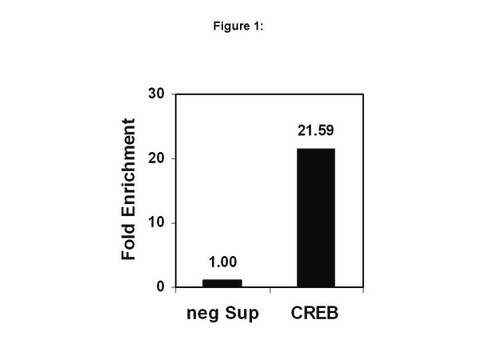
Sonicated chromatin prepared from HeLa cells (1 X 10⁶ cell equivalents per IP with 15 min fixation) were subjected to chromatin immunoprecipitation using 2 µg of either Normal Mouse IgG or 2 µg of Anti-CTCF and the Magna ChIP G Kit (Cat. # 17-611).
Successful immunoprecipitation of CTCF associated DNA fragments was verified by qPCR using ChIP Primers, Human H19 ICR as a positive locus, and a representative published negative locus (Wendt, K.S., et al., 2008) (Please see figures). Data is presented as percent input of each IP sample relative to input chromatin for each amplicon and ChIP sample as indicated.
Please refer to the EZ-Magna ChIP A (Cat. # 17-408) or EZ-ChIP (Cat. # 17-371) protocol for experimental details.
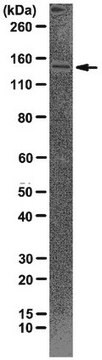
Western Blot Analysis:
Representative lot data.
K562 cell lysate was resolved by electrophoresis, transferred to PVDF membranes and probed with Anti-CTCF, clone 1.2.1.5.4 (1 μg/mL).
Proteins were visualized using a Goat Anti-Mouse conjugated to HRP and a chemiluminescence detection system (Please see figures).
The following molecular weights have been reported in the literature: 180 kDa (CTCF-180), 130 kDa (CTCF-130), 82 kDa (CTCF-82), 70 kDa (CTCF-70). See Klenova, E.M., et al, (1997) Nucleic Acids Res. 25, 466–473 and Torrano,V., et al, (2006) Journal of Cell Science 119, 1746-1759) for additional details.
Please see molecular weight section for additional information.
Biochem/physiol Actions
Physical form
Normal Mouse IgG. Two vials containing 25 µg purified IgG in 25 µL storage buffer containing 0.1% sodium azide. Store at -20°C.
ChIP Primers, Human H19 ICR. One vial containing 75 μL of 5 μM of each primer specific for human H19 internal control region. Store at -20°C.
FOR: CCC ATC TTG CT GACC TCAC
REV: AGA CCT GGG ACG TTT CTG TG
Analysis Note
Sonicated chromatin prepared from HeLa cells (1 X 10⁶ cell equivalents per IP with 15 min fixation) were subjected to chromatin immunoprecipitation using 2 µg of either Normal Mouse IgG or 2 µg of Anti-CTCF and the Magna ChIP® G Kit (Cat. # 17-611). Successful immunoprecipitation of CTCF associated DNA fragments was verified by qPCR using ChIP Primers Human H19 ICR (Please see figures).
Please refer to the EZ-Magna ChIP A (Cat. # 17-408) or EZ-ChIP (Cat. # 17-371) protocol for experimental details.
Includes negative control mouse IgG antibody and primers specific for human H19 ICR.
Legal Information
1 of 1
Tato položka | |||
|---|---|---|---|
| antibody form purified immunoglobulin | antibody form - | antibody form culture supernatant | antibody form purified antibody |
| species reactivity human | species reactivity human, mouse | species reactivity mouse, rat, human | species reactivity human |
| biological source mouse | biological source mouse | biological source rabbit | biological source mouse |
| clone 1.2.1.5.4, monoclonal | clone monoclonal | clone NL904, monoclonal | clone 1.2.1.5.4, monoclonal |
| Gene Information human ... CTCF(10664) | Gene Information human ... TCF7L2(6934) | Gene Information human ... CREB1(1385) | Gene Information human ... CTCF(10664) |
| shipped in dry ice | shipped in dry ice | shipped in dry ice | shipped in wet ice |


Skladovací třída
10 - Combustible liquids
wgk
WGK 1
Osvědčení o analýze (COA)
Vyhledejte osvědčení Osvědčení o analýze (COA) zadáním čísla šarže/dávky těchto produktů. Čísla šarže a dávky lze nalézt na štítku produktu za slovy „Lot“ nebo „Batch“.
Již tento produkt vlastníte?
Dokumenty související s produkty, které jste v minulosti zakoupili, byly za účelem usnadnění shromážděny ve vaší Knihovně dokumentů.
Související obsah
Epigenetics describes heritable changes in gene expression caused by non-genetic mechanisms. Epigenetic regulation allows a cell to vary its response based on its biological and environmental contexts. Epigenetic changes can effect transcriptional and post-transcriptional regulation via mechanisms such as histone modification, chromatin and nucleosome remodeling, DNA methylation, and small and non-coding RNA-mediated regulation. These mechanisms, in cooperation with transcription factors and other nucleic acid-binding proteins, regulate gene expression. Epigenetic mechanisms of gene regulation impacts diverse areas of research—from agriculture to human health. Common epigenetic assays such as chromatin immunoprecipitation (ChIP) and RNA immunoprecipitation (RIP) rely on high quality antibodies that recognize specific epigenetic modifications for accurate results. EMD Millipore offers over 100 ChIPAb+™ and RIPAb+™ validated antibody kits that are quality tested on ChIP/RIP assays and are conveniently provided with control qPCR primers and negative control antibodies to ensure first time ChIP/RIP success.
Signaling Product Guide: Antibodies, small molecule inhibitors, kits, assays and proteins for signaling research.
Globální číslo obchodní položky
| Skladová položka | GTIN |
|---|---|
| 17-10044 | 04053252679230 |