Přejít k obsahu
Merck

Přeskočit na

P6834

Monoclonal Anti-Proliferating Cell Protein Ki-67 antibody produced in mouse

clone PP-67, ascites fluid

Synonyma:

Anti-Ki-67

Přihlásit pro zobrazení organizačních a smluvních cen.

Vybrat velikost

Změnit zobrazení
Velikost baleníSkladová položkaDostupnostCena
100 μL
Obraťte se na zákaznický servis a vyžádejte si informaci o dostupnosti.
11 200,00 Kč
200 μL
Obraťte se na zákaznický servis a vyžádejte si informaci o dostupnosti.
16 500,00 Kč

O této položce

UNSPSC Code:
12352203
NACRES:
NA.41
MDL number:
Conjugate:
unconjugated
Clone:
PP-67, monoclonal
Application:
ARR, IHC (p)
Citations:
27

11 200,00 Kč


Obraťte se na zákaznický servis a vyžádejte si informaci o dostupnosti.
K vašemu cílovému použití je dostupná rekombinantní protilátka bez obsahu konzervačních látek. Vyzkoušejte ZRB1007

Požádejte o hromadnou objednávku
Technický servis
Potřebujete pomoc? Náš tým zkušených odborníků je vám k dispozici.
Dovolte nám, abychom vám pomohli


biological source

mouse

Quality Level

conjugate

unconjugated

antibody form

ascites fluid

antibody product type

primary antibodies

clone

PP-67, monoclonal

contains

15 mM sodium azide

species reactivity

human

technique(s)

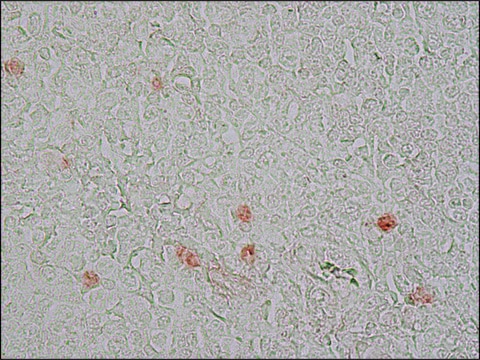
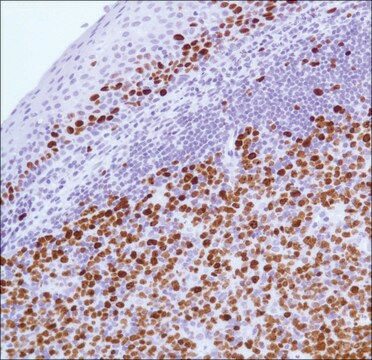
immunoblotting: suitable, immunohistochemistry (formalin-fixed, paraffin-embedded sections): 1:800 using microwave-treated human tonsil sections, microarray: suitable

isotype

IgM

UniProt accession no.

shipped in

dry ice

storage temp.

−20°C

target post-translational modification

unmodified

Gene Information

human ... MKI67(4288)

General description

Marker of proliferation Ki-67 (MKI67) consists of a phosphopeptide-binding forkhead-associated (FHA) domain and a protein phosphatase 1 (PP1)-binding site at the amino- terminal, 16 tandem repeats at the central region and leucine and arginine (LR) pairs at the carboxy- terminal. It is expressed at all active phases of the cell cycle. The gene encoding this protein is localized on human chromosome 10.
Marker of proliferation Ki-67 (MKI67- antigen identified by monoclonal antibody) consists of a phosphopeptide-binding forkhead-associated (FHA) domain and a protein phosphatase 1 (PP1)-binding site at the amino- terminal, 16 tandem repeats at the central region and leucine and arginine (LR) pairs at the carboxy- terminal. It is expressed at all active phases (G1, S, G2, and mitosis) of the cell cycle. The gene encoding this protein is localized on human chromosome 10.

Immunogen

HeLa cell nuclear preparation.

Application

Applications in which this antibody has been used successfully, and the associated peer-reviewed papers, are given below.
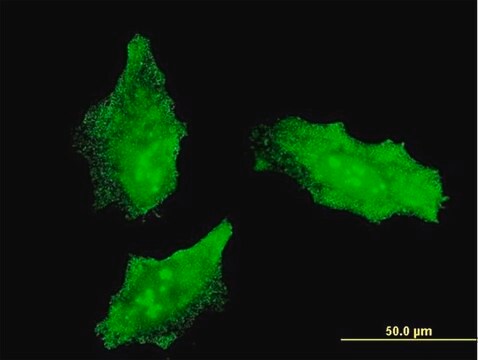
Immunocytochemistry (1 paper)
Applications in which this antibody has been used successfully, and the associated peer-reviewed papers, are given below.
Immunocytochemistry.
Monoclonal Anti-Proliferating Cell Protein Ki-67 antibody produced in mouse has also been used for immunohistochemistry.[1]

Biochem/physiol Actions

Marker of proliferation Ki-67 (MKI67), which is a part of the mitotic chromosome periphery, acts as a biological surfactant to maintain individual mitotic chromosomes dispersed in the cytoplasm after nuclear envelope disassembly. It is a prognostic marker in breast and prostate cancer. MKI67 is also a potential cell proliferation marker.
Marker of proliferation Ki-67 (MKI67- antigen identified by monoclonal antibody), which is a part of the mitotic chromosome periphery, acts as a biological surfactant to maintain individual mitotic chromosomes dispersed in the cytoplasm after nuclear envelope disassembly. It is a prognostic marker in breast and prostate cancer. MKI67 is also a potential cell proliferation marker. Ki-67 is considered as poor prognostic factors of adenoid cystic carcinoma.
Reacts with the Ki-67 nuclear antigen (345 and 395 kDa, and several lower m.w. proteins) in immunoblotting. The product shows an immunohistochemical staining pattern similar to that obtained with other anti-Ki-67/MIB-1 reagents. It labels proliferating cells in frozen human tissue and in formalin-fixed, paraffin-embedded tissue. A microwave heating retrieval step is required for successful labeling of routinely formalin-fixed, paraffin-embedded human tissue.

Disclaimer

Unless otherwise stated in our catalog or other company documentation accompanying the product(s), our products are intended for research use only and are not to be used for any other purpose, which includes but is not limited to, unauthorized commercial uses, in vitro diagnostic uses, ex vivo or in vivo therapeutic uses or any type of consumption or application to humans or animals.

Porovnat podobné položky

Zobrazit úplné porovnání

Zobrazit rozdíly

1 of 1

Tato položka
WH0004288M1SAB5500134SAB4501880
antibody form

ascites fluid

antibody form

purified immunoglobulin

antibody form

tissue culture supernatant

antibody form

affinity isolated antibody

species reactivity

human

species reactivity

human

species reactivity

human (tested)

species reactivity

human

biological source

mouse

biological source

mouse

biological source

rabbit

biological source

rabbit

clone

PP-67, monoclonal

clone

7B8, monoclonal

clone

SP6, monoclonal

clone

polyclonal

Gene Information

human ... MKI67(4288)

Gene Information

human ... MKI67(4288)

Gene Information

human ... MKI67(4288)

Gene Information

human ... MKI67(4288)

conjugate

unconjugated

conjugate

unconjugated

conjugate

unconjugated

conjugate

unconjugated


Still not finding the right product?

Vyzkoušejte náš nástroj Nástroj pro výběr produktů a zúžte své možnosti.


Skladovací třída

10 - Combustible liquids

wgk

nwg

flash_point_f

Not applicable

flash_point_c

Not applicable


Vyberte jednu z posledních verzí:

Osvědčení o analýze (COA)

Lot/Batch Number

Nevidíte správnou verzi?

Potřebujete-li konkrétní verzi, můžete vyhledat daný certifikát podle čísla dávky nebo čísla šarže.

Již tento produkt vlastníte?

Dokumenty související s produkty, které jste v minulosti zakoupili, byly za účelem usnadnění shromážděny ve vaší Knihovně dokumentů.

Navštívit knihovnu dokumentů


Sortimentní položky

Buněčné testy pro buněčnou proliferaci (BrdU, MTT, WST1), životaschopnost buněk a experimenty cytotoxicity pro aplikace v oblasti rakoviny, neurověd a výzkumu kmenových buněk.

Cell based assays for cell proliferation (BrdU, MTT, WST1), cell viability and cytotoxicity experiments for applications in cancer, neuroscience and stem cell research.

Související obsah

Instructions


Ki67 labelling index: an independent predictor of progression in prostate cancer treated by radical prostatectomy.
Bubendorf L
The Journal of Pathology (1996)
Xuebao Xiang et al.
Oncology letters, 15(3), 3049-3055 (2018-02-13)
Recent advances have highlighted the important roles of long non-coding RNAs (lncRNAs) in a number of biological processes, including oncogenesis. However, the function of lncRNA cartilage injury-related (lncRNA-CIR) in bladder cancer progression remains elusive. A novel function for lncRNA-CIR in
The Ki-67 protein: from the known and the unknown.
Scholzen T and Gerdes J
Journal of Cellular Physiology. Supplement (2000)


Globální číslo obchodní položky

Skladová položkaGTIN
P6834-200UL04061838025845
P6834-100UL04061838025838

Questions

Reviews

No rating value

Active Filters