Přejít k obsahu
Merck

Přeskočit na

L8793

Anti-MAP1LC3A antibody

rabbit polyclonal

Synonyma:

Anti-MAP1 light chain 3-like protein 1, Anti-MAP1A/1B light chain 3 A, Anti-MAP1A/MAP1B LC3 A, Anti-MAP1ALC3, Anti-MAP1BLC3, Anti-MAP1LC3A, Anti-Microtubule-associated protein 1 light chain 3 alpha

Přihlásit pro zobrazení organizačních a smluvních cen.

O této položce

UNSPSC Code:
12352203
NACRES:
NA.41
Conjugate:
unconjugated
Clone:
polyclonal
Application:
IP, WB
Citations:
15


Název produktu

Anti-LC3A antibody produced in rabbit, ~1 mg/mL, affinity isolated antibody, buffered aqueous solution

biological source

rabbit

Quality Level

conjugate

unconjugated

antibody form

affinity isolated antibody

antibody product type

primary antibodies

clone

polyclonal

form

buffered aqueous solution

mol wt

antigen 16-18 kDa

species reactivity

mouse, human, rat

concentration

~1 mg/mL

technique(s)

immunoprecipitation (IP): 5-10 μg using extracts of human U87 cells, western blot: 0.5-1 μg/mL using whole extracts of rat and mouse brain

UniProt accession no.

shipped in

dry ice

storage temp.

−20°C

target post-translational modification

unmodified

Gene Information

human ... MAP1LC3A(84557)
mouse ... Map1lc3a(66734)
rat ... Map1lc3a(362245)

General description

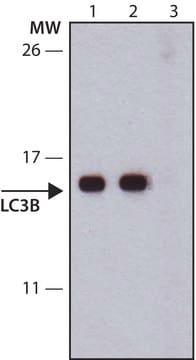
Microtubule-associated proteins 1A/1B light chain 3 or MAP1LC3 is a cellular protein that is involved in the formation of autophagosomes . MAP1LC3 genes have three known human isoforms, namely, MAP1LC3A, MAP1LC3B and MAP1LC3C. These isoforms have different responses to amino acid starvation and varied sub-cellular localization patterns . Anti-LC3A antibody reacts with human and rat LC3A-I (approx. 18 kDa) and LC3A-II (approx. 16 kDa) by immunoblotting and immunoprecipitation. The antibody is also specific for mouse LC3A-I (approx. 18 kDa). Specific cell treatment and/or long exposure may be required for the detection of mouse LC3A-II. The immunizing peptide specifically inhibits the detection of the LC3A bands by immunoblotting.

Immunogen

Synthetic peptide corresponding to amino acids of human LC3A isoform α, conjugated to KLH via C-terminal cysteine residue. The corresponding sequence is identical in rat and mouse.

Application

Anti-LC3A antibody produced in rabbit has been used in
  • immunohistochemistry
  • immunostaining
  • western blotting[1]

Biochem/physiol Actions

Anti-LC3A antibody recognizes human and rat microtubule-associated protein light chain 3-A (LC3A-I) and LC3A-II by immunoblotting and immunoprecipitation (~18 kDa and ~16 kDa, respectively) and mouse LC3A-I (~18 kDa).
Microtubule-associated protein light chain 3-I (LC3-I) is modified to a membrane-bound form, LC3-II (a LC3-phospholipid conjugate), by mammalian autophagy related 7 (Atg7) and Atg3, which are E1- and E2-like enzymes, respectively. The amount of LC3 II correlates with the extent of autophagosome formation. LC3A can also be as an autophagosomal marker.

Physical form

Solution in 0.01 M phosphate buffered saline, pH 7.4, containing 15 mM sodium azide.

Preparation Note

For continuous use, store at 2-8 °C for up to one month. For extended storage, freeze in working aliquots. Repeated freezing and thawing, or storage in “frost-free” freezers, is not recommended. If slight turbidity occurs upon prolonged storage, clarify the solution by centrifugation before use. Working dilutions should be discarded if not used within 12 hours.

Disclaimer

Unless otherwise stated in our catalog or other company documentation accompanying the product(s), our products are intended for research use only and are not to be used for any other purpose, which includes but is not limited to, unauthorized commercial uses, in vitro diagnostic uses, ex vivo or in vivo therapeutic uses or any type of consumption or application to humans or animals.

Porovnat podobné položky

Zobrazit úplné porovnání

Zobrazit rozdíly

1 of 1

Tato položka
L8918SAB4200361SAB1306617
conjugate

unconjugated

conjugate

unconjugated

conjugate

unconjugated

conjugate

-

Quality Level

200

Quality Level

200

Quality Level

200

Quality Level

-

antibody form

affinity isolated antibody

antibody form

affinity isolated antibody

antibody form

purified immunoglobulin

antibody form

purified immunoglobulin

biological source

rabbit

biological source

rabbit

biological source

mouse

biological source

rabbit

species reactivity

mouse, human, rat

species reactivity

mouse, human, rat

species reactivity

human

species reactivity

human, mouse

UniProt accession no.

Q9H492

UniProt accession no.

Q9H492

UniProt accession no.

Q9GZQ8

UniProt accession no.

Q9H492


Still not finding the right product?

nebo

Vyzkoušejte náš nástroj Nástroj pro výběr produktů a zúžte své možnosti.


Skladovací třída

10 - Combustible liquids

wgk

WGK 3

flash_point_f

Not applicable

flash_point_c

Not applicable

ppe

Eyeshields, Gloves, multi-purpose combination respirator cartridge (US)


Vyberte jednu z posledních verzí:

Osvědčení o analýze (COA)

Lot/Batch Number

Nevidíte správnou verzi?

Potřebujete-li konkrétní verzi, můžete vyhledat daný certifikát podle čísla dávky nebo čísla šarže.

Již tento produkt vlastníte?

Dokumenty související s produkty, které jste v minulosti zakoupili, byly za účelem usnadnění shromážděny ve vaší Knihovně dokumentů.

Navštívit knihovnu dokumentů


Související obsah

Instructions


Kaito Nihira et al.
The Journal of pathology, 234(2), 277-288 (2014-04-02)
The development of therapeutic resistance to EGFR tyrosine kinase inhibitors (EGFR-TKIs, ie erlotinib or gefitinib) has been the major clinical problem when treating lung adenocarcinoma patients with these agents. However, its mechanisms have not necessarily been well studied to this
Rowan Gurney et al.
Neuropathology : official journal of the Japanese Society of Neuropathology (2018-05-12)
A failure of protein degradation may underpin Lewy body disease (LBD) where α-synuclein is assimilated into the pathognomic Lewy bodies and Lewy neurites. We investigated histological alterations in lysosomes and autophagosomes in the substantia nigra (SN) and cingulate gyrus (CG)
João Cláudio Damasceno-Sá et al.
Memorias do Instituto Oswaldo Cruz, 116, e200417-e200417 (2021-03-18)
Toxoplasma gondii causes toxoplasmosis and is controlled by activated macrophages. However, infection of macrophages by tachyzoites induces TGF-β signaling (TGF-s) inhibiting nitric oxide (NO) production. NO inhibition may be a general escape mechanism of distinct T. gondii strains. To evaluate


Globální číslo obchodní položky

Skladová položkaGTIN
L8793-200UL04061838031556

Questions

Reviews

No rating value

Active Filters