Přejít k obsahu
Merck

Přeskočit na

5074

Bovine Collagen Type I

from bovine skin, liquid, 5 mg/mL, suitable for cell culture, used for 3D Hydrogel formation, PureCol EZ Gel

Synonyma:

Collagen type

Přihlásit pro zobrazení organizačních a smluvních cen.

Vybrat velikost

Změnit zobrazení
Velikost baleníSkladová položkaDostupnostCena
35 mL
Obraťte se na zákaznický servis a vyžádejte si informaci o dostupnosti.
18 200,00 Kč

O této položce

UNSPSC Code:
12352202
NACRES:
NA.75
Biological source:
bovine skin
Form:
solid
Technique(s):
cell culture | mammalian: suitable
Assay:
≥99% (SDS-PAGE Electrophoresis – Silver Stain, SDS-PAGE)

18 200,00 Kč


Obraťte se na zákaznický servis a vyžádejte si informaci o dostupnosti.

Požádejte o hromadnou objednávku
Technický servis
Potřebujete pomoc? Náš tým zkušených odborníků je vám k dispozici.
Dovolte nám, abychom vám pomohli


Název produktu

PureCol EZ Gel solution,

biological source

bovine skin

Quality Level

sterility

sterile

assay

≥99% (SDS-PAGE Electrophoresis – Silver Stain, SDS-PAGE)

form

solid

packaging

pkg of 35 mL

technique(s)

cell culture | mammalian: suitable

shipped in

wet ice

storage temp.

2-8°C

General description

PureCol is used in cell culture, tissue engineering and as a coating material for medical devices.[1]PureCol EZ Gel is a ready-to-use collagen solution that forms a firm gel by simply warming to 37°C in an incubator. The product consists of purified Type I bovine collagen at a concentration of approximately 5 mg/ml (0.5%), DMEM/F-12 medium and a mixture of L-glutamine and dipeptide (L-alanine-L-glutamine) to provide a long-lasting L-glutamine source for cell culture.

Application

The PureCol EZ Gel solution has been used:
  • for coating culture plates to facilitate the seeding and growth of epithelial cells derived from human nasal epithelial tissue
  • as a component in the bioartificial tendon preparation, providing a gel matrix for seeding human tendon cells and promoting their growth and collagen gel formation[2]
  • for embedding mouse Achilles tendon-derived cells in 3D-collagen constructs, providing a biomimetic environment for studying tendon biology and performing qPCR, immunohistochemical, and western blot analyses.[3]

Features and Benefits

PureCol EZ Gel is designed to improve gel consistency by providing a pre-formulated solution of media and collagen that have been adjusted to a neutral pH. This product avoids the inconsistencies in the preparation of the gel that can arise through variables of reagent addition, pH adjustment and handling conditions. PureCol EZ Gel is ideal for providing a firm gel and can also be used in the preparation of a thin layer for culturing cells. PureCol EZ Gel collagen is provided in a user-friendly packaging for use and storage. This product is sterile and supplied as a ready to use solution. PureCol EZ Gel is available in 35 mL volume, and produced by aseptic processing. 3D gels allow for the study of the effects of the mechanical properties of the ECM, such as density and rigidity, on cell development, migration, and morphology. Unlike 2D systems, 3D environments allow cell extensions to simultaneously interact with integrins on all cell surfaces, resulting in the activation of specific signaling pathways. Gel stiffness or rigidity also affects cell migration differently in 3D versus 2D environments. Furthermore, integrin-independent mechanical interactions resulting from the entanglement of matrix fibrils with cell extensions are possible in 3D systems, but not in 2D systems where the cells are attached to a flat surface.1-3

Preparation Note

3-D Gel Preparation Procedure
1. Remove PureCol EZ Gel from 2-10°C storage. To prevent gelation, maintain temperature of product at 2-10°C.
2. Introduce PureCol EZ Gel into cell culture system. Cells can be added to the PureCol EZ Gel solution.
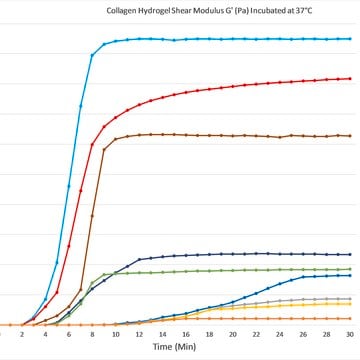
3. To form gel, warm to 37°C. The beginning of gelation will occur within 40 minutes, but allow approximately 90 to minutes for firm gel formation.

Legal Information

PureCol is a trademark of Advanced BioMatrix, Inc.

Porovnat podobné položky

Zobrazit úplné porovnání

Zobrazit rozdíly

1 of 1

Tato položka
C4243G1393C2124
biological source

bovine skin

biological source

bovine skin

biological source

bovine hide

biological source

bovine skin

technique(s)

cell culture | mammalian: suitable

technique(s)

cell culture | mammalian: suitable (3D matrix formation)

technique(s)

cell culture | mammalian: suitable

technique(s)

cell culture | mammalian: suitable using and for 3D matrix formation.

sterility

sterile

sterility

sterile-filtered

sterility

sterile

sterility

sterile-filtered

assay

≥99% (SDS-PAGE Electrophoresis – Silver Stain, SDS-PAGE)

assay

≥99.9% (SDS-PAGE)

assay

-

assay

-

Quality Level

200

Quality Level

200

Quality Level

200

Quality Level

200

form

solid

form

liquid

form

solution

form

liquid


Still not finding the right product?

Explore all of our products under PureCol EZ Gel solution


Skladovací třída

13 - Non Combustible Solids

wgk

WGK 1

flash_point_f

Not applicable

flash_point_c

Not applicable


Vyberte jednu z posledních verzí:

Osvědčení o analýze (COA)

Lot/Batch Number

Nevidíte správnou verzi?

Potřebujete-li konkrétní verzi, můžete vyhledat daný certifikát podle čísla dávky nebo čísla šarže.

Již tento produkt vlastníte?

Dokumenty související s produkty, které jste v minulosti zakoupili, byly za účelem usnadnění shromážděny ve vaší Knihovně dokumentů.

Navštívit knihovnu dokumentů


Sortimentní položky

Hydrogela are the most widely used systems for 3D cell culture. Learn more about this technology (what are hydrogels? How to chose?)


Karen A Beningo et al.
Proceedings of the National Academy of Sciences of the United States of America, 101(52), 18024-18029 (2004-12-17)
Fibroblasts in 2D cultures differ dramatically in behavior from those in the 3D environment of a multicellular organism. However, the basis of this disparity is unknown. A key difference is the spatial arrangement of anchored extracellular matrix (ECM) receptors to
Role of P2X7R in eosinophilic and non?eosinophilic chronic rhinosinusitis with nasal polyps
Wang Y, et al.
Molecular Medicine Reports, 24(1), 521-521 (2021)
Muhammad H Zaman et al.
Proceedings of the National Academy of Sciences of the United States of America, 103(29), 10889-10894 (2006-07-13)
Cell migration on 2D surfaces is governed by a balance between counteracting tractile and adhesion forces. Although biochemical factors such as adhesion receptor and ligand concentration and binding, signaling through cell adhesion complexes, and cytoskeletal structure assembly/disassembly have been studied


Globální číslo obchodní položky

Skladová položkaGTIN
154458-10G04061833431498
5074-35ML04061832450384

Questions

Reviews

No rating value

Active Filters