
HTS079M

ChemiSCREEN Human VPAC2 VIP Receptor Membrane Preparation
Human VPAC2 / VIP2 GPCR membrane preparation for Radioligand binding Assays & GTPγS binding.
Vybrat velikost
| Velikost balení | Skladová položka | Dostupnost | Cena |
|---|---|---|---|
| 200 units | Očekávané datum odeslání19. května 2026odAreál Kühne+Nagel spol. s r.o. | 22 800,00 Kč |
O této položce
22 800,00 Kč
Očekávané datum odeslání19. května 2026podrobné informace
biological source
human
Quality Level
recombinant
expressed in Chem-1 cells
manufacturer/tradename
ChemiScreen, Chemicon®
technique(s)
ligand binding assay: suitable (GTPγS), radioligand binding assay (RLBA): suitable
NCBI accession no.
UniProt accession no.
shipped in
dry ice
storage temp.
-65 to -96°C
General description
Application
Biochem/physiol Actions
Features and Benefits
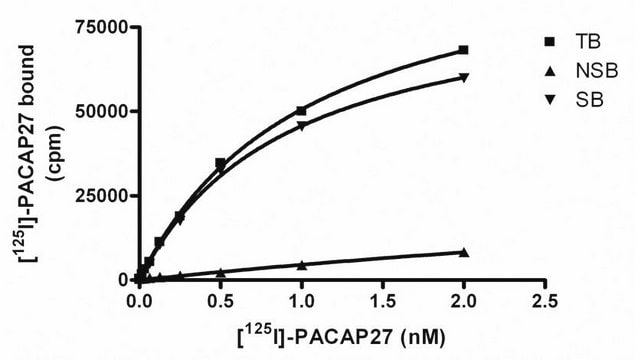
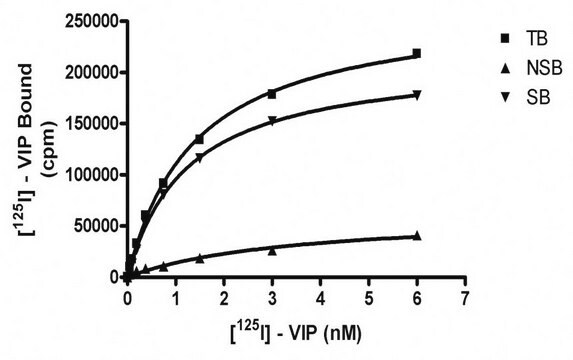
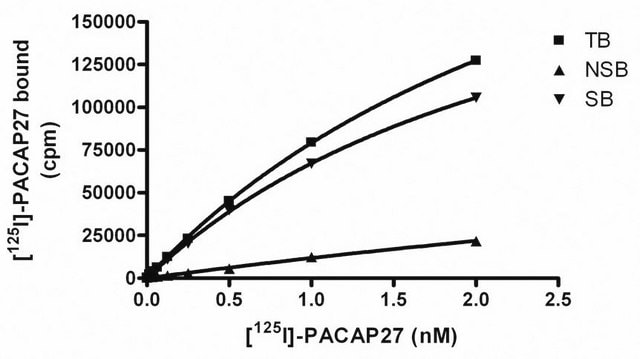
Membranes are mixed with radioactive ligand and unlabeled competitor (see Figures 1 and 2 for concentrations tested) in binding buffer in a nonbinding 96-well plate, and incubated for 1-2 h. Prior to filtration, a GF/C 96-well filter plate is coated with 0.33% polyethyleneimine for 30 min, then washed with 50mM HEPES, pH 7.4, 0.5% BSA. Binding reaction is transferred to the filter plate, and washed 3 times (1 mL per well per wash) with Wash Buffer. The plate is dried and counted.
Binding buffer: 50 mM Hepes, pH 7.4, 5 mM MgCl2, 1 mM CaCl2, 0.2% BSA, filtered and stored at 4°C
Radioligand: [125I] PACAP27 (Perkin Elmer # NEX294)
Wash Buffer: 50 mM Hepes, pH 7.4, 500mM NaCl , 0.1% BSA, filtered and stored at 4°C.
One package contains enough membranes for at least 200 assays (units), where an unit is the amount of membrane that will yield greater than 15-fold signal:background with 125I-labeled PACAP27 at 0.5 nM.
Physical form
Packaging method: Membranes protein were adjusted to the indicated concentration in packaging buffer, rapidly frozen, and stored at -80°C.
Analysis Note
| 10 µg/well | 5 µg/well | |
|---|---|---|
| Signal:Background | 25.5. | 22.8 |
| Specific Binding (cpm) | 32913 | 27650 |
SPECIFICATIONS: 1 unit = 5 µg membrane preparation
Bmax: 17.3 pmol/mg
Kd: 0.9 nM
Legal Information
1 of 1
Tato položka | |||
|---|---|---|---|
| shipped in dry ice | shipped in dry ice | shipped in dry ice | shipped in dry ice |
| technique(s) ligand binding assay: suitable (GTPγS), radioligand binding assay (RLBA): suitable | technique(s) ligand binding assay: suitable (GTPγS), radioligand binding assay (RLBA): suitable | technique(s) ligand binding assay: suitable (GTPγS), radioligand binding assay (RLBA): suitable | technique(s) ligand binding assay: suitable (GTPγS), radioligand binding assay (RLBA): suitable |
| Quality Level 100 | Quality Level 100 | Quality Level 100 | Quality Level 100 |
| UniProt accession no. | UniProt accession no. | UniProt accession no. | UniProt accession no. |
| biological source human | biological source human | biological source human | biological source human |
| recombinant expressed in Chem-1 cells | recombinant expressed in Chem-1 cells | recombinant expressed in Chem-1 cells | recombinant expressed in Chem-1 cells |

Skladovací třída
12 - Non Combustible Liquids
wgk
WGK 2
Osvědčení o analýze (COA)
Vyhledejte osvědčení Osvědčení o analýze (COA) zadáním čísla šarže/dávky těchto produktů. Čísla šarže a dávky lze nalézt na štítku produktu za slovy „Lot“ nebo „Batch“.
Již tento produkt vlastníte?
Dokumenty související s produkty, které jste v minulosti zakoupili, byly za účelem usnadnění shromážděny ve vaší Knihovně dokumentů.
Globální číslo obchodní položky
| Skladová položka | GTIN |
|---|---|
| HTS079M | 04053252406928 |