
06-599

Anti-acetyl-Histone H3 Antibody
from rabbit
Synonyma:
H3 histone family, member T, histone 3, H3, histone cluster 3, H3
Vybrat velikost
| Velikost balení | Skladová položka | Dostupnost | Cena |
|---|---|---|---|
| 100 μg | K dispozici k odeslání DNESodAreál Kühne+Nagel spol. s r.o. | 16 100,00 Kč |
O této položce
16 100,00 Kč
K dispozici k odeslání DNESpodrobné informace
biological source
rabbit
Quality Level
antibody form
purified antibody
antibody product type
primary antibodies
clone
polyclonal
species reactivity
mouse, rat, human
technique(s)
ChIP: suitable (ChIP-seq), immunocytochemistry: suitable, western blot: suitable
NCBI accession no.
UniProt accession no.
shipped in
wet ice
target post-translational modification
acetylation (not specified)
Gene Information
human ... H3C1(8350)
mouse ... H3C1(360198)
rat ... H3C1(679994)
General description
Immunogen
Application
Chromatin Immunoprecipitation: This antibody has been shown to work for chIP using HeLa extracted chromatin and 5 mg of this antibody.
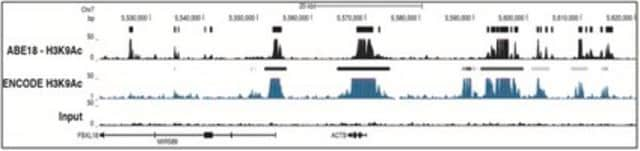
ChIP-Seq: This antibody has been shown to work for ChIP-Seq in Kanai, A., et. al. (2011). DNA Research 18:379-392.
Epigenetics & Nuclear Function
Histones
Biochem/physiol Actions
Physical form
Preparation Note
Analysis Note
HeLa acid extract, sodium butyrate treated HeLa cells, and recombinant Histone H3
Western Blot Analysis: 0.05 µg/mL of this antibody detected Histone H3 on 10 µg of HeLa acid extract, sodium butyrate treated HeLa cells, and recombinant Histone H3.
Other Notes
Disclaimer
1 of 1
Tato položka | |||
|---|---|---|---|
| antibody form purified antibody | antibody form serum | antibody form affinity isolated antibody | antibody form serum |
| biological source rabbit | biological source rabbit | biological source rabbit | biological source rabbit |
| clone polyclonal | clone polyclonal | clone polyclonal | clone polyclonal |
| species reactivity mouse, rat, human | species reactivity Saccharomyces cerevisiae, yeast, human | species reactivity mouse, chicken, human | species reactivity human, Saccharomyces cerevisiae, yeast, vertebrates |
| UniProt accession no. | UniProt accession no. | UniProt accession no. | UniProt accession no. |
| technique(s) ChIP: suitable (ChIP-seq), western blot: suitable, immunocytochemistry: suitable | technique(s) ChIP: suitable (ChIP-seq), dot blot: suitable, multiplexing: suitable, western blot: suitable | technique(s) ChIP: suitable (ChIP-seq), dot blot: suitable, multiplexing: suitable, western blot: suitable | technique(s) ChIP: suitable (ChIP-seq), multiplexing: suitable, western blot: suitable |


Still not finding the right product?
Vyzkoušejte náš nástroj Nástroj pro výběr produktů a zúžte své možnosti.
Skladovací třída
12 - Non Combustible Liquids
Osvědčení o analýze (COA)
Vyhledejte osvědčení Osvědčení o analýze (COA) zadáním čísla šarže/dávky těchto produktů. Čísla šarže a dávky lze nalézt na štítku produktu za slovy „Lot“ nebo „Batch“.
Již tento produkt vlastníte?
Dokumenty související s produkty, které jste v minulosti zakoupili, byly za účelem usnadnění shromážděny ve vaší Knihovně dokumentů.
Související obsah
Western blotting is one of the most commonly used techniques in the lab, yet difficulties persist in obtaining consistent, quality results. We’ve been helping scientists publish their Western blots for decades, with continued innovation and steadfast technical support. Explore our expanded portfolio of products, including optimized reagents for chemiluminescent and Ḁuorescent Westerns, as well as the SNAP i.d.® system, which reduces blocking, washing and antibody incubation time from hours to minutes.
Cancer is a complex disease manifestation. At its core, it remains a disease of abnormal cellular proliferation and inappropriate gene expression. In the early days, carcinogenesis was viewed simply as resulting from a collection of genetic mutations that altered the gene expression of key oncogenic genes or tumor suppressor genes leading to uncontrolled growth and disease (Virani, S et al 2012). Today, however, research is showing that carcinogenesis results from the successive accumulation of heritable genetic and epigenetic changes. Moreover, the success in how we predict, treat and overcome cancer will likely involve not only understanding the consequences of direct genetic changes that can cause cancer, but also how the epigenetic and environmental changes cause cancer (Johnson C et al 2015; Waldmann T et al 2013). Epigenetics is the study of heritable gene expression as it relates to changes in DNA structure that are not tied to changes in DNA sequence but, instead, are tied to how the nucleic acid material is read or processed via the myriad of protein-protein, protein-nucleic acid, and nucleic acid-nucleic acid interactions that ultimately manifest themselves into a specific expression phenotype (Ngai SC et al 2012, Johnson C et al 2015). This review will discuss some of the principal aspects of epigenetic research and how they relate to our current understanding of carcinogenesis. Because epigenetics affects phenotype and changes in epigenetics are thought to be key to environmental adaptability and thus may in fact be reversed or manipulated, understanding the integration of experimental and epidemiologic science surrounding cancer and its many manifestations should lead to more effective cancer prognostics as well as treatments (Virani S et al 2012).
Globální číslo obchodní položky
| Skladová položka | GTIN |
|---|---|
| 12-360 | 04053252735738 |