Pular para o conteúdo
Merck

Pular para

P1495

Anti-Phosphatidylserine Receptor antibody produced in rabbit

1-1.5 mg/mL, affinity isolated antibody, buffered aqueous solution

Sinônimo(s):

Anti-PSR

Faça login para ver os preços organizacionais e de contrato.

Selecione um tamanho

Alterar visualização
Tamanho da embalagemSKUDisponibilidadePreço
200 μL
Verificar disponibilidade no carrinho
R$ 4.302,00

Sobre este item

UNSPSC Code:
12352203
NACRES:
NA.41
MDL number:
Conjugate:
unconjugated
Clone:
polyclonal
Application:
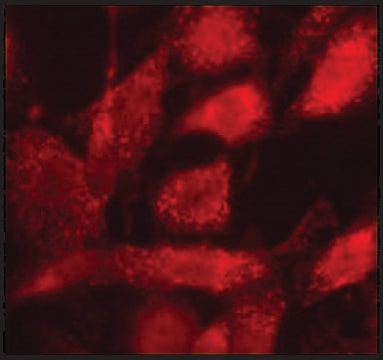
ARR, IP, WB
Citations:
6

R$ 4.302,00


Verificar disponibilidade no carrinho

Peça uma encomenda em massa
Assistência Técnica
Precisa de ajuda? Nossa equipe de cientistas experientes está à sua disposição.
Estamos aqui para ajudar


biological source

rabbit

Quality Level

conjugate

unconjugated

antibody form

affinity isolated antibody

antibody product type

primary antibodies

clone

polyclonal

form

buffered aqueous solution

mol wt

antigen 50-70 kDa

species reactivity

mouse, human

concentration

1-1.5 mg/mL

technique(s)

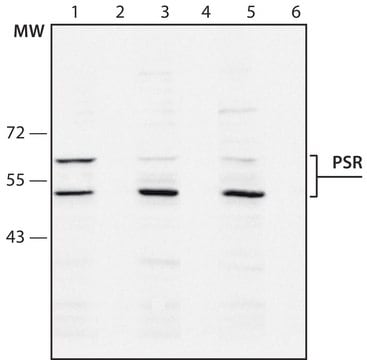
immunoprecipitation (IP): suitable, microarray: suitable, western blot: 1:1,000 using whole extracts of human HeLa or A549 cells, western blot: 1:500 using whole extracts of mouse NIH3T3 cells

UniProt accession no.

shipped in

dry ice

storage temp.

−20°C

target post-translational modification

unmodified

Gene Information

human ... JMJD6(23210)
mouse ... Jmjd6(107817)

General description

Phosphatidylserine Receptor (PSR) is an evolutionarily conserved glycoprotein that is widely expressed in cells and tissues. It is very susceptible to cleavage by protease or elastase. PSR engagement plays an important role in macro-pinocytosis and uptake of tethered apoptotic cells. Cooperation with other receptors and their ligands may also be needed for ingestion of apoptotic cells. PSR is involved in suppression of inflammatory and immune responses.
Phosphatidylserine receptor belongs to the group of Jumonji domain containing protein 6 (JMJD6). It is known to be localized to the phagocytes. PSR is an evolutionarily conserved glycoprotein that is widely expressed in cells and tissues.

Immunogen

synthetic peptide corresponding to amino acid residues 363-381 of the human phosphatidylserine receptor conjugated to maleimide-activated KLH. The corresponding sequence in mouse differs by one amino acid.

Application

Anti-Phosphatidylserine Receptor antibody is sutiable for use in immunoprecipitation and immunoblotting (~50-70 kDa) applications.

Biochem/physiol Actions

Anti-Phosphatidylserine Receptor (PSR) recognizes human and mouse phosphatidylserine receptor (PSR). Detection of the phosphatidylserine receptor by immunoblotting is specifically inhibited by the immunizing peptide, a synthetic peptide corresponding to amino acid residues 363-381 of the human phosphatidylserine receptor, conjugated to maleimide-activated KLH as immunogen.
Phosphatidylserine receptor (PSR) is very susceptible to cleavage by protease or elastase. PSR engagement plays an important role in macro-pinocytosis and uptake of tethered apoptotic cells. Cooperation with other receptors and their ligands may also be needed for ingestion of apoptotic cells. PSR is involved in suppression of inflammatory and immune responses.

Physical form

Solution in 0.01 M phosphate buffered saline, pH 7.4, containing 1% bovine serum albumin and 15 mm sodium azide.

Disclaimer

Unless otherwise stated in our catalog or other company documentation accompanying the product(s), our products are intended for research use only and are not to be used for any other purpose, which includes but is not limited to, unauthorized commercial uses, in vitro diagnostic uses, ex vivo or in vivo therapeutic uses or any type of consumption or application to humans or animals.

Comparar Itens Semelhantes

Ver Comparação Total

Mostrar diferenças

1 of 1

Este Item
P0497R8656A7356
Quality Level

200

Quality Level

200

Quality Level

200

Quality Level

200

biological source

rabbit

biological source

rabbit

biological source

rabbit

biological source

rabbit

antibody form

affinity isolated antibody

antibody form

affinity isolated antibody

antibody form

affinity isolated antibody

antibody form

fractionated antiserum

conjugate

unconjugated

conjugate

unconjugated

conjugate

unconjugated

conjugate

unconjugated

storage temp.

−20°C

storage temp.

−20°C

storage temp.

−20°C

storage temp.

−20°C

form

buffered aqueous solution

form

buffered aqueous solution

form

buffered aqueous solution

form

buffered aqueous solution


Still not finding the right product?

Experimente nossa Ferramenta de seleção de produtos para restringir suas opções


Classe de armazenamento

12 - Non Combustible Liquids

wgk

nwg

flash_point_f

Not applicable

flash_point_c

Not applicable


Escolha uma das versões mais recentes:

Certificados de análise (COA)

Lot/Batch Number

Não está vendo a versão correta?

Se precisar de uma versão específica, você pode procurar um certificado específico pelo número do lote ou da remessa.

Já possui este produto?

Encontre a documentação dos produtos que você adquiriu recentemente na biblioteca de documentos.

Visite a Biblioteca de Documentos


Conteúdo relacionado

Instructions


Differential effects of apoptotic versus lysed cells on macrophage production of cytokines: role of proteases
Fadok VA, et al.
Journal of immunology (Baltimore, Md. : 1950), 166(11), 6847-6854 (2001)
Eva Pallinger et al.
Scientific reports, 8(1), 4662-4662 (2018-03-20)
Earlier evidence suggests, that the embryo signals to the maternal immune system. Extracellular vesicles (EVs) are produced by all types of cells, and because they transport different kinds of molecules from one cell to the other, they can be considered
Phosphatidylserine, a death knell
Schlegel RA and Williamson P
Cell Death and Differentiation, 8(6), 551-551 (2001)


Número de item de comércio global

SKUGTIN
P1495-200UL04061838106711

Questions

Reviews

No rating value

Active Filters