Pular para o conteúdo
Merck

Pular para

AV32002

Anti-ARNTL (AB1) antibody produced in rabbit

IgG fraction of antiserum

Sinônimo(s):

Anti-Aryl hydrocarbon receptor Nuclear translocator-like

Faça login para ver os preços organizacionais e de contrato.

Sobre este item

NACRES:
NA.41
UNSPSC Code:
12352203
Conjugate:
unconjugated
Clone:
polyclonal
Application:
IHC, WB
Citations:
2


biological source

rabbit

conjugate

unconjugated

antibody form

IgG fraction of antiserum

antibody product type

primary antibodies

clone

polyclonal

form

buffered aqueous solution

mol wt

25 kDa

species reactivity

sheep, bovine, rat, guinea pig, horse, human

concentration

0.5 mg - 1 mg/mL

technique(s)

immunohistochemistry: suitable, western blot: suitable

NCBI accession no.

UniProt accession no.

shipped in

wet ice

storage temp.

−20°C

target post-translational modification

unmodified

Gene Information

human ... ARNTL(406)

General description

ARNTL is a basic helix-loop-helix protein that associates with CLOCK to form a heterodimer. ARNTL may be involved in p53-mediated tumor suppression. Furthermore, ARNTL may be linked to bipolar disorder.
Rabbit Anti-ARNTL (AB1) antibody recognizes bovine, pig, canine, human, mouse, and rat ARNTL.

Immunogen

Synthetic peptide directed towards the N terminal region of human ARNTL

Application

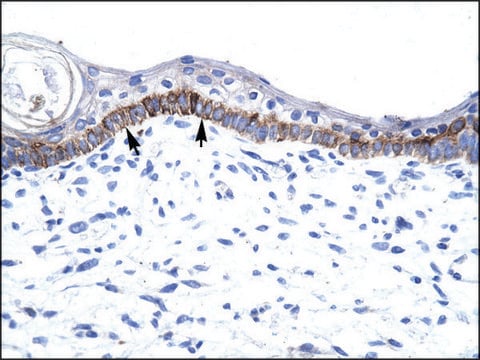
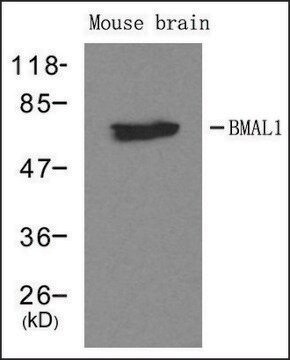
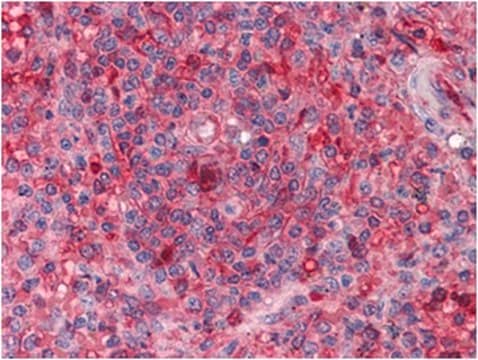
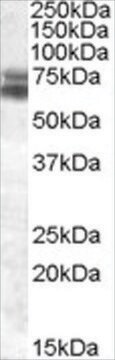
Rabbit Anti-ARNTL (AB1) antibody can be used for IHC (4-8μg/ml, using paraffin-embedded tissues) and western blot (5μg/ml) assays.

Biochem/physiol Actions

ARNTL is a general dimerization partner for a subset of the basic-helix-loop-helix (bHLH)-PER-ARNT-SIM (PAS) superfamily of transcriptional regulators.

Physical form

Purified antibody supplied in 1x PBS buffer with 0.09% (w/v) sodium azide and 2% sucrose.

Other Notes

Synthetic peptide located within the following region: TDYQESMDTDKDDPHGRLEYTEHQGRIKNAREAHSQIEKRRRDKMNSF

Disclaimer

Unless otherwise stated in our catalog or other company documentation accompanying the product(s), our products are intended for research use only and are not to be used for any other purpose, which includes but is not limited to, unauthorized commercial uses, in vitro diagnostic uses, ex vivo or in vivo therapeutic uses or any type of consumption or application to humans or animals.

Comparar Itens Semelhantes

Ver Comparação Total

Mostrar diferenças

1 of 1

Este Item
SAB4300614MABN673SAB2500166
antibody form

IgG fraction of antiserum

antibody form

affinity isolated antibody

antibody form

ascites fluid

antibody form

affinity isolated antibody

conjugate

unconjugated

conjugate

unconjugated

conjugate

unconjugated

conjugate

unconjugated

biological source

rabbit

biological source

rabbit

biological source

mouse

biological source

goat

mol wt

25 kDa

mol wt

~69 kDa

mol wt

-

mol wt

-

clone

polyclonal

clone

polyclonal

clone

1C5, monoclonal

clone

polyclonal

form

buffered aqueous solution

form

buffered aqueous solution

form

-

form

buffered aqueous solution


Still not finding the right product?

Experimente nossa Ferramenta de seleção de produtos para restringir suas opções


Classe de armazenamento

10 - Combustible liquids

wgk

WGK 3

flash_point_f

Not applicable

flash_point_c

Not applicable


Escolha uma das versões mais recentes:

Certificados de análise (COA)

Lot/Batch Number

Não está vendo a versão correta?

Se precisar de uma versão específica, você pode procurar um certificado específico pelo número do lote ou da remessa.

Já possui este produto?

Encontre a documentação dos produtos que você adquiriu recentemente na biblioteca de documentos.

Visite a Biblioteca de Documentos


Jasper Mullenders et al.
PloS one, 4(3), e4798-e4798 (2009-03-12)
The p53 tumor suppressor gene is mutated in about half of human cancers, but the p53 pathway is thought to be functionally inactivated in the vast majority of cancer. Understanding how tumor cells can become insensitive to p53 activation is
Caroline M Nievergelt et al.
American journal of medical genetics. Part B, Neuropsychiatric genetics : the official publication of the International Society of Psychiatric Genetics, 141B(3), 234-241 (2006-03-11)
Bipolar affective disorder (BPAD) is suspected to arise in part from malfunctions of the circadian system, a system that enables adaptation to a daily and seasonally cycling environment. Genetic variations altering functions of genes involved with the input to the


Questions

Reviews

No rating value

Active Filters