
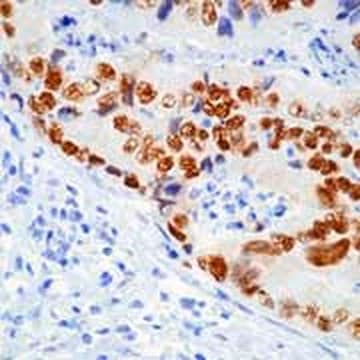
Under non-denaturing conditions, such as immunoprecipitation, immunofluorescence, and frozen sections, Anti-p53 (Ab-3) does not recognize normal (wild-type) p53 protein. This antibody recognizes an epitope exposed by activating mutations or denaturation. In denaturing protocols, such as immunoblotting and paraffin sections, Anti-p53 (Ab-3) will recognize both mutant and wild-type p53.
OP29

Anti-p53 (Ab-3) (Mutant) Mouse mAb (PAb240)
liquid, clone PAb240, Calbiochem®
Synonim(y):
Mutant p53 Antibody
Zaloguj się, aby wyświetlić ceny organizacyjne i kontraktowe.
Wybierz wielkość
Zmień widok
| Gabaryty przesyłki | SKU | Dostępność | Cena netto |
|---|---|---|---|
| 100 μg | Sprawdź dostępność w koszyku | 2120,00 zł | |
| 200 μg | Sprawdź dostępność w koszyku | 2510,00 zł |
Informacje o tej pozycji
NACRES:
NA.41
UNSPSC Code:
12352203
Clone:
PAb240, monoclonal
Species reactivity:
mouse, rat, human, chicken, hamster, bovine
Application:
—
Citations:
19
Pomoc techniczna
Potrzebujesz pomocy? Nasz zespół doświadczonych naukowców chętnie Ci pomoże.
Pozwól nam pomócbiological source
mouse
Quality Level
antibody form
purified antibody
antibody product type
primary antibodies
clone
PAb240, monoclonal
form
liquid
contains
≤0.1% sodium azide as preservative
species reactivity
mouse, rat, human, chicken, hamster, bovine
should not react with
Xenopus
manufacturer/tradename
Calbiochem®
storage condition
do not freeze
dilution
(Flow Cytometry (1-20 µg/mL)
Frozen Sections (10 µg/mL)
Gel Shift
Immunoblotting (5 µg/mL)
Immunofluorescence (1-20 µg/mL,
Immunoprecipitation (1 µg per sample)
Paraffin Sections )
isotype
IgG1
shipped in
wet ice
storage temp.
2-8°C
target post-translational modification
unmodified
Gene Information
human ... TP53(7157)
General description
Purified mouse monoclonal antibody generated by immunizing BALB/c mice with the specified immunogen and fusing splenocytes with SP2 mouse myeloma cells (see application references). Recognizes the ~53 kDa mutant p53 protein under non-denaturing conditions. Recognizes both the mutant and the wild-type p53 protein under denaturing conditions.
Recognizes the ~53 kDa mutant p53 protein under non-denaturing conditions by immunoprecipitation, immunofluorescence, and flow cytometry. Recognizes both mutant and wild-type p53 by immunoblotting and paraffin sections under denaturing conditions.
This Anti-p53 (Ab-3) (Mutant) Mouse mAb (PAb240) is validated for use in FC, Frozen Sections, Gel Shift, Immunoblotting, IF, IP, Paraffin Sections for the detection of p53 (Ab-3) (Mutant).
Immunogen
Epitope: within amino acids 213-217
Human
a recombinant protein consisting of amino acids 14-389 of p53 fused to β-galactosidase
Application
Flow Cytometry (1-20 µg/ml)
Frozen Sections (10 µg/ml)
Gel Shift (see comments)
Immunoblotting (5 µg/ml)
Immunofluorescence (1-20 µg/ml, see application references)
Immunoprecipitation (1 µg per sample)
Paraffin Sections (see application references)
Frozen Sections (10 µg/ml)
Gel Shift (see comments)
Immunoblotting (5 µg/ml)
Immunofluorescence (1-20 µg/ml, see application references)
Immunoprecipitation (1 µg per sample)
Paraffin Sections (see application references)
Packaging
Please refer to vial label for lot-specific concentration.
Physical form
In 50 mM sodium phosphate buffer, 0.2% gelatin, pH 7.5.
Analysis Note
Negative Control
SK-OV-3 cells
SK-OV-3 cells
Positive Control
A431, Hs27 (wild-type p53), or SK-BR-3 cells or breast carcinoma tissue
A431, Hs27 (wild-type p53), or SK-BR-3 cells or breast carcinoma tissue
Other Notes
El-Deiry, W.S., et al. 1994. Cancer Res.54, 1169.
Greenblatt, M.S., et al. 1994. Cancer Res.54, 4855.
Barak, Y., et al. 1993. EMBO J.12, 461.
Kastan, M.B., et al. 1992. Cell71, 587.
Kuerbitz, S.J. 1992. Proc. Natl. Acad. Sci. USA89, 7491.
Lane, D.P. 1992. Nature358, 15.
Kastan, M.B., et al. 1991. Cancer Res.51, 6304.
Greenblatt, M.S., et al. 1994. Cancer Res.54, 4855.
Barak, Y., et al. 1993. EMBO J.12, 461.
Kastan, M.B., et al. 1992. Cell71, 587.
Kuerbitz, S.J. 1992. Proc. Natl. Acad. Sci. USA89, 7491.
Lane, D.P. 1992. Nature358, 15.
Kastan, M.B., et al. 1991. Cancer Res.51, 6304.
Under non-denaturing conditions (immunoprecipitation, immunofluorescence and frozen sections), Anti-p53 (Ab-3) does not recognize normal (wild-type) p53 protein; it recognizes an epitope exposed by activating mutations or denaturation. In denaturing protocols (immunoblotting and paraffin sections), Anti-p53 (Ab-3) will recognize both mutant and wild-type p53. Will not recognize to some p53 molecules with mutations in the RHSVV epitope, but will react to TFIIIA, which has the RHSVV epitope. For gel shift assay, use Cat. No. OP29L and resuspend in 100 µl buffer. Antibody should be titrated for optimal results in individual systems.
Legal Information
CALBIOCHEM is a registered trademark of Merck KGaA, Darmstadt, Germany
Disclaimer
Toxicity: Standard Handling (A)
Ta strona może zawierać tekst przetłumaczony maszynowo.
1 of 1
Ta pozycja | |||
|---|---|---|---|
| clone PAb240, monoclonal | clone DO-7, monoclonal | clone PAb421, monoclonal | clone PAb1801, monoclonal |
| species reactivity mouse, rat, human, chicken, hamster, bovine | species reactivity bovine, monkey, human | species reactivity rabbit, monkey, human, mouse, rat | species reactivity human |
| Gene Information human ... TP53(7157) | Gene Information human ... TP53(7157) | Gene Information human ... TP53(7157) | Gene Information human ... TP53(7157) |
| antibody form purified antibody | antibody form purified antibody | antibody form purified antibody | antibody form purified antibody |
| biological source mouse | biological source mouse | biological source mouse | biological source mouse |
| storage temp. 2-8°C | storage temp. −20°C | storage temp. 2-8°C | storage temp. 2-8°C |
Still not finding the right product?
Klasa składowania
10 - Combustible liquids
wgk
nwg
flash_point_f
Not applicable
flash_point_c
Not applicable
Certyfikaty analizy (CoA)
Poszukaj Certyfikaty analizy (CoA), wpisując numer partii/serii produktów. Numery serii i partii można znaleźć na etykiecie produktu po słowach „seria” lub „partia”.
Masz już ten produkt?
Dokumenty związane z niedawno zakupionymi produktami zostały zamieszczone w Bibliotece dokumentów.
Powiązane treści
Preethi H Gunaratne et al.
Cancer, 125(14), 2409-2422 (2019-04-24)
Over 96% of high-grade ovarian carcinomas and 50% of all cancers are characterized by alterations in the p53 gene. Therapeutic strategies to restore and/or reactivate the p53 pathway have been challenging. By contrast, p63, which shares many of the downstream
Zih-Yin Lai et al.
International journal of molecular sciences, 22(16) (2021-08-28)
As the most common gene mutation found in cancers, p53 mutations are detected in up to 96% of high-grade serous ovarian carcinoma (HGSOC). Meanwhile, mutant p53 overexpression is known to drive oncogenic phenotypes in cancer patients and to sustain the
Tae Won Kwak et al.
OncoTargets and therapy, 10, 137-144 (2017-01-06)
Epigallocatechin-3-gallate (EGCG) is an antioxidant agent derived from green tea. Because it has chemopreventive and anti-invasive effect against various cancer cells, EGCG can be used to inhibit proliferation and invasion of cholangiocarcinoma (CCA) cells. The anticancer effects of EGCG were
Numer pozycji handlu globalnego
| SKU | NUMER GTIN |
|---|---|
| OP29-100UG | 07790788053888 |
| OP29-200UG | 04055977208429 |
-
For observing the R175H mutant p53, I should not boil/denature my protein samples; is that correct?
1 answer-
Helpful?
-