Przejdź do zawartości
Merck

Przejdź do

V3640

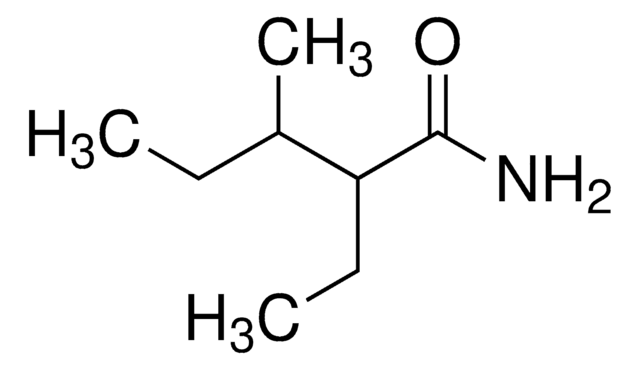
Valpromide

≥97% (NMR)

Synonim(y):

2-Propylvaleramide, 2-propyl-pentanamide, Depamid, Depamide, Di-n-propylacetamide, Dipropylacetamide

Zaloguj się, aby wyświetlić ceny organizacyjne i kontraktowe.

Wybierz wielkość

Zmień widok
Gabaryty przesyłkiSKUDostępnośćCena netto

Informacje o tej pozycji

Wzór empiryczny (zapis Hilla):
C8H17NO
Numer CAS:
Masa cząsteczkowa:
143.23
NACRES:
NA.77
PubChem Substance ID:
UNSPSC Code:
12352200
MDL number:
Assay:
≥97% (NMR)
Form:
powder
Quality level:
Informacje o cenach i dostępności nie są obecnie dostępne.
Pomoc techniczna
Potrzebujesz pomocy? Nasz zespół doświadczonych naukowców chętnie Ci pomoże.
Pozwól nam pomóc


Quality Level

assay

≥97% (NMR)

form

powder

color

white to off-white

solubility

DMSO: >10 mg/mL

originator

Sanofi Aventis

storage temp.

room temp

SMILES string

CCCC(CCC)C(N)=O

InChI

1S/C8H17NO/c1-3-5-7(6-4-2)8(9)10/h7H,3-6H2,1-2H3,(H2,9,10)

InChI key

OMOMUFTZPTXCHP-UHFFFAOYSA-N

Application

Valpromide has been used to pretreat NIH/3T3 cells to test its effect on cytomegalovirus (CMV) viral replication.[1] It has also been used to test its antiviral functionality in herpes simplex virus type 1 (HSV-1) infected human oligodendroglioma (HOG) cells.[2] It may be used to test its effect on apoptosis induction in astrocytes.

Biochem/physiol Actions

Valpromide (VPD) is a derivative of valproic acid (VPA) and is used as an antiepileptic drug.
Valpromide (VPD) is a derivative of valproic acid (VPA) and is used as an antiepileptic drug. It is hydrolyzed quickly to VPA in vivo, but has intrinsic anticonvulsant activity.
Valpromide possesses antipsychotic property. It lacks the toxic and teratogenic effects of valproic acid.[2] It also lacks the histone deacetylase (HDAC) inhibitory activity of valproic acid.[2]

Features and Benefits

This compound was developed by Sanofi Aventis. To browse the list of other pharma-developed compounds and Approved Drugs/Drug Candidates, click here.
Ta strona może zawierać tekst przetłumaczony maszynowo.

Porównaj podobne pozycje

Wyświetl pełne porównanie

Pokaż różnice

1 of 1

Ta pozycja
V4765T1330SML0838
assay

≥97% (NMR)

assay

≥98% (NMR)

assay

≥98% (HPLC)

assay

≥98% (HPLC)

form

powder

form

powder

form

powder

form

powder

Quality Level

100

Quality Level

100

Quality Level

100

Quality Level

100

storage temp.

room temp

storage temp.

room temp

storage temp.

room temp

storage temp.

room temp

solubility

DMSO: >10 mg/mL

solubility

DMSO: 20 mg/mL, clear

solubility

DMSO: >10 mg/mL

solubility

DMSO: 10 mg/mL, clear (warmed)

color

white to off-white

color

white to off-white

color

white

color

white to light brown


Still not finding the right product?

Explore all of our products under


pictograms

Exclamation mark

signalword

Warning

hcodes

Hazard Classifications

Acute Tox. 4 Oral

Klasa składowania

11 - Combustible Solids

wgk

WGK 3

flash_point_f

Not applicable

flash_point_c

Not applicable


Wybierz jedną z najnowszych wersji:

Certyfikaty analizy (CoA)

Lot/Batch Number

Nie widzisz odpowiedniej wersji?

Jeśli potrzebujesz konkretnej wersji, możesz wyszukać konkretny certyfikat według numeru partii lub serii.

Masz już ten produkt?

Dokumenty związane z niedawno zakupionymi produktami zostały zamieszczone w Bibliotece dokumentów.

Odwiedź Bibliotekę dokumentów


Cheng-Wei Li et al.
PloS one, 13(8), e0202537-e0202537 (2018-08-23)
Epstein-Barr virus (EBV), also known as human herpesvirus 4, is prevalent in all human populations. EBV mainly infects human B lymphocytes and epithelial cells, and is therefore associated with their various malignancies. To unravel the cellular mechanisms during the infection
Karine Cambon et al.
Molecular therapy. Methods & clinical development, 5, 259-276 (2017-06-13)
Huntington's disease (HD) is an autosomal dominant neurodegenerative disorder resulting from a polyglutamine expansion in the huntingtin (HTT) protein. There is currently no cure for this disease, but recent studies suggest that RNAi to downregulate the expression of both normal
Valproic acid induces apoptosis in differentiating hippocampal neurons by the release of tumor necrosis factor-alpha from activated astrocytes
Wang C, et al.
Neuroscience Letters, 497(2), 122-127 (2011)


Numer pozycji handlu globalnego

SKUNUMER GTIN
V3640-10MG04061837480935
V3640-50MG04061832561455

Questions

Reviews

No rating value

Active Filters