Przejdź do zawartości
Merck

Przejdź do

NE1022

PhosphoDetect Anti-Neurofilament H Mouse mAb (SMI-31)

liquid, clone SMI-31, Calbiochem®

Synonim(y):

Anti-neurofilament antibody

Zaloguj się, aby wyświetlić ceny organizacyjne i kontraktowe.

Wybierz wielkość

Zmień widok
Gabaryty przesyłkiSKUDostępnośćCena netto
100 μL

Dostępne do wysyłki DZISIAJzKuehne + Nagel Sp. z o.o.

2530,00 zł

Informacje o tej pozycji

NACRES:
NA.41
UNSPSC Code:
12352203
Clone:
SMI-31, monoclonal
Species reactivity:
mouse, human, rat
Application:
Citations:
27

2530,00 zł


Dostępne do wysyłki DZISIAJSzczegóły


Zamów zamówienie zbiorcze
Pomoc techniczna
Potrzebujesz pomocy? Nasz zespół doświadczonych naukowców chętnie Ci pomoże.
Pozwól nam pomóc


biological source

mouse

Quality Level

antibody form

purified antibody

antibody product type

primary antibodies

clone

SMI-31, monoclonal

form

liquid

contains

≤0.1% sodium azide as preservative

species reactivity

mouse, human, rat

species reactivity (predicted by homology)

mammals

manufacturer/tradename

Calbiochem®

storage condition

OK to freeze, avoid repeated freeze/thaw cycles

dilution

(ELISA (1:1000)
Frozen Sections (1:1000)
Immunoblotting (1:1000)
Immunocytochemistry (1:1000)
Paraffin Sections (1:1000, heat pre-treatment required)
Immunoprecipitation )

isotype

IgG1

shipped in

wet ice

storage temp.

2-8°C

target post-translational modification

unmodified

Gene Information

human ... NEFH(4744)

General description

Mouse monoclonal antibody supplied as purified antibody. Recognizes the ~180-200 kDa phosphorylated neurofilament H protein.
Recognizes the ~180-200 kDa phosphorylated neurofilament H protein in rat central nervous system (CNS) cytoskeletal preparations. Also weakly recognizes phosphorylated NF-M protein.
This PhosphoDetect Anti-Neurofilament H Mouse mAb (SMI-31) is validated for use in ELISA, Frozen Sections, Immunoblotting, ICC, Paraffin Sections, IP for the detection of Neurofilament H.

Immunogen

homogenized, hypothalami from Fischer 344 rat brain

Application


ELISA (1:1000)
Frozen Sections (1:1000, see comments)
Immunoblotting (1:1000)
Immunocytochemistry (1:1000, see comments)
Paraffin Sections (1:1000, heat pre-treatment required, see comments)
Immunoprecipitation (see comments)

Physical form

Phosphate buffer solution, pH7.2, containing 0.09% sodium azide

Other Notes

Raina, A.K., et al. 1999. Neuroreport10, 1355.
Yang, C.C., et al. 1998. Brain121, 1089.
Giasson, B.I and Mushynski, W.E. 1996. J. Biol. Chem.271, 30404.
Mirabella, M., et al. 1996. J. Neuropath. Exp. Neurol.55, 774.
Xiao, J. and Monteiro, M.J. 1994. J. Neurosci.14, 1820.
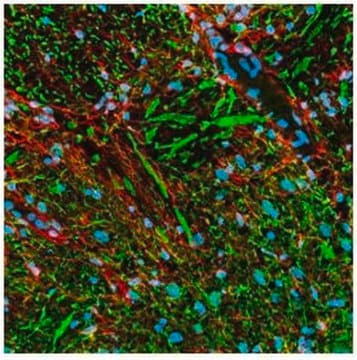
Strongly recognizes phosphorylated neurofilament H and, to a lesser extent, phosphorylated neurofilament M. By immunocytochemistry this antibody broadly stains thick and thin axons and some dendrites, such as basket cell dendrites, but not Purkinje cell dendrites. Does not generally stain nerve cell bodies or other cells and tissues except peripheral axons. May also stain neuronal cell bodies in pathological conditions. Aberrant phosphorylation of neurofilament H in cell bodies can be demonstrated in neuronal cell cultures following treatment with agents that induce stress-activated protein kinase. This antibody is reported to co-immunoprecipitate neurofilament-associated kinase (NAK 115) via interaction of the antibody with the tail domain of neurofilament H. Phosphatase treatment of tissue sections or immunoblotting samples abolishes antibody reactivity. Reactivity is unaffected by trypsin treatment of samples. Tissues and cultured cells can be fixed with a variety of paraformaldehyde- or formaldehyde-containing fixatives, including Bouin′s fixative. Post-fixation in cold methanol or methanol/hydrogen peroxide facilitates access of the antibody to the epitope in frozen sections or thick tissue sections fixed in 4% paraformaldehyde and in cultured cells. For staining formalin-fixed, paraffin sections it is recommended that the de-paraffinized tissue be autoclaved in dH2O for 10 min or boiled in Tris-buffered saline, pH 9.0, in a microwave for 15 min to expose the epitope. Antibody should be titrated for optimal results in individual systems.

Legal Information

CALBIOCHEM is a registered trademark of Merck KGaA, Darmstadt, Germany

Disclaimer

Toxicity: Standard Handling (A)
Ta strona może zawierać tekst przetłumaczony maszynowo.

Porównaj podobne pozycje

Wyświetl pełne porównanie

Pokaż różnice

1 of 1

Ta pozycja
OP143OP07525295
clone

SMI-31, monoclonal

clone

4B11, monoclonal

clone

327, monoclonal

clone

PY20, monoclonal

species reactivity

mouse, human, rat

species reactivity

mouse, human

species reactivity

mouse, human, rat

species reactivity

-

antibody form

purified antibody

antibody form

purified antibody

antibody form

purified antibody

antibody form

purified antibody

Gene Information

human ... NEFH(4744)

Gene Information

human ... MDM2(4193)
mouse ... Mdm2(17246)

Gene Information

human ... SRC(6714)

Gene Information

human ... PID1(55022)

biological source

mouse

biological source

mouse

biological source

mouse

biological source

mouse

isotype

IgG1

isotype

IgG2a

isotype

IgG1

isotype

IgG2b


Still not finding the right product?

Wypróbuj nasze narzędzie Narzędzie selektora produktów, aby zawęzić opcje.


Klasa składowania

12 - Non Combustible Liquids

wgk

nwg

flash_point_f

Not applicable

flash_point_c

Not applicable


Certyfikaty analizy (CoA)

Poszukaj Certyfikaty analizy (CoA), wpisując numer partii/serii produktów. Numery serii i partii można znaleźć na etykiecie produktu po słowach „seria” lub „partia”.

Masz już ten produkt?

Dokumenty związane z niedawno zakupionymi produktami zostały zamieszczone w Bibliotece dokumentów.

Odwiedź Bibliotekę dokumentów


Takuya Hayashi et al.
Molecular neurodegeneration, 8, 4-4 (2013-01-22)
Neurodegenerative diseases including Parkinson's and Alzheimer's diseases progress slowly and steadily over years or decades. They show significant between-subject variation in progress and clinical symptoms, which makes it difficult to predict the course of long-term disease progression with or without
Seungyong Lee et al.
Nature communications, 12(1), 4939-4939 (2021-08-18)
Pain is a central feature of soft tissue trauma, which under certain contexts, results in aberrant osteochondral differentiation of tissue-specific stem cells. Here, the role of sensory nerve fibers in this abnormal cell fate decision is investigated using a severe
Michael J Whitehead et al.
Scientific reports, 8(1), 5219-5219 (2018-03-28)
Axon degeneration underlies many nervous system diseases; therefore understanding the regulatory signalling pathways is fundamental to identifying potential therapeutics. Previously, we demonstrated heparan sulphates (HS) as a potentially new target for promoting CNS repair. HS modulate cell signalling by both


Numer pozycji handlu globalnego

SKUNUMER GTIN
NE1022-100UL04055977209907

Questions

Reviews

No rating value

Active Filters