
Przejdź do
M5793

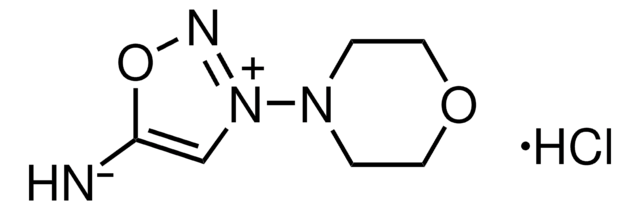
3-Morpholinosydnonimine hydrochloride
guanylyl cyclase activator
Synonim(y):
3-(4-Morpholinyl)sydnone imine hydrochloride, Linsidomine hydrochloride, SIN-1 hydrochloride
Zaloguj się, aby wyświetlić ceny organizacyjne i kontraktowe.
Wybierz wielkość
Zmień widok
| Gabaryty przesyłki | SKU | Dostępność | Cena netto |
|---|---|---|---|
| 25 mg | Skontaktuj się z Obsługą Klienta, aby uzyskać informacje na temat dostępności | 989,00 zł | |
| 100 mg | Skontaktuj się z Obsługą Klienta, aby uzyskać informacje na temat dostępności | 3130,00 zł |
Informacje o tej pozycji
Wzór empiryczny (zapis Hilla):
C6H10N4O2 · HCl
Numer CAS:
Masa cząsteczkowa:
206.63
UNSPSC Code:
12352200
PubChem Substance ID:
NACRES:
NA.77
MDL number:
989,00 zł
Skontaktuj się z Obsługą Klienta, aby uzyskać informacje na temat dostępności
Pomoc techniczna
Potrzebujesz pomocy? Nasz zespół doświadczonych naukowców chętnie Ci pomoże.
Pozwól nam pomócNazwa produktu
3-Morpholinosydnonimine hydrochloride, (consistent with structure, NMR)
Quality Segment
storage temp.
−20°C
SMILES string
Cl[H].[NH-]c1c[n+](no1)N2CCOCC2
InChI
1S/C6H10N4O2.ClH/c7-6-5-10(8-12-6)9-1-3-11-4-2-9;/h5,7H,1-4H2;1H
InChI key
NCGICGYLBXGBGN-UHFFFAOYSA-N
Application
3-Morpholinosydnonimine hydrochloride has been used:
- as a peroxynitrite donor standard to study the accumulation of peroxynitrite in Arabidopsis thaliana[1]
- to study its effects on nitrosative stress in human brain vascular pericytes and human embryonic kidney cells[2]
- as a ROS to study its effects on mouse embryonic fibroblasts[3]
Biochem/physiol Actions
3-Morpholinosydnonimine participates in the inhibition of cysteine proteases.[4]
Liberates nitric oxide (NO) spontaneously when in solution, activating guanylyl cyclase and causing an increase in cyclic-GMP. This product is a vasodilator and inhibits platelet aggregation. Using molecular oxygen, it generates both superoxide anion and nitric oxide that spontaneously form peroxynitrite.
Liberates nitric oxide (NO) spontaneously when in solution, activating guanylyl cyclase and causing an increase in cyclic-GMP; vasodilator.
Ta strona może zawierać tekst przetłumaczony maszynowo.
1 of 1
Ta pozycja | |||
|---|---|---|---|
| Quality Level 200 | Quality Level 100 | Quality Level 100 | Quality Level 100 |
| storage temp. −20°C | storage temp. 2-8°C | storage temp. - | storage temp. −20°C |

Klasa składowania
11 - Combustible Solids
wgk
WGK 2
flash_point_f
Not applicable
flash_point_c
Not applicable
ppe
Eyeshields, Gloves, type N95 (US)
Wybierz jedną z najnowszych wersji:
Masz już ten produkt?
Dokumenty związane z niedawno zakupionymi produktami zostały zamieszczone w Bibliotece dokumentów.
Produkty
Nitric oxide (NO) as a signal transporter in neurons, endothelial cells and in the immune system.
DISCOVER Bioactive Small Molecules for Nitric Oxide & Cell Stress Research
Numer pozycji handlu globalnego
| SKU | NUMER GTIN |
|---|---|
| M5793-100MG | 04061834060369 |
| M5793-25MG | 04061834060376 |