Przejdź do zawartości
Merck

E1145

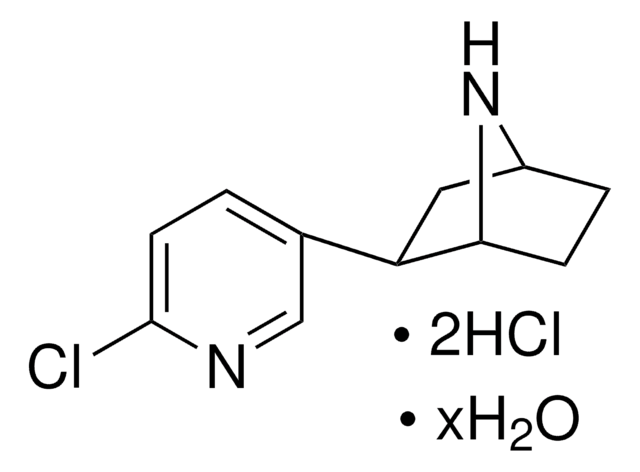
(±)-Epibatidine dihydrochloride hydrate

≥98% (HPLC), nicotinic acetylcholine receptor agonist, powder

Synonim(y):

exo-(±)-2-(6-Chloro-3-pyridinyl)-7-azabicyclo[2.2.1]heptane dihydrochloride hydrate

Zaloguj się, aby wyświetlić ceny organizacyjne i kontraktowe.

Wybierz wielkość

5 MG

899,00 zł

899,00 zł


Skontaktuj się z Obsługą Klienta, aby uzyskać informacje na temat dostępności

Zamów zamówienie zbiorcze

Informacje o tej pozycji

Wzór empiryczny (zapis Hilla):
C11H13ClN2 · 2HCl · xH2O
Masa cząsteczkowa:
281.61 (anhydrous basis)
UNSPSC Code:
12352200
PubChem Substance ID:
NACRES:
NA.77
Assay:
≥98% (HPLC)
Form:
powder
Quality level:
Storage condition:
desiccated

Przejdź do

Pomoc techniczna
Potrzebujesz pomocy? Nasz zespół doświadczonych naukowców chętnie Ci pomoże.
Pozwól nam pomóc

Nazwa produktu

(±)-Epibatidine dihydrochloride hydrate, ≥98% (HPLC), powder

Quality Level

assay

≥98% (HPLC)

form

powder

storage condition

desiccated

color

off-white

solubility

DMSO: >4 mg/mL, methanol: 4 mg/mL

SMILES string

Cl[H].Cl[H].[H]O[H].Clc1ccc(cn1)[C@H]2CC3CCC2N3

InChI

1S/C11H13ClN2.2ClH.H2O/c12-11-4-1-7(6-13-11)9-5-8-2-3-10(9)14-8;;;/h1,4,6,8-10,14H,2-3,5H2;2*1H;1H2/t8?,9-,10?;;;/m1.../s1

InChI key

AXWYRFKDLRSESC-VAGRNHIFSA-N

Powiązane kategorie

Porównaj podobne pozycje

Wyświetl pełne porównanie

Pokaż różnice

1 of 4

Ta pozycja
D6196SML0180D6946
form

powder

form

powder

form

powder

form

powder

assay

≥98% (HPLC)

assay

≥98% (HPLC)

assay

≥98% (HPLC)

assay

≥98% (HPLC)

Quality Level

100

Quality Level

100

Quality Level

100

Quality Level

100

storage condition

desiccated

storage condition

-

storage condition

desiccated

storage condition

-

solubility

DMSO: >4 mg/mL, methanol: 4 mg/mL

solubility

H2O: ≥10 mg/mL

solubility

H2O: ≥15 mg/mL at ~60 °C

solubility

DMSO: ≥30 mg/mL

color

off-white

color

white to off-white

color

white to tan

color

yellow

Biochem/physiol Actions

Epibatidine is most potent nicotinic acetylcholine receptor agonist known; non-opioid analgesic.
The activity of epibatidine at neuronal and neuromuscular nicotinic acetylcholine receptors was compared with the activity of nicotine and suxamethonium. Activation of ganglionic nicotinic receptors by epibatidine was shown in the guinea-pig ileum (contraction mediated by the cholinergic neurons of the ileum) and in pithed and atropinized rats (rise in blood pressure). Epibatidine also activated nicotinic receptors at the peripheral terminals of afferent C-fibres (rabbit ear) and in the brain (antidiuresis in rats). The agonistic effects of epibatidine were followed by long-lasting receptor desensitization. No antinociceptive effect of epibatidine was seen in rats at a dose free of motor impairment. On muscle end plate nicotinic receptors of the rat diaphragm (not responding to depolarizing agents by contraction), epibatidine was equipotent with suxamethonium in causing neuromuscular inhibition. On an extraocular muscle of the rabbit (responding to depolarizing agents by contraction) epibatidine in vitro and in situ caused a contraction at a 100-fold lower dose than suxamethonium. The Straub tail reaction in mice to epibatidine could be attributed to the sustained stimulation of motor end plate receptors of the "slow contracting" type of muscle fibres by epibatidine. Epibatidine was the most potent agonist on all neuronal and neuromuscular nicotinic receptors examined.

Features and Benefits

This compound is featured on the Acetylcholine Receptors (Nicotinic) page of the Handbook of Receptor Classification and Signal Transduction. To browse other handbook pages, click here.
Ta strona może zawierać tekst przetłumaczony maszynowo.

pictograms

Skull and crossbones

signalword

Danger

Hazard Classifications

Acute Tox. 2 Dermal - Acute Tox. 2 Oral

Klasa składowania

6.1A - Combustible acute toxic Cat. 1 and 2 / very toxic hazardous materials

wgk

WGK 3

flash_point_f

Not applicable

flash_point_c

Not applicable

ppe

Eyeshields, Faceshields, Gloves, type P3 (EN 143) respirator cartridges


Wybierz jedną z najnowszych wersji:

Certyfikaty analizy (CoA)

Lot/Batch Number

Nie widzisz odpowiedniej wersji?

Jeśli potrzebujesz konkretnej wersji, możesz wyszukać konkretny certyfikat według numeru partii lub serii.

Masz już ten produkt?

Dokumenty związane z niedawno zakupionymi produktami zostały zamieszczone w Bibliotece dokumentów.

Odwiedź Bibliotekę dokumentów

M W Decker et al.
Biochemical pharmacology, 58(6), 917-923 (1999-10-06)
Pharmacological treatments for pain have come largely from two classes of compounds--the opioids and the nonsteroidal anti-inflammatory drugs (NSAIDs). Because of deficiencies associated with these two classes of compounds, exploration of novel approaches to pain relief has intensified of late.
Aurora Alvarez-Buylla et al.
eLife, 12 (2024-01-11)
Alkaloids are important bioactive molecules throughout the natural world, and in many animals they serve as a source of chemical defense against predation. Dendrobatid poison frogs bioaccumulate alkaloids from their diet to make themselves toxic or unpalatable to predators. Despite
W Sihver et al.
Neuroscience, 94(3), 685-696 (1999-12-01)
The laminar binding distribution of three nicotinic receptor agonists, [3H](-)nicotine, [3H]cytisine, and [3H]epibatidine, and their relation to the [3H]vesamicol binding, which is known to represent the vesicular acetylcholine transport sites, was performed employing in vitro autoradiography on the medial temporal
Ali Yehia et al.
Current protocols in pharmacology, 88(1), e73-e73 (2020-02-19)
Automated patch-clamp (APC) systems have become indispensable tools of drug-discovery programs by allowing high-throughput electrophysiology-based screening of ion channel compounds. The recent development and introduction of microfluidics-based APC systems have made it possible to study the interactions of ligand-gated ion
Y Zhang et al.
Journal of neurophysiology, 124(5), 1377-1387 (2020-08-28)
Olivocochlear neurons make temporary cholinergic synapses on inner hair cells of the rodent cochlea in the first 2 to 3 wk after birth. Repetitive stimulation of these efferent neurons causes facilitation of evoked release and increased spontaneous release that continues

Numer pozycji handlu globalnego

SKUNUMER GTIN
E1145-5MG04061832090610

Questions

Reviews

No rating value

Active Filters

Nasz zespół naukowców ma doświadczenie we wszystkich obszarach badań, w tym w naukach przyrodniczych, materiałoznawstwie, syntezie chemicznej, chromatografii, analityce i wielu innych dziedzinach.

Skontaktuj się z zespołem ds. pomocy technicznej