Przejdź do zawartości
Merck

Przejdź do

ABS30

Anti-Sulfenic Acid Modified Cysteine (2-Thiodimedone-Specific Ig) Antibody

serum, from rabbit

Synonim(y):

Sulfenic Acid Modified Cysteine (2-Thiodimedone-Specific Ig)

Zaloguj się, aby wyświetlić ceny organizacyjne i kontraktowe.

Wybierz wielkość

Zmień widok
Gabaryty przesyłkiSKUDostępnośćCena netto
100 μL

Dostępne do wysyłki DZISIAJzKuehne + Nagel Sp. z o.o.

1960,00 zł

Informacje o tej pozycji

UNSPSC Code:
12352203
NACRES:
NA.41
eCl@ss:
32160702
Clone:
polyclonal
Species reactivity:
human, mouse, rat
Application:
WB
Citations:
9

1960,00 zł


Dostępne do wysyłki DZISIAJSzczegóły


Zamów zamówienie zbiorcze
Pomoc techniczna
Potrzebujesz pomocy? Nasz zespół doświadczonych naukowców chętnie Ci pomoże.
Pozwól nam pomóc


biological source

rabbit

Quality Level

antibody form

serum

antibody product type

primary antibodies

clone

polyclonal

species reactivity

human, mouse, rat

species reactivity (predicted by homology)

all

technique(s)

western blot: suitable

isotype

IgG

shipped in

wet ice

target post-translational modification

unmodified

General description

Protein sulfenic acid formation is a reversible post-translational modification that may be used to monitor protein oxidation on reactive cysteines within target proteins. This can be detected with protein sulfenic acid derivatised with dimedone.
Pan antibody smear is expected.

Immunogen

Linear peptide corresponding to sulfenic acid modified proteins.

Application

Anti-Sulfenic Acid Modified Cysteine (2-Thiodimedone-Specific Ig) Antibody detects level of Sulfenic Acid Modified Cysteine & has been published & validated for use in WB.
Immunofluorescence Analysis: A previous lot was used by an independent laboratory in IF. (Seo, YH, et al. (2009). PNAS. 106(38): 16163-16168.)

Biochem/physiol Actions

This anitbody recognizes sulfenic acid modified proteins. Pan modification against all species.

Analysis Note

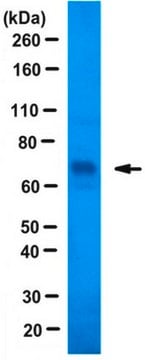
Evaluated by Western Blot in rat ventricular myocyte lysate.

Western Blot Analysis: 01:1,000 dilution of this antibody detected sulfenic acid modified proteins on 10 µg of rat ventricular myocyte lysate.
Ta strona może zawierać tekst przetłumaczony maszynowo.

Porównaj podobne pozycje

Wyświetl pełne porównanie

Pokaż różnice

1 of 1

Ta pozycja
ABN1011ABE1081MABS487
Quality Level

100

Quality Level

100

Quality Level

100

Quality Level

100

biological source

rabbit

biological source

rabbit

biological source

rabbit

biological source

human (Recombinant)

antibody form

serum

antibody form

serum

antibody form

serum

antibody form

purified immunoglobulin

technique(s)

western blot: suitable

technique(s)

immunocytochemistry: suitable, western blot: suitable

technique(s)

western blot: suitable

technique(s)

ELISA: suitable, western blot: suitable

clone

polyclonal

clone

polyclonal

clone

polyclonal

clone

C4, monoclonal

shipped in

wet ice

shipped in

wet ice

shipped in

wet ice

shipped in

wet ice


Still not finding the right product?

Wypróbuj nasze narzędzie Narzędzie selektora produktów, aby zawęzić opcje.


Klasa składowania

10 - Combustible liquids

wgk

WGK 1


Certyfikaty analizy (CoA)

Poszukaj Certyfikaty analizy (CoA), wpisując numer partii/serii produktów. Numery serii i partii można znaleźć na etykiecie produktu po słowach „seria” lub „partia”.

Masz już ten produkt?

Dokumenty związane z niedawno zakupionymi produktami zostały zamieszczone w Bibliotece dokumentów.

Odwiedź Bibliotekę dokumentów


Ester Zito et al.
Molecular cell, 48(1), 39-51 (2012-09-18)
Endoplasmic reticulum (ER) thiol oxidases initiate a disulfide relay to oxidatively fold secreted proteins. We found that combined loss-of-function mutations in genes encoding the ER thiol oxidases ERO1α, ERO1β, and PRDX4 compromised the extracellular matrix in mice and interfered with
Nannan Zhou et al.
The Journal of clinical investigation, 133(24) (2023-12-15)
Elevation of reactive oxygen species (ROS) levels is a general consequence of tumor cells' response to treatment and may cause tumor cell death. Mechanisms by which tumor cells clear fatal ROS, thereby rescuing redox balance and entering a chemoresistant state
Phillip A Wages
Current protocols in toxicology, 71, 17-17 (2017-02-02)
Protein sulfenylation is a post-translational modification that is linked to many cell signaling networks and specific protein functions, thus the detection of any sulfenylated protein after a toxicological exposure is of importance. Specifically, the detection of protein sulfenylation can provide


Numer pozycji handlu globalnego

SKUNUMER GTIN
ABS3004053252517587

Questions

Reviews

No rating value

Active Filters