Przejdź do zawartości
Merck

Przejdź do

ABN83

Anti-Vesicular Nucleotide Transporter (VNUT Antibody)

serum, from guinea pig

Synonim(y):

Solute carrier family 17 member 9

Zaloguj się, aby wyświetlić ceny organizacyjne i kontraktowe.

Informacje o tej pozycji

UNSPSC Code:
12352203
NACRES:
NA.41
eCl@ss:
32160702
Conjugate:
unconjugated
Clone:
polyclonal
Application:
IF, WB
Citations:
7


biological source

guinea pig

conjugate

unconjugated

antibody form

serum

antibody product type

primary antibodies

clone

polyclonal

species reactivity

mouse, rat

technique(s)

immunofluorescence: suitable, western blot: suitable

NCBI accession no.

UniProt accession no.

shipped in

dry ice

target post-translational modification

unmodified

Gene Information

mouse ... Slc17A9(228993)
rat ... Slc17A9(362287)

General description

Solute carrier family 17 member 9 (UniProt; also known as Vesicular nucleotide transporter, VNUT) is encoded by the Slc17a9 (also known as Vnut) gene (Gene ID 228993) in murine species. VNUT is an anion transporter family member that mediates the active accumulation of nucleotides (i.e., ATP, ADP, and UTP) into secretory vesicles, as well as the exocytosis of ATP from various tissue types. VNUT is expressed by tyrosine hydroxylase-/TH-positive dopaminergic (DA) amacrine/interplexiform cells (IPCs) in the retina, as well as by both DA and non-DA neurons in the midbrain. In addition to the 447-amino acid Slc17a9 transcript (NM_183161), putative protein coding isoforms based on automated computational analysis have been predicted (X1, XM_006500589; X2, XM_006500590; X3, XM_006500591). Two protein bands of sizes ~75 and ~50 kDa are identified in mouse retinal and cortical tissues by immunoblotting, with the 75 kDa band being the 447-a.a. canonical VNUT isoform and the ~50 kDa band likely representing isoform X1/X2. In addition, a ~60 kDa form is also reported, representing either another spliced form or less glycosylated form. Murine VNUT is a 11-transmembrane (a.a. 40-60, 74-94, 103-123, 129-149, 169-189, 192-212, 252-272, 287-307, 327-347, 380-400, 413-433) vesicular protein, having an extacellular/vacuolar N-terminal end (a.a. 1-39) and a cytoplasmic C-terminal tail (a.a. 434-447) with 5 cytoplasmic and 5 extacellular/vacuolar loops in between.
~75/60/50 kDa observed. Target band size appears larger than the calculated molecular weight of 48.48 kDa due to glycosylation. Uncharacterized band(s) may appear in some lysates.

Immunogen

Epitope: Second extracellular loop.
KLH-conjugated linear peptide corresponding to a sequence from the second extracellular loop of mouse Vesicular Nucleotide Transporter (VNUT).

Application

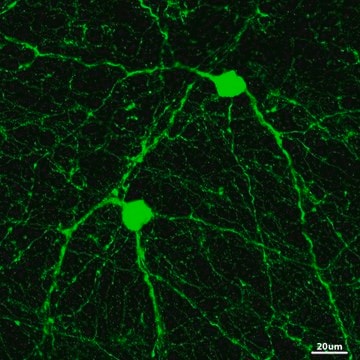
Immunofluorescence Analysis: A 1:1000 dilution from a representative lot immunostained amacrine/interplexiform cell (IPC) type by fluorescent immunohistochemistry staining of 4% paraformaldehyde-fixed, OCT-embedded mouse and rat vertical retinal cryosections, as well as of flatmounted mouse and rat retinae (Courtesy of Dr. Erica Fletcher, The University of Melbourne, Australia).
Western Blotting Analysis: A 1:500 dilution from a representative lot detected purified full-length recombinant VNUT, as well as endogenous VNUT in mouse retina extract (Courtesy of Dr Erica Fletcher, The University of Melbourne, Australia).
Immunofluorescence Analysis: A 1:1000 dilution from a representative lot immunostained VNUT-positive neurons in the substantia nigra (SN) by fluorescent immunohistochemistry staining of 4% paraformaldehyde-fixed, free-floating mouse brain cryosections (Courtesy of Dr. Erica Fletcher, The University of Melbourne, Australia).
Immunofluorescence Analysis: A representative lot immunostained tyrosine hydroxylase-/TH-positive amacrine/interplexiform cell (IPC) type in the inner nuclear layer (INL) by fluorescent immunohistochemistry staining of 4% paraformaldehyde-fixed, OCT-embedded mouse and rat vertical retinal cryosections, as well as flatmounted mouse retina (Ho, T., et al. (2015). Front. Cell. Neurosci. In Press).
Immunofluorescence Analysis: A representative lot immunostained tyrosine hydroxylase-/TH-positive dopaminergic neurons in the substantia nigra (SN) and ventral tegmental area (VTA) by fluorescent immunohistochemistry staining of 4% paraformaldehyde-fixed, free-floating mouse brain cryosections (Ho, T., et al. (2015). Front. Cell. Neurosci. In Press).
Western Blotting Analysis: A representative lot detected the ~75 kDa and ~50 kDa X1/X2 VNUT isoforms in murine retinal and cortical homogenates, while no VUNT expression was detected in kidney homogenate. Immunogen peptide blocking abolished target bands detection (Ho, T., et al. (2015). Front. Cell. Neurosci. In Press).
Research Category
Neuroscience
Research Sub Category
Developmental Neuroscience
This Anti-Vesicular Nucleotide Transporter (VNUT antibody is validated for use in WB, IF for the detection of Vesicular Nucleotide Transporter (VNUT.

Biochem/physiol Actions

This guinea pig polyclonal antiserum detected the ~75 kDa, ~60 kDa, and the ~50 kDa (X1/X2 VNUT isoforms) VNUT target bands in murine retinal and cortical homogenates. Immunogen peptide blocking abolished target bands detection.

Physical form

Guinea pig polyclonal serum with 0.05% sodium azide.
Unpurified

Preparation Note

Stable for 1 year at -20°C from date of receipt.
Handling Recommendations: Upon receipt and prior to removing the cap, centrifuge the vial and gently mix the solution. Aliquot into microcentrifuge tubes and store at -20°C. Avoid repeated freeze/thaw cycles, which may damage IgG and affect product performance.

Analysis Note

Evaluated by Western Blotting in mouse brain tissue lysate.

Western Blotting Analysis: A 1:500 dilution of this antibody detected Vesicular Nucleotide Transporter (VNUT) in 10 µg of mouse brain tissue lysate.

Other Notes

Concentration: Please refer to lot specific datasheet.

Disclaimer

Unless otherwise stated in our catalog or other company documentation accompanying the product(s), our products are intended for research use only and are not to be used for any other purpose, which includes but is not limited to, unauthorized commercial uses, in vitro diagnostic uses, ex vivo or in vivo therapeutic uses or any type of consumption or application to humans or animals.
Ta strona może zawierać tekst przetłumaczony maszynowo.

Porównaj podobne pozycje

Wyświetl pełne porównanie

Pokaż różnice

1 of 1

Ta pozycja
AB5905MAB5502MAB5504
conjugate

unconjugated

conjugate

-

conjugate

-

conjugate

unconjugated

biological source

guinea pig

biological source

guinea pig

biological source

mouse

biological source

mouse

antibody form

serum

antibody form

serum

antibody form

purified immunoglobulin

antibody form

purified antibody

Gene Information

mouse ... Slc17A9(228993)
rat ... Slc17A9(362287)

Gene Information

rat ... Slc17A7(116638)

Gene Information

rat ... Slc17A7(116638)

Gene Information

human ... SLC17A6(57084)

clone

polyclonal

clone

polyclonal

clone

3C10.2, monoclonal

clone

8G9.2, monoclonal

species reactivity

mouse, rat

species reactivity

rat

species reactivity

mouse

species reactivity

mouse, rat


Still not finding the right product?

Wypróbuj nasze narzędzie Narzędzie selektora produktów, aby zawęzić opcje.


Klasa składowania

10 - Combustible liquids

wgk

WGK 1


Certyfikaty analizy (CoA)

Poszukaj Certyfikaty analizy (CoA), wpisując numer partii/serii produktów. Numery serii i partii można znaleźć na etykiecie produktu po słowach „seria” lub „partia”.

Masz już ten produkt?

Dokumenty związane z niedawno zakupionymi produktami zostały zamieszczone w Bibliotece dokumentów.

Odwiedź Bibliotekę dokumentów


Van B Lu et al.
Nature communications, 10(1), 1029-1029 (2019-03-06)
Enteroendocrine cells are specialised sensory cells located in the intestinal epithelium and generate signals in response to food ingestion. Whilst traditionally considered hormone-producing cells, there is evidence that they also initiate activity in the afferent vagus nerve and thereby signal
Tracy Ho et al.
Frontiers in cellular neuroscience, 9, 389-389 (2015-10-27)
Vesicular nucleotide transporter (VNUT) is required for active accumulation of adenosine tri-phosphate (ATP) into vesicles for purinergic neurotransmission, however, the cell types that express VNUT in the central nervous system remain unknown. This study characterized VNUT expression within the mammalian
Jonathan M Beckel et al.
Scientific reports, 8(1), 5726-5726 (2018-04-11)
Cross-reactions between innate immunity, lysosomal function, and purinergic pathways may link signaling systems in cellular pathologies. We found activation of toll-like receptor 3 (TLR3) triggers lysosomal ATP release from both astrocytes and retinal pigmented epithelial (RPE) cells. ATP efflux was


Numer pozycji handlu globalnego

SKUNUMER GTIN
ABN8304055977123791

Questions

Reviews

No rating value

Active Filters