Przejdź do zawartości
Merck

Przejdź do

MAB5502

Anti-Vesicular Glutamate Transporter 1 Antibody

CHEMICON®, mouse monoclonal, 3C10.2

Synonim(y):

Solute carrier family 17 member 7, Brain-specific Na(+)-dependent inorganic phosphate cotransporter, vGluT1

Zaloguj się, aby wyświetlić ceny organizacyjne i kontraktowe.

Wybierz wielkość

Zmień widok
Gabaryty przesyłkiSKUDostępnośćCena netto
100 μg

Dostępne do wysyłki DZISIAJzKuehne + Nagel Sp. z o.o.

2350,00 zł

Informacje o tej pozycji

UNSPSC Code:
12352203
eCl@ss:
32160702
NACRES:
NA.41
Clone:
3C10.2, monoclonal
Species reactivity:
mouse
Application:
IHC, WB
Citations:
76

2350,00 zł


Dostępne do wysyłki DZISIAJSzczegóły

Rekombinowane, niezawierające konserwantów przeciwciało jest dostępne dla Twojego celu. Wypróbuj ZMS1109

Zamów zamówienie zbiorcze
Pomoc techniczna
Potrzebujesz pomocy? Nasz zespół doświadczonych naukowców chętnie Ci pomoże.
Pozwól nam pomóc


Nazwa produktu

Anti-Vesicular Glutamate Transporter 1 Antibody, clone 3C10.2, Chemicon®, from mouse

biological source

mouse

Quality Level

antibody form

purified immunoglobulin

antibody product type

primary antibodies

clone

3C10.2, monoclonal

species reactivity

mouse

species reactivity (predicted by homology)

rat

manufacturer/tradename

Chemicon®

technique(s)

immunohistochemistry: suitable, western blot: suitable

isotype

IgG1

NCBI accession no.

UniProt accession no.

shipped in

wet ice

target post-translational modification

unmodified

Gene Information

General description

60 kDa
VGLUT1 is expressed in a subset of glutamate neurons and transports glutamate into native synaptic vesicles from the brain, exhibiting a conductance for chloride that is blocked by glutamate. Vesicular glutamate transport has a substantially lower apparent affinity than the plasma membrane excitatory amino acid transporters. Glutamate transport by VGLUT1 is saturated with a K(m) of approximately 2 mM, in the same range as transport by synaptic vesicles. Finally, plasma membrane glutamate transporters recognize both aspartate and glutamate as substrates, whereas VGLUT1 does not recognize aspartate. Vesicular glutamate transporters pack the neurotransmitter into synaptic vesicles so that they can be released into the synapse. VGLUTs are dependent on a proton gradient that they create by hydrolysing adenosine triphosphate (ATP). VGLUTs have only between one hundredth and one thousandth the affinity for glutamate that EAATs have.

Immunogen

Recombinant protein from rat VGLUT1.

Application

Immunohistochemistry:
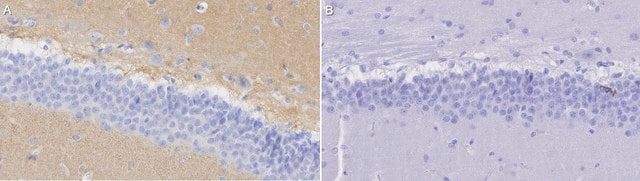
A previous lot of this antibody was tested on IH.

Optimal working dilutions must be determined by end user.
Research Category
Neuroscience
Research Sub Category
Ion Channels & Transporters

Neuronal & Glial Markers
This Anti-Vesicular Glutamate Transporter 1 Antibody, clone 3C10.2, Cat. No. MAB5502, is validated for use in IH, WB for the detection of VGluT1.

Biochem/physiol Actions

Reacts with VGLUT1 (Vesicular Glutamate Transporter 1).

Physical form

Format: Purified
Protein A purified
Purified mouse monoclonal IgG1 in buffer containing PBS containing 0.1% sodium azide.

Preparation Note

Stable for 6 months at 2-8ºC in undiluted aliquots from date of receipt.

Analysis Note

Routinely evaluated by Western Blot on Mouse Brain lysates.

Western Blot Analysis:
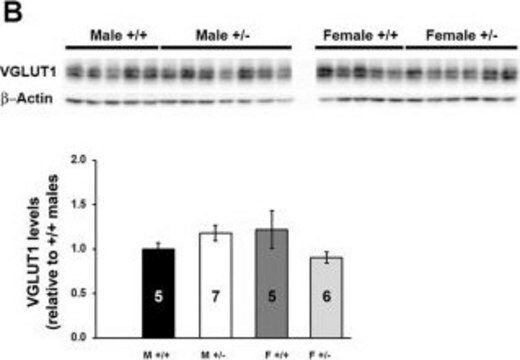
1:500 dilution of this lot detected Vesicular Glutamate Transporter 1 on 10 μg of Mouse Brain lysates.
Control
Brain

VGLUT1 Control Peptide AG208

Other Notes

Concentration: Please refer to the Certificate of Analysis for the lot-specific concentration.

Legal Information

CHEMICON is a registered trademark of Merck KGaA, Darmstadt, Germany

Disclaimer

Unless otherwise stated in our catalog or other company documentation accompanying the product(s), our products are intended for research use only and are not to be used for any other purpose, which includes but is not limited to, unauthorized commercial uses, in vitro diagnostic uses, ex vivo or in vivo therapeutic uses or any type of consumption or application to humans or animals.
Ta strona może zawierać tekst przetłumaczony maszynowo.

Porównaj podobne pozycje

Wyświetl pełne porównanie

Pokaż różnice

1 of 1

Ta pozycja
AB5905V0389MAB5504
Gene Information

rat ... Slc17A7(116638)

Gene Information

rat ... Slc17A7(116638)

Gene Information

human ... SLC17A7(57030)

Gene Information

human ... SLC17A6(57084)

clone

3C10.2, monoclonal

clone

polyclonal

clone

polyclonal

clone

8G9.2, monoclonal

biological source

mouse

biological source

guinea pig

biological source

rabbit

biological source

mouse

antibody form

purified immunoglobulin

antibody form

serum

antibody form

IgG fraction of antiserum

antibody form

purified antibody

species reactivity

mouse

species reactivity

rat

species reactivity

human

species reactivity

mouse, rat

technique(s)

immunohistochemistry: suitable, western blot: suitable

technique(s)

immunohistochemistry: suitable

technique(s)

microarray: suitable, western blot (chemiluminescent): 1:1,000 using synaptic vesicle (SV) fraction of rat brain.

technique(s)

immunohistochemistry: suitable, western blot: suitable


Still not finding the right product?

Explore all of our products under

lub

Wypróbuj nasze narzędzie Narzędzie selektora produktów, aby zawęzić opcje.


wgk

WGK 2

Klasa składowania

12 - Non Combustible Liquids

flash_point_f

Not applicable

flash_point_c

Not applicable


Certyfikaty analizy (CoA)

Poszukaj Certyfikaty analizy (CoA), wpisując numer partii/serii produktów. Numery serii i partii można znaleźć na etykiecie produktu po słowach „seria” lub „partia”.

Masz już ten produkt?

Dokumenty związane z niedawno zakupionymi produktami zostały zamieszczone w Bibliotece dokumentów.

Odwiedź Bibliotekę dokumentów


April P Neal et al.
Toxicological sciences : an official journal of the Society of Toxicology, 116(1), 249-263 (2010-04-09)
Lead (Pb(2+)) exposure is known to affect presynaptic neurotransmitter release in both in vivo and cell culture models. However, the precise mechanism by which Pb(2+) impairs neurotransmitter release remains unknown. In the current study, we show that Pb(2+) exposure during
Xiaoyang Li et al.
Stem cells and development, 25(10), 803-813 (2016-03-30)
Spiral ganglion neurons (SGNs) are usually damaged in sensorineural hearing loss. SGN-derived neural stem cells (NSCs) have been identified and proposed to differentiate into neurons to replace damaged SGNs. However, it remains obscure whether SGN-NSC-derived neurons (ScNs) are electrophysiologically functional
Olga C Jorge-Torres et al.
Cell reports, 23(6), 1665-1677 (2018-05-10)
Rett syndrome (RTT) is the second leading cause of mental impairment in girls and is currently untreatable. RTT is caused, in more than 95% of cases, by loss-of-function mutations in the methyl CpG-binding protein 2 gene (MeCP2). We propose here


Numer pozycji handlu globalnego

SKUNUMER GTIN
MAB550204053252264597

Questions

Reviews

No rating value

Active Filters