Przejdź do zawartości
Merck

Przejdź do

ABC80

Anti-phospho AMBRA1 Antibody (Ser52)

from rabbit, purified by affinity chromatography

Synonim(y):

Activating molecule in BECN1-regulated autophagy protein 1, Ambra, Ambra-1

Zaloguj się, aby wyświetlić ceny organizacyjne i kontraktowe.

Informacje o tej pozycji

UNSPSC Code:
12352203
NACRES:
NA.41
eCl@ss:
32160702
Clone:
polyclonal
Species reactivity:
human
Application:
WB, inhibition assay
Citations:
3

biological source

rabbit

Quality Level

antibody form

affinity isolated antibody

antibody product type

primary antibodies

clone

polyclonal

purified by

affinity chromatography

species reactivity

human

species reactivity (predicted by homology)

rat (based on 100% sequence homology), mouse (based on 100% sequence homology), bovine (based on 100% sequence homology)

technique(s)

inhibition assay: suitable (peptide), western blot: suitable

NCBI accession no.

Porównaj podobne pozycje

Wyświetl pełne porównanie

Pokaż różnice

1 of 1

Ta pozycja
ABC131PRS4555SAB4700853
antibody form

affinity isolated antibody

antibody form

affinity isolated antibody

antibody form

affinity isolated antibody

antibody form

purified immunoglobulin

biological source

rabbit

biological source

rabbit

biological source

rabbit

biological source

mouse

Quality Level

100

Quality Level

100

Quality Level

100

Quality Level

-

clone

polyclonal

clone

polyclonal

clone

polyclonal

clone

ABRA1-01, monoclonal

UniProt accession no.

Q9C0C7

UniProt accession no.

A2AH22

UniProt accession no.

Q9C0C7

UniProt accession no.

-

technique(s)

inhibition assay: suitable (peptide), western blot: suitable

technique(s)

western blot: suitable

technique(s)

immunofluorescence: suitable, immunohistochemistry: suitable, indirect ELISA: suitable, western blot: suitable

technique(s)

flow cytometry: 1.5 μg/mL

General description

Activating molecule in BECN1-regulated autophagy protein 1 (AMBRA1) interacts with BECN1, likely forming a complex with BECN1 and PIK3C3. AMBRA1 is involved in autophagy by controlling protein turnover during neuronal development, and in regulating differentiation, survival and proliferation of normal cells.
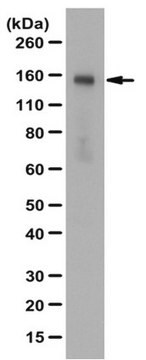
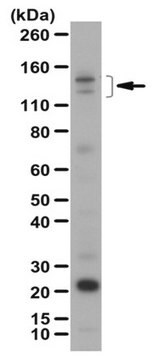
~150 kDa observed. Uniprot describes 6 isoforms from 83 kDa to 143 kDa This protein may be observed at higher molecular weights possibly due to hyperphosphorylation (Nazio, F., et al. (2013). Nat Cell Biol. [Epub ahead of print].).

Immunogen

Epitope: Phosphorylated Ser52
KLH-conjugated linear peptide corresponding to human AMBRA1 phosphorylated at Ser52.

Application

Detect Activating molecule in BECN1-regulated autophagy protein 1 using this rabbit polyclonal antibody, Anti-phospho AMBRA1 Antibody (Ser52) validated for use in western blotting & Peptide Inhibition Assay.
Research Category
Apoptosis & Cancer
Research Sub Category
Apoptosis - Additional
Western Blotting/Peptide Inhibition Analysis: 2 µg/mL from a representative lot detected phospho AMBRA1 (Ser52) in WB/PIA.

Western Blotting Analysis: A representative lot from an independent laboratory detected phospho AMBRA1 (Ser52) in HEK293 cell lysates trated without Torin1 or EBS and demonstrated a loss of signal in HEK293 cell lysates treated with Torin1 or EBS (Nazio, F., et al. (2013). Nat Cell Biol.15(4):406-416.).

Biochem/physiol Actions

This antibody recognizes AMBRA1 phosphorylated at Ser52.

Physical form

Affinity purified
Purified rabbit polyclonal in buffer containing 0.1 M Tris-Glycine (pH 7.4), 150 mM NaCl with 0.05% sodium azide.

Preparation Note

Stable for 1 year at 2-8°C from date of receipt.

Analysis Note

Control
HEK293 cell lysate
Evaluated by Western Blotting in HEK293 cell lysate.

Western Blotting Analysis: 2 µg/mL of this antibody detected phospho AMBRA1 (Ser52) in 10 µg of HEK293 cell lysate.

Other Notes

Concentration: Please refer to the Certificate of Analysis for the lot-specific concentration.

Disclaimer

Unless otherwise stated in our catalog or other company documentation accompanying the product(s), our products are intended for research use only and are not to be used for any other purpose, which includes but is not limited to, unauthorized commercial uses, in vitro diagnostic uses, ex vivo or in vivo therapeutic uses or any type of consumption or application to humans or animals.
Ta strona może zawierać tekst przetłumaczony maszynowo.

Nie możesz znaleźć właściwego produktu?  

Wypróbuj nasz Narzędzie selektora produktów.

Klasa składowania

12 - Non Combustible Liquids

wgk

WGK 1

flash_point_f

Not applicable

flash_point_c

Not applicable


Certyfikaty analizy (CoA)

Poszukaj Certyfikaty analizy (CoA), wpisując numer partii/serii produktów. Numery serii i partii można znaleźć na etykiecie produktu po słowach „seria” lub „partia”.

Masz już ten produkt?

Dokumenty związane z niedawno zakupionymi produktami zostały zamieszczone w Bibliotece dokumentów.

Odwiedź Bibliotekę dokumentów

Hui Liu et al.
Cellular and molecular biology (Noisy-le-Grand, France), 69(11), 139-245 (2023-11-28)
The research aims to explore the protective effects of ghrelin and its underlying molecular mechanisms in an H9C2 hypoxia/reoxygenation model. H9C2 cells were transfected with ghrelin overexpression lentiviral vector. The hypoxia/reoxygenation H9C2 model was constructed. The expression of ghrelin was
Saverio Marchi et al.
EMBO molecular medicine, 7(11), 1403-1417 (2015-09-30)
Cerebral cavernous malformation (CCM) is a major cerebrovascular disease affecting approximately 0.3-0.5% of the population and is characterized by enlarged and leaky capillaries that predispose to seizures, focal neurological deficits, and fatal intracerebral hemorrhages. Cerebral cavernous malformation is a genetic
Zhengwei Ma et al.
The Journal of clinical investigation, 130(9), 5011-5026 (2020-08-18)
Dysregulation of autophagy in diabetic kidney disease (DKD) has been reported, but the underlying mechanism and its pathogenic role remain elusive. We show that autophagy was inhibited in DKD models and in human diabetic kidneys. Ablation of autophagy-related gene 7

Numer pozycji handlu globalnego

SKUNUMER GTIN
ABC8004053252915987

Questions

Reviews

No rating value

Active Filters

Nasz zespół naukowców ma doświadczenie we wszystkich obszarach badań, w tym w naukach przyrodniczych, materiałoznawstwie, syntezie chemicznej, chromatografii, analityce i wielu innych dziedzinach.

Skontaktuj się z zespołem ds. pomocy technicznej