Przejdź do zawartości
Merck

Przejdź do

681665

Wnt Agonist

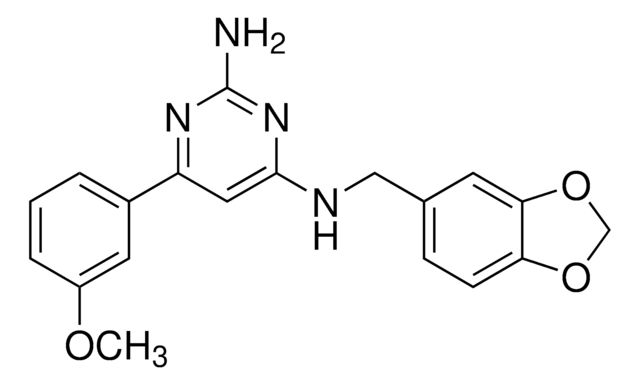
The Wnt Agonist, also referenced under CAS 853220-52-7, controls the biological activity of Wnt. This small molecule/inhibitor is primarily used for Cancer applications.

Synonim(y):

Wnt Agonist, 2-Amino-4-(3,4-(methylenedioxy)benzylamino)-6-(3-methoxyphenyl)pyrimidine, Wnt Pathway Activator I

Zaloguj się, aby wyświetlić ceny organizacyjne i kontraktowe.

Wybierz wielkość

Zmień widok
Gabaryty przesyłkiSKUDostępnośćCena netto
5 mg

Przewidywany termin wysyłki22 maja 2026zKuehne + Nagel Sp. z o.o.

1100,00 zł

Informacje o tej pozycji

Wzór empiryczny (zapis Hilla):
C19H18N4O3
Numer CAS:
Masa cząsteczkowa:
350.37
MDL number:
UNSPSC Code:
12352200
NACRES:
NA.77
Assay:
≥95% (HPLC)
Form:
solid (sticky)
Quality level:
Storage condition:
OK to freeze, protect from light

1100,00 zł


Przewidywany termin wysyłki22 maja 2026Szczegóły


Zamów zamówienie zbiorcze
Pomoc techniczna
Potrzebujesz pomocy? Nasz zespół doświadczonych naukowców chętnie Ci pomoże.
Pozwól nam pomóc


Quality Level

assay

≥95% (HPLC)

form

solid (sticky)

manufacturer/tradename

Calbiochem®

storage condition

OK to freeze, protect from light

color

yellowish

solubility

DMSO: 10 mg/mL, ethanol: 5 mg/mL

shipped in

ambient

storage temp.

2-8°C

SMILES string

N(Cc3cc4c(cc3)OCO4)c1nc(nc(c1)c2cc(ccc2)OC)N

InChI

1S/C19H18N4O3/c1-24-14-4-2-3-13(8-14)15-9-18(23-19(20)22-15)21-10-12-5-6-16-17(7-12)26-11-25-16/h2-9H,10-11H2,1H3,(H3,20,21,22,23)

InChI key

FABQUVYDAXWUQP-UHFFFAOYSA-N

General description

A cell-permeable, potent, and selective activator of Wnt signaling that does not inhibit the activity of GSK-3β (IC50 >60 µM). Shown to mimic the effect of Wnt and induce β-catenin and TCF (T-cell fate)-dependent transcriptional activity (EC50 = 700 nM in HEK-293T cells). Reported to cause substantial head defects during Xenopus embryonic development.

Biochem/physiol Actions

Cell permeable: yes
EC50 = 700 nM inducing β-catenin and TCF (T-cell fate)-dependent transcriptional activity in HEK-293T cells
Primary Target
Selective activator of Wnt signaling
Product does not compete with ATP.
Reversible: no

Packaging

Packaged under inert gas

Preparation Note

Following reconstitution, aliquot and freeze (-20°C). Stock solutions are stable for up to 6 months at -20°C.

Other Notes

Liu, J., et al. 2005. Angew. Chem. Int. Ed.44, 1987.

Legal Information

CALBIOCHEM is a registered trademark of Merck KGaA, Darmstadt, Germany

Disclaimer

Toxicity: Standard Handling (A)
Ta strona może zawierać tekst przetłumaczony maszynowo.

Porównaj podobne pozycje

Wyświetl pełne porównanie

Pokaż różnice

1 of 1

Ta pozycja
681664681674681669
form

solid (sticky)

form

liquid

form

solid

form

solid

assay

≥95% (HPLC)

assay

≥95% (HPLC)

assay

≥95% (1H-NMR)

assay

≥95% (HPLC)

manufacturer/tradename

Calbiochem®

manufacturer/tradename

Calbiochem®

manufacturer/tradename

Calbiochem®

manufacturer/tradename

Calbiochem®

Quality Level

100

Quality Level

100

Quality Level

100

Quality Level

100

storage temp.

2-8°C

storage temp.

−70°C

storage temp.

2-8°C

storage temp.

2-8°C

solubility

DMSO: 10 mg/mL, ethanol: 5 mg/mL

solubility

-

solubility

DMSO: 50 mg/mL

solubility

DMSO: 10 mg/mL


Klasa składowania

11 - Combustible Solids

wgk

WGK 3

flash_point_f

Not applicable

flash_point_c

Not applicable


Certyfikaty analizy (CoA)

Poszukaj Certyfikaty analizy (CoA), wpisując numer partii/serii produktów. Numery serii i partii można znaleźć na etykiecie produktu po słowach „seria” lub „partia”.

Masz już ten produkt?

Dokumenty związane z niedawno zakupionymi produktami zostały zamieszczone w Bibliotece dokumentów.

Odwiedź Bibliotekę dokumentów


Chiharu Kimura-Yoshida et al.
Communications biology, 5(1), 378-378 (2022-04-21)
Previously, we have shown that the translocation of Grainyhead-like 3 (GRHL3) transcription factor from the nucleus to the cytoplasm triggers the switch from canonical Wnt signaling for epidermal differentiation to non-canonical Wnt signaling for epithelial morphogenesis. However, the molecular mechanism
Camille Cohen et al.
Nature communications, 15(1), 743-743 (2024-01-26)
Chronic kidney disease (CKD) is a public health problem driven by myofibroblast accumulation, leading to interstitial fibrosis. Heterogeneity is a recently recognized characteristic in kidney fibroblasts in CKD, but the role of different populations is still unclear. Here, we characterize


Numer pozycji handlu globalnego

SKUNUMER GTIN
681665-5MG04055977260236

Questions

Reviews

No rating value

Active Filters