Przejdź do zawartości
Merck

Przejdź do

T4280

Anti-Rat IgG (whole molecule)−TRITC antibody produced in rabbit

affinity isolated antibody, buffered aqueous solution

Zaloguj się, aby wyświetlić ceny organizacyjne i kontraktowe.

Informacje o tej pozycji

UNSPSC Code:
12352203
NACRES:
NA.46
MDL number:
Conjugate:
TRITC conjugate
Clone:
polyclonal
Application:
IF (d), IHC (p)
Citations:
16


biological source

rabbit

conjugate

TRITC conjugate

antibody form

affinity isolated antibody

antibody product type

secondary antibodies

clone

polyclonal

form

buffered aqueous solution

storage condition

protect from light

technique(s)

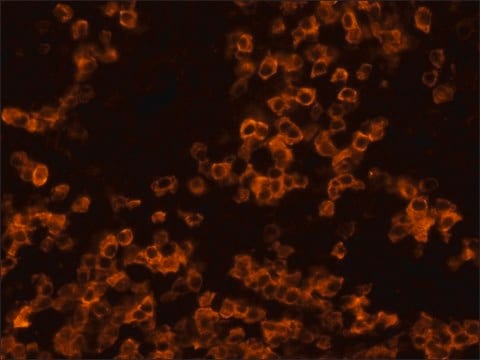
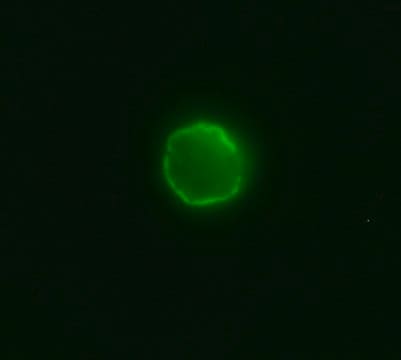
direct immunofluorescence: 1:100 using human peripheral blood, immunohistochemistry (formalin-fixed, paraffin-embedded sections): 1:100 using human tonsils

storage temp.

−20°C

target post-translational modification

unmodified

General description

Binds all rat Igs
IgG is present in large quantities in the human serum. IgG is composed of glycoproteins, out of which it is 82-96% proteins and 4-18% carbohydrates. It consists of four sub-classes i.e IgG1, IgG2, IgG3, and IgG4. IgG is composed of four polypeptide chains-two heavy chains (γ chains) and two light chains (κ or λ chains) which are linked by inter-chain disulfide bonds. The heavy chains consist of a N-terminal variable domain (VH) and three constant domains (CH1, CH2, CH3). A hinge region exists between the CH1 and CH2 region. The light chains have one N-terminal variable domain (VL) and one constant domain (CL). The heavy and the light chains are linked at VH and CH1 domain to form the Fab arm (Fragment antigen binding). The antigen binds to the V regions of the antibody.

Application

Anti-Rat IgG (whole molecule)-TRITC antibody has been used in
  • confocal microscopy
  • immunohistochemistry
  • immunofluorescence

Biochem/physiol Actions

IgG antibody subtype is the most abundant of serum immunoglobulins of the immune system. It is secreted by B cells and is found in blood and extracellular fluids and provides protection from infections caused by bacteria, fungi and viruses. Maternal IgG is transferred to fetus through the placenta that is vital for immune defense of the neonate against infections.
IgG, a monoclonal antibody can be cleaved at the hinge region by nonspecific proteases like papain and pepsin. This can result in univalent Fab (Fragment antigen binding) fragments or bivalent F(ab′)2 fragments. These two enzymes have a broad substrate specificity resulting in heterogenous fragments.

Physical form

Solution in 0.01 M phosphate buffered saline, pH 7.4, containing 15 mM sodium azide.

Preparation Note

Adsorbed to reduce background staining with human samples.

Other Notes

Antibody adsorbed with human IgG.

Disclaimer

Unless otherwise stated in our catalog or other company documentation accompanying the product(s), our products are intended for research use only and are not to be used for any other purpose, which includes but is not limited to, unauthorized commercial uses, in vitro diagnostic uses, ex vivo or in vivo therapeutic uses or any type of consumption or application to humans or animals.
Ta strona może zawierać tekst przetłumaczony maszynowo.

Porównaj podobne pozycje

Wyświetl pełne porównanie

Pokaż różnice

1 of 1

Ta pozycja
A5545F4262T2402
antibody form

affinity isolated antibody

antibody form

affinity isolated antibody

antibody form

IgG fraction of antiserum

antibody form

IgG fraction of antiserum

biological source

rabbit

biological source

rabbit

biological source

goat

biological source

rabbit

conjugate

TRITC conjugate

conjugate

peroxidase conjugate

conjugate

FITC conjugate

conjugate

TRITC conjugate

technique(s)

direct immunofluorescence: 1:100 using human peripheral blood, immunohistochemistry (formalin-fixed, paraffin-embedded sections): 1:100 using human tonsils

technique(s)

direct ELISA: 1:50,000-1:80,000, dot blot: 1:50,000-1:100,000 (chemiluminescent), immunohistochemistry (formalin-fixed, paraffin-embedded sections): 1:400-1:800

technique(s)

direct immunofluorescence: 1:32

technique(s)

direct immunofluorescence: 1:64, immunohistochemistry (formalin-fixed, paraffin-embedded sections): 1:200

form

buffered aqueous solution

form

buffered aqueous solution

form

buffered aqueous solution

form

buffered aqueous solution

clone

polyclonal

clone

polyclonal

clone

polyclonal

clone

polyclonal


Still not finding the right product?

lub

Wypróbuj nasze narzędzie Narzędzie selektora produktów, aby zawęzić opcje.


Klasa składowania

10 - Combustible liquids

wgk

WGK 3

flash_point_f

Not applicable

flash_point_c

Not applicable

ppe

Eyeshields, Gloves, multi-purpose combination respirator cartridge (US)


Wybierz jedną z najnowszych wersji:

Certyfikaty analizy (CoA)

Lot/Batch Number

It looks like we've run into a problem, but you can still download Certificates of Analysis from our Dokumenty section.

Proszę o kontakt, jeśli potrzebna jest pomoc Obsługa Klienta

Masz już ten produkt?

Dokumenty związane z niedawno zakupionymi produktami zostały zamieszczone w Bibliotece dokumentów.

Odwiedź Bibliotekę dokumentów


Questions

Reviews

No rating value

Active Filters