
Przejdź do
SML0146

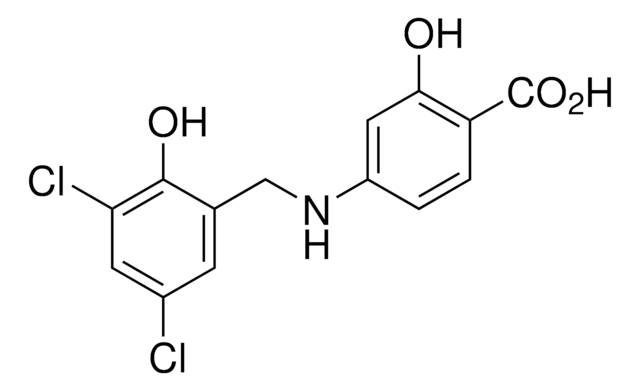
ZL006
≥98% (HPLC)
Synonim(y):
4-((3,5-Dichloro-2-hydroxybenzyl)amino)-2-hydroxybenzoic acid
Zaloguj się, aby wyświetlić ceny organizacyjne i kontraktowe.
Informacje o tej pozycji
Wzór empiryczny (zapis Hilla):
C14H11Cl2NO4
Numer CAS:
Masa cząsteczkowa:
328.15
NACRES:
NA.25
PubChem Substance ID:
UNSPSC Code:
12352200
MDL number:
Quality Level
assay
≥98% (HPLC)
form
powder
color
white to tan
solubility
DMSO: ≥5 mg/mL (warmed to 60° C)
storage temp.
2-8°C
SMILES string
OC1=C(Cl)C=C(Cl)C=C1CNC(C=C2)=CC(O)=C2C(O)=O
InChI
1S/C14H11Cl2NO4/c15-8-3-7(13(19)11(16)4-8)6-17-9-1-2-10(14(20)21)12(18)5-9/h1-5,17-19H,6H2,(H,20,21)
InChI key
RTEYSQSXRFVKTJ-UHFFFAOYSA-N
Biochem/physiol Actions
Inhibitor of nNOS-PSD-95 interaction
ZL006 inhibits the ischemia-induced interaction of nNOS with postsynaptic density protein-95 (PSD-95), preventing glutamate-induced excitotoxicity and cerebral ischemic damage. It does not inhibit nNOS itself. ZL006 is brain penetrant, and has been tested in both rat and mouse models of stroke.
ZL006, a novel neuroprotectant, is also called as 5-(3, 5-dichloro-2-hydroxybenzylamino)-2-hydroxybenzoic acid.[1] It has the ability to block the interaction of neuronal nitric oxide synthase (nNOS)/postsynaptic density protein-95 (PSD-95) in co-immunoprecipitation assays of extracts from glutamate or cultured neurons and cortical brain, stimulated by ischemia.[1]
Ta strona może zawierać tekst przetłumaczony maszynowo.
1 of 1
Ta pozycja | |||
|---|---|---|---|
| form powder | form powder | form powder | form powder |
| assay ≥98% (HPLC) | assay ≥98% (HPLC) | assay ≥98% (HPLC) | assay ≥98% (HPLC) |
| Quality Level 100 | Quality Level 100 | Quality Level 100 | Quality Level 100 |
| storage temp. 2-8°C | storage temp. 2-8°C | storage temp. 2-8°C | storage temp. 2-8°C |
| solubility DMSO: ≥5 mg/mL (warmed to 60° C) | solubility DMSO: 2 mg/mL, clear | solubility DMSO: 2 mg/mL, clear | solubility DMSO: 2 mg/mL, clear |
| color white to tan | color white to beige | color white to beige | color white to beige |

Klasa składowania
11 - Combustible Solids
wgk
WGK 3
Wybierz jedną z najnowszych wersji:
Masz już ten produkt?
Dokumenty związane z niedawno zakupionymi produktami zostały zamieszczone w Bibliotece dokumentów.
Wenrui Qu et al.
Cerebral cortex (New York, N.Y. : 1991), 30(7), 3859-3871 (2020-01-29)
Excessive activation of N-methyl-D-aspartate receptors (NMDARs) and the resulting neuronal nitric oxide synthase (nNOS) activation plays a crucial role in the pathogenesis of traumatic brain injury (TBI). However, directly inhibiting NMDARs or nNOS produces adverse side effects because they play
Sandra Tillmann et al.
PloS one, 12(8), e0182698-e0182698 (2017-08-05)
N-methyl-D-aspartate receptor (NMDA-R) antagonists and nitric oxide inhibitors have shown promising efficacy in depression but commonly induce adverse events. To circumvent these, a more indirect disruption of the nitric oxide synthase/postsynaptic density protein 95 kDa complex at the NMDA-R has
Satoshi Deyama et al.
Neuropharmacology, 118, 59-68 (2017-03-13)
Pain consists of sensory and affective components. Although the neuronal mechanisms underlying the sensory component of pain have been studied extensively, those underlying its affective component are only beginning to be elucidated. Previously, we showed the pivotal role of the
Numer pozycji handlu globalnego
| SKU | NUMER GTIN |
|---|---|
| SML0146-25MG | 04061833221914 |
| SML0146-5MG | 04061833221921 |