Przejdź do zawartości
Merck

Przejdź do

S7822

Anti-SMC6 antibody produced in rabbit

IgG fraction of antiserum, buffered aqueous solution

Synonim(y):

Anti-SMC6L1, Anti-Structural maintenance of chromosome 6, Anti-Structural maintenance of chromosomes 6-like 1

Zaloguj się, aby wyświetlić ceny organizacyjne i kontraktowe.

Wybierz wielkość

Zmień widok
Gabaryty przesyłkiSKUDostępnośćCena netto
200 μL
Skontaktuj się z Obsługą Klienta, aby uzyskać informacje na temat dostępności
2310,00 zł
1963,50 zł

Informacje o tej pozycji

NACRES:
NA.41
UNSPSC Code:
12352203
Conjugate:
unconjugated
Clone:
polyclonal
Application:
WB
Citations:
11

1963,50 zł

Cena katalogowa2310,00 złZaoszczędź 15%

Skontaktuj się z Obsługą Klienta, aby uzyskać informacje na temat dostępności

Zamów zamówienie zbiorcze
Pomoc techniczna
Potrzebujesz pomocy? Nasz zespół doświadczonych naukowców chętnie Ci pomoże.
Pozwól nam pomóc


biological source

rabbit

Quality Level

conjugate

unconjugated

antibody form

IgG fraction of antiserum

antibody product type

primary antibodies

clone

polyclonal

form

buffered aqueous solution

mol wt

antigen 126 kDa

species reactivity

human, rat (predicted), mouse (predicted)

technique(s)

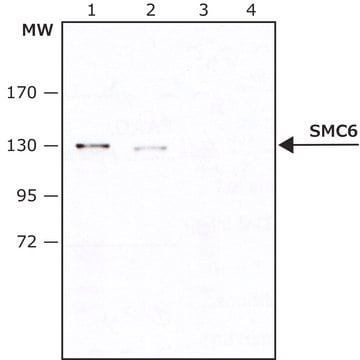
western blot: 1:250-1:500 using whole cell extract of HEK293-T expressing SMC6

UniProt accession no.

shipped in

dry ice

storage temp.

−20°C

target post-translational modification

unmodified

Gene Information

human ... SMC6(79677)
mouse ... Smc6(67241)
rat ... Smc6l1(313961)

General description

Structural maintenance of chromosomes protein 6 (SCM6) belongs to the structural maintenance of chromosomes family. There are at least six SMC family members that form three heterodimers in specific combinations. SCM6 gene is mapped to human chromosome 2p24.2. Structurally, SCM6 has DNA-binding domains at the N and C termini, a long coiled-coil domain, and a hinge region.

Immunogen

synthetic peptide corresponding to amino acids 766-779 of human SMC6, conjugated to KLH via an N-terminal cysteine residue. This sequence differs by one amino acid in mouse, and by two amino acids in rat.

Application

Anti-SMC6 antibody produced in rabbit may be used in immunoblotting.

Biochem/physiol Actions

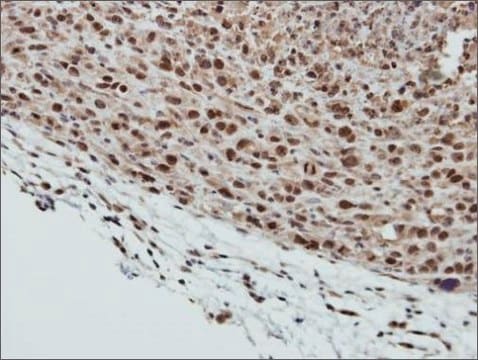
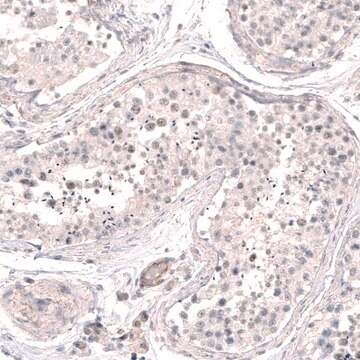
Anti-SMC6 (also known as SMC6L1) specifically recognizes SMC6.
Structural maintenance of chromosomes protein 6 (SCM6) along with SMC5 is mainly involved in the cellular response to DNA damage in yeast as well as humans. The yeast SMC5/6 complex contains several non-SMC elements (NSE), including methyl methanesulfonate-sensitivity protein 21 (MMS21) which sumoylates components of the complex. The SMC5/6 complex is recruited to nuclease-induced double strand breaks(DSBs). This event is crucial for human SMC1/3 cohesion complex recruitment to DSBs. SCM6 is known to interact with the papillomavirus E2 protein. Mitotic aberration and abnormal distribution of topoisomerase IIα are associated with depleted levels of Smc5 and Smc6.

Physical form

Solution in 0.01 M phos­phate buffered saline, pH 7.4, containing 15 mM sodium azide.

Preparation Note

For continuous use, store at 2-8 °C for up to one month. For extended storage, freeze in working aliquots. Repeated freezing and thawing, or storage in “frost-free” freezers, is not recommended. If slight turbidity occurs upon prolonged storage, clarify the solution by centrifugation before use. Working dilutions should be discarded if not used within 12 hours.

Disclaimer

Unless otherwise stated in our catalog or other company documentation accompanying the product(s), our products are intended for research use only and are not to be used for any other purpose, which includes but is not limited to, unauthorized commercial uses, in vitro diagnostic uses, ex vivo or in vivo therapeutic uses or any type of consumption or application to humans or animals.
Ta strona może zawierać tekst przetłumaczony maszynowo.

Porównaj podobne pozycje

Wyświetl pełne porównanie

Pokaż różnice

1 of 1

Ta pozycja
SAB2701298HPA042733HPA042823
biological source

rabbit

biological source

rabbit

biological source

rabbit

biological source

rabbit

antibody form

IgG fraction of antiserum

antibody form

affinity isolated antibody

antibody form

affinity isolated antibody

antibody form

affinity isolated antibody

Quality Level

200

Quality Level

100

Quality Level

100

Quality Level

100

conjugate

unconjugated

conjugate

unconjugated

conjugate

unconjugated

conjugate

unconjugated

shipped in

dry ice

shipped in

wet ice

shipped in

wet ice

shipped in

wet ice

clone

polyclonal

clone

polyclonal

clone

polyclonal

clone

polyclonal


Still not finding the right product?

Explore all of our products under

lub

Wypróbuj nasze narzędzie Narzędzie selektora produktów, aby zawęzić opcje.


Klasa składowania

10 - Combustible liquids

wgk

nwg

flash_point_f

Not applicable

flash_point_c

Not applicable

ppe

Eyeshields, Gloves, multi-purpose combination respirator cartridge (US)


Wybierz jedną z najnowszych wersji:

Certyfikaty analizy (CoA)

Lot/Batch Number

Nie widzisz odpowiedniej wersji?

Jeśli potrzebujesz konkretnej wersji, możesz wyszukać konkretny certyfikat według numeru partii lub serii.

Masz już ten produkt?

Dokumenty związane z niedawno zakupionymi produktami zostały zamieszczone w Bibliotece dokumentów.

Odwiedź Bibliotekę dokumentów


Powiązane treści

Instructions


Ming Yu et al.
Epigenetics, 10(9), 803-809 (2015-07-18)
Aberrant DNA methylation is a common epigenetic alteration found in colorectal adenomas and cancers and plays a role in cancer initiation and progression. Aberrantly methylated DNA loci can also be found infrequently present in normal colon tissue, where they seem
Patrick Ryan Potts et al.
Nature structural & molecular biology, 14(7), 581-590 (2007-06-26)
Most cancer cells activate telomerase to elongate telomeres and achieve unlimited replicative potential. Some cancer cells cannot activate telomerase and use telomere homologous recombination (HR) to elongate telomeres, a mechanism termed alternative lengthening of telomeres (ALT). A hallmark of ALT
Dongjun Jeong et al.
Molecular medicine reports, 17(6), 8173-8179 (2018-04-26)
Loss of runt‑related transcription factor 3 (RUNX3) has been reported in various cancers, and one of the mechanisms mediating loss of RUNX3 expression is DNA methylation. However, the role of RUNX3 expression and its DNA methylation status as prognostic factors in


Numer pozycji handlu globalnego

SKUNUMER GTIN
S782208436037123313
S7822-200UL04061838033246
S7822-25UL04061838033253

Questions

Reviews

No rating value

Active Filters