
Przejdź do
S6147

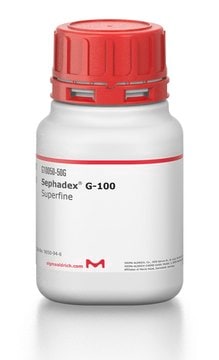
Sephadex® G-100
DNA grade, BioReagent, Molecular Biology, medium
Zaloguj się, aby wyświetlić ceny organizacyjne i kontraktowe.
Wybierz wielkość
Zmień widok
| Gabaryty przesyłki | SKU | Dostępność | Cena netto |
|---|---|---|---|
| 25 g | Skontaktuj się z Obsługą Klienta, aby uzyskać informacje na temat dostępności | 1470,00 zł | |
| 100 g | Skontaktuj się z Obsługą Klienta, aby uzyskać informacje na temat dostępności | 4550,00 zł 3867,50 zł |
Informacje o tej pozycji
1470,00 zł
Skontaktuj się z Obsługą Klienta, aby uzyskać informacje na temat dostępności
Pomoc techniczna
Potrzebujesz pomocy? Nasz zespół doświadczonych naukowców chętnie Ci pomoże.
Pozwól nam pomócgrade
Molecular Biology
Quality Level
product line
BioReagent
form
beads
technique(s)
buffer exchange: suitable
matrix active group
phase
swelling
1 g swells to 9-11 mL
bead diameter
40-120 μm
pore size
exclusion limit (25 bp dsDNA; (rA)27)
pH
2-10
application(s)
life science and biopharma
compatibility
Cytiva
foreign activity
DNase, RNase, none detected
storage temp.
room temp
General description
Sephadex® G-100, Medium is an often-cited gel filtration medium for desalting and buffer exchange of very large molecules. Sephadex® is prepared by crosslinking dextran with epichlorohydrin. Sephadex products differ in their degree of cross-linking and hence in their degree of swelling and their molecular fractionation range. “Medium” indicates a large particle size for use in large-scale group separations where high flow rates and low operating pressures are required.
Application
Sephadex® G-100 is suitable for spin column purification of DNA (from contaminating small molecules) for use in hybridizations. It was used to purify the enzyme polyphenoloxidases isolated from banana by gel filteration.
Features and Benefits
- Excellent recovery
- Minimal sample dilution
- Quick and easy to use
Legal Information
Sephadex is a registered trademark of Cytiva
Ta strona może zawierać tekst przetłumaczony maszynowo.
1 of 1
Ta pozycja | |||
|---|---|---|---|
| compatibility Cytiva | compatibility - | compatibility Cytiva | compatibility - |
| application(s) life science and biopharma | application(s) - | application(s) life science and biopharma | application(s) - |
| technique(s) buffer exchange: suitable | technique(s) - | technique(s) affinity chromatography: suitable | technique(s) LPLC: suitable |
| matrix active group phase | matrix active group - | matrix active group phase | matrix active group polymer |
| foreign activity DNase, RNase, none detected | foreign activity - | foreign activity - | foreign activity - |
| pore size exclusion limit (25 bp dsDNA; (rA)27) | pore size - | pore size - | pore size - |



Klasa składowania
11 - Combustible Solids
wgk
WGK 3
flash_point_f
Not applicable
flash_point_c
Not applicable
ppe
Eyeshields, Gloves, type N95 (US)
Wybierz jedną z najnowszych wersji:
Masz już ten produkt?
Dokumenty związane z niedawno zakupionymi produktami zostały zamieszczone w Bibliotece dokumentów.
Powiązane treści
Isolation, purification and physicochemical characterization of polyphenoloxidases (PPO) from a dwarf variety of banana (Musa cavendishii, L)
Galeazzi MAM et al
Journal of Food Science, 46, 150-155 (1981)
Evan S Leibner et al.
Acta biomaterialia, 5(5), 1389-1398 (2009-01-13)
Analytical protocol greatly influences the measurement of human serum albumin (HSA) adsorption to commercial expanded polytetrafluororethylene (ePTFE) exhibiting superhydrophobic wetting properties. Degassing of buffer solutions and evacuation of ePTFE adsorbent to remove trapped air immediately prior to contact with protein
S Kaushik et al.
Methods in molecular biology (Clifton, N.J.), 445, 227-244 (2008-04-22)
Chaperone-mediated autophagy (CMA) is the only type of autophagy in mammalian cells able to selectively degrade cytosolic proteins in lysosomes. CMA is maximally activated in response to stressors such as prolonged starvation, exposure to toxic compounds, or oxidative stress. We
Numer pozycji handlu globalnego
| SKU | NUMER GTIN |
|---|---|
| S6147-25G | 04061833750704 |
| S6147-100G | 04061833750698 |