Przejdź do zawartości
Merck

Przejdź do

S4813

Anti-α1-Syntrophin (RA-16) antibody produced in rabbit

buffered aqueous solution, IgG fraction of antiserum

Synonim(y):

Anti-SNTA1

Zaloguj się, aby wyświetlić ceny organizacyjne i kontraktowe.

Wybierz wielkość

Zmień widok
Gabaryty przesyłkiSKUDostępnośćCena netto
0.2 mL
Skontaktuj się z Obsługą Klienta, aby uzyskać informacje na temat dostępności
2390,00 zł
2031,50 zł

Informacje o tej pozycji

UNSPSC Code:
12352203
NACRES:
NA.41
MDL number:
Conjugate:
unconjugated
Clone:
polyclonal
Application:
ARR, IHC (f), WB
Citations:
8

2031,50 zł

Cena katalogowa2390,00 złZaoszczędź 15%

Skontaktuj się z Obsługą Klienta, aby uzyskać informacje na temat dostępności

Zamów zamówienie zbiorcze
Pomoc techniczna
Potrzebujesz pomocy? Nasz zespół doświadczonych naukowców chętnie Ci pomoże.
Pozwól nam pomóc


biological source

rabbit

Quality Level

conjugate

unconjugated

antibody form

IgG fraction of antiserum

antibody product type

primary antibodies

clone

polyclonal

form

buffered aqueous solution

mol wt

antigen 60 kDa

species reactivity

rat

technique(s)

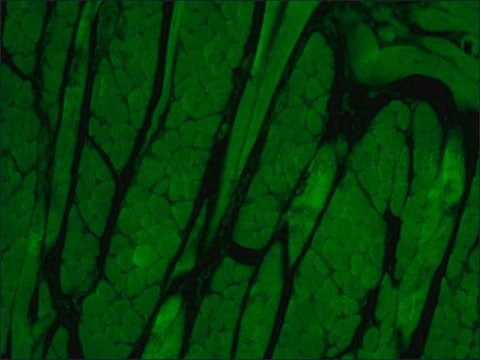
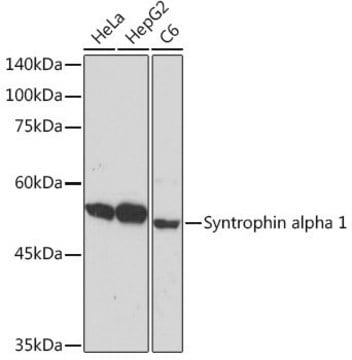
immunohistochemistry (frozen sections): suitable using 0.5% paraformaldehyde fixed/0.5% Triton X-100 treated rat skeletal muscle, microarray: suitable, western blot: 1:2,000 using rat skeletal muscle homogenate extract (membrane fraction)

shipped in

dry ice

storage temp.

−20°C

target post-translational modification

unmodified

Gene Information

mouse ... Snta1(20648)
rat ... Snta1(362242)

General description

α1-syntrophin (SNTA1) is a dystrophin-associated protein, that has four domains- a postsynaptic density protein-95/disc large/zona occludens-1 (PDZ) domain, two pleckstrin homology (PH1 and PH2) domains and a syntrophin unique (SU) domain. It is located on human chromosome 20q11.2. It is usually present in the peripheral cytoplasmic membrane.
Anti-α1-Syntrophin (RA-16) is developed in rabbit using a synthetic peptide corresponding to a sequence of mouse α1-syntrophin The syntrophins are a family of intracellular peripheral membrane proteins (58-60 kDa), comprising at least three isoforms α1, β1, and β2-syntrophins. Syntrophins in mammalian skeletal muscle have been shown to be part of a complex of proteins associated with dystrophin, the product of Duchenne/Becker muscular dystrophy gene. The C-terminal 57 amino acids region of syntrophins is highly conserved among the three isoforms, and may contain the binding site for dystrophin.

Immunogen

synthetic peptide corresponding to a sequence of mouse α1-syntrophin (amino acids 191-206 with N-terminally added lysine) conjugated to KLH.

Application

Anti-α1-Syntrophin (RA-16) antibody produced in rabbit has been used in immunohistochemistry and immunoblotting.

Biochem/physiol Actions

α1-Syntrophin recruit signaling proteins(2) to the membrane via association with the dystrophin complex.
α1-syntrophin (SNTA1) mutations results in LQTS (cardiac channelopathies like long QT syndrome). It modulates the development of adipocyte lipid droplet. It also participates in the survival signaling pathway in myoblasts. α1-syntrophin controls voltage-gated Na+ channels. It acts as a substrate for stress-activated protein kinase-3 (SAPK-3).

Physical form

Solution in 0.01 M phosphate buffered saline, pH 7.4, containing 15 mM sodium azide.

Disclaimer

Unless otherwise stated in our catalog or other company documentation accompanying the product(s), our products are intended for research use only and are not to be used for any other purpose, which includes but is not limited to, unauthorized commercial uses, in vitro diagnostic uses, ex vivo or in vivo therapeutic uses or any type of consumption or application to humans or animals.
Ta strona może zawierać tekst przetłumaczony maszynowo.

Porównaj podobne pozycje

Wyświetl pełne porównanie

Pokaż różnice

1 of 1

Ta pozycja
S3062D8168SAB5701356
conjugate

unconjugated

conjugate

unconjugated

conjugate

unconjugated

conjugate

unconjugated

Quality Level

200

Quality Level

200

Quality Level

200

Quality Level

100

biological source

rabbit

biological source

rabbit

biological source

mouse

biological source

rabbit

antibody form

IgG fraction of antiserum

antibody form

IgG fraction of antiserum

antibody form

ascites fluid

antibody form

-

shipped in

dry ice

shipped in

-

shipped in

dry ice

shipped in

wet ice

technique(s)

immunohistochemistry (frozen sections): suitable using 0.5% paraformaldehyde fixed/0.5% Triton X-100 treated rat skeletal muscle, western blot: 1:2,000 using rat skeletal muscle homogenate extract (membrane fraction), microarray: suitable

technique(s)

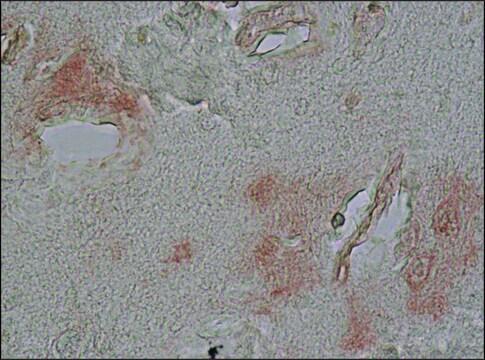
immunohistochemistry (formalin-fixed, paraffin-embedded sections): 1:200 using formic acid treated sections of Alzheimer′s Disease brain, microarray: suitable, western blot: 1:1,000 using extract of rat brain homogenate

technique(s)

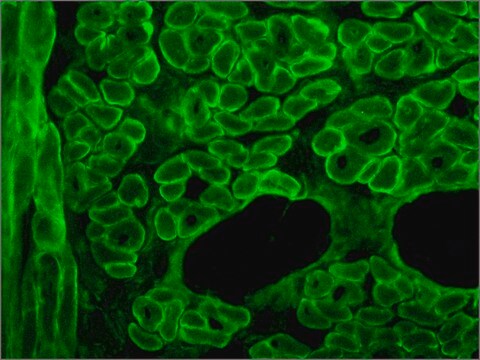
indirect ELISA: suitable, indirect immunofluorescence: 1:400 using frozen human or animal muscle tissue sections., microarray: suitable, western blot: suitable

technique(s)

immunohistochemistry: 1:50-1:200, western blot: 1:500-1:2000


Still not finding the right product?

Wypróbuj nasze narzędzie Narzędzie selektora produktów, aby zawęzić opcje.


Klasa składowania

10 - Combustible liquids

wgk

WGK 3

flash_point_f

Not applicable

flash_point_c

Not applicable


Wybierz jedną z najnowszych wersji:

Certyfikaty analizy (CoA)

Lot/Batch Number

Nie widzisz odpowiedniej wersji?

Jeśli potrzebujesz konkretnej wersji, możesz wyszukać konkretny certyfikat według numeru partii lub serii.

Masz już ten produkt?

Dokumenty związane z niedawno zakupionymi produktami zostały zamieszczone w Bibliotece dokumentów.

Odwiedź Bibliotekę dokumentów


Powiązane treści


?-Syntrophin is involved in the survival signaling pathway in myoblasts under menadione-induced oxidative stress
Lim JA, et al.
Experimental Cell Research, 344(1), 1-10 (2016)
The adaptor protein alpha-syntrophin regulates adipocyte lipid droplet growth
Eisinger K, et al.
Experimental Cell Research, 345(1), 100-107 (2016)
Clinical utility gene card for: long-QT syndrome (types 1-13)
Beckmann BM, et al.
European Journal of Human Genetics, 21(10) (2013)


Numer pozycji handlu globalnego

SKUNUMER GTIN
S4813-.2ML04061837724473

Questions

Reviews

No rating value

Active Filters