Przejdź do zawartości
Merck

Przejdź do

M0691

Anti-Myosin VI antibody, Mouse monoclonal

~1 mg/mL, clone MUD-19, purified from hybridoma cell culture

Zaloguj się, aby wyświetlić ceny organizacyjne i kontraktowe.

Wybierz wielkość

Zmień widok
Gabaryty przesyłkiSKUDostępnośćCena netto
100 μL
Skontaktuj się z Obsługą Klienta, aby uzyskać informacje na temat dostępności
2740,00 zł
200 μL
Skontaktuj się z Obsługą Klienta, aby uzyskać informacje na temat dostępności
2890,00 zł

Informacje o tej pozycji

UNSPSC Code:
12352203
NACRES:
NA.41
MDL number:
Conjugate:
unconjugated
Clone:
MUD-19, monoclonal
Application:
ARR, ELISA (i), IHC, IP, WB
Citations:
16

2740,00 zł


Skontaktuj się z Obsługą Klienta, aby uzyskać informacje na temat dostępności

Zamów zamówienie zbiorcze
Pomoc techniczna
Potrzebujesz pomocy? Nasz zespół doświadczonych naukowców chętnie Ci pomoże.
Pozwól nam pomóc


biological source

mouse

Quality Level

conjugate

unconjugated

antibody form

purified from hybridoma cell culture

antibody product type

primary antibodies

clone

MUD-19, monoclonal

form

buffered aqueous solution

mol wt

antigen ~150 kDa by SDS-PAGE

species reactivity

human, mouse, rat

concentration

~1 mg/mL

technique(s)

immunohistochemistry: suitable, immunoprecipitation (IP): suitable, indirect ELISA: suitable, microarray: suitable, western blot: 2 μg/mL using A431 total cell extract

isotype

IgG1

UniProt accession no.

shipped in

dry ice

storage temp.

−20°C

target post-translational modification

unmodified

Gene Information

human ... MYO6(4646)
mouse ... Myo6(17920)
rat ... Myo6(315840)

General description

Monoclonal Anti-Myosin VI (mouse IgG1 isotype) is derived from the MUD-19 hybridoma produced by the fusion of mouse myeloma cells and splenocytes from mice immunized with a synthetic peptide corresponding to amino acids of human myosin VI. Myosin VI is a relatively abundant widespread unconventional myosin composed of an N-terminal motor domain, a light chain binding neck region, a coil-coiled region and a highly conserved C-terminal domain.
Myosins are actin-dependent motors that have 15 classes based on their phylogenetics . Myosin VI is an unconventional actin motor that moves towards the minus ends of actin filaments, which is opposite to the movement of conventional myosins.

Application

Monoclonal Anti-Myosin VI antibody produced in mouse has been used in:
  • enzyme-linked immunosorbent assay (ELISA)
  • immunoprecipitation
  • western blot assay
  • immunohistochemistry

Biochem/physiol Actions

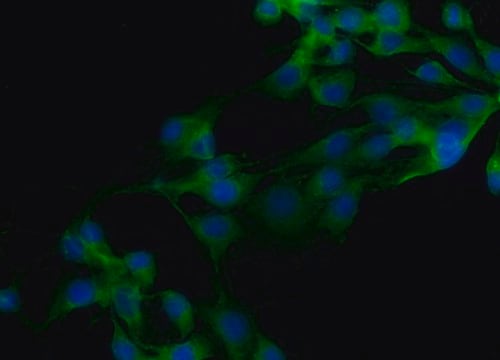
Monoclonal Anti-Myosin VI antibody is specific for myosin VI in rats, humans and mice.
Myosin VI is involved in the generation of cell shape change, cell motility, membrane remodeling and possibly in organelle and particle transport or tethering. It is also involved in membrane trafficking pathways in cultured mammalian cells where it is associated with the membrane ruffles and the trans-Golgi network. Myosin VI plays an essential role in the development of the mouse inner ear where it is expressed in the hair cell body, in the actin-rich cuticular plate at the base of the stereocilia and in the peri cuticular necklace region. Myosin VI gene mutations are involved in deafness and balance defects in the Snell′s Waltzer mouse. Myosin VI is present in the Golgi complex and may regulate vesicular transport across the membranes.

Physical form

Supplied as a solution in 0.01 M phosphate buffered saline, pH 7.4, containing 1% bovine serum albumin and 15 mM sodium azide.

Disclaimer

Unless otherwise stated in our catalog or other company documentation accompanying the product(s), our products are intended for research use only and are not to be used for any other purpose, which includes but is not limited to, unauthorized commercial uses, in vitro diagnostic uses, ex vivo or in vivo therapeutic uses or any type of consumption or application to humans or animals.
Ta strona może zawierać tekst przetłumaczony maszynowo.

Porównaj podobne pozycje

Wyświetl pełne porównanie

Pokaż różnice

1 of 1

Ta pozycja
M7443A1106M5187
Gene Information

human ... MYO6(4646)
mouse ... Myo6(17920)
rat ... Myo6(315840)

Gene Information

human ... MECP2(4204)
mouse ... Mecp2(17257)
rat ... Mecp2(29386)

Gene Information

human ... ATM(472)
mouse ... Atm(11920)

Gene Information

human ... MYO6(4646)

species reactivity

human, mouse, rat

species reactivity

mouse, human, rat, monkey

species reactivity

human, mouse

species reactivity

rat, canine

antibody form

purified from hybridoma cell culture

antibody form

purified from hybridoma cell culture

antibody form

purified from hybridoma cell culture

antibody form

affinity isolated antibody

conjugate

unconjugated

conjugate

unconjugated

conjugate

unconjugated

conjugate

unconjugated

biological source

mouse

biological source

mouse

biological source

mouse

biological source

rabbit

clone

MUD-19, monoclonal

clone

Men-8, monoclonal

clone

MAT3-4G10/8, monoclonal

clone

polyclonal


Still not finding the right product?

Wypróbuj nasze narzędzie Narzędzie selektora produktów, aby zawęzić opcje.


Klasa składowania

10 - Combustible liquids

wgk

WGK 3

flash_point_f

Not applicable

flash_point_c

Not applicable


Wybierz jedną z najnowszych wersji:

Certyfikaty analizy (CoA)

Lot/Batch Number

Nie widzisz odpowiedniej wersji?

Jeśli potrzebujesz konkretnej wersji, możesz wyszukać konkretny certyfikat według numeru partii lub serii.

Masz już ten produkt?

Dokumenty związane z niedawno zakupionymi produktami zostały zamieszczone w Bibliotece dokumentów.

Odwiedź Bibliotekę dokumentów


Powiązane treści


Rong Xu et al.
The Korean journal of physiology & pharmacology : official journal of the Korean Physiological Society and the Korean Society of Pharmacology, 20(2), 139-145 (2016-03-05)
Previously characterized as a backward motor, myosin VI (MYO6), which belongs to myosin family, moves toward the minus end of the actin track, a direction opposite to all other known myosin members. Recent researches have illuminated the role of MYO6
Francesca Demichelis et al.
Genes, chromosomes & cancer, 48(4), 366-380 (2009-01-22)
Emerging molecular and clinical data suggest that ETS fusion prostate cancer represents a distinct molecular subclass, driven most commonly by a hormonally regulated promoter and characterized by an aggressive natural history. The study of the genomic landscape of prostate cancer
Unconventional Myosins in Inner-Ear Sensory Epithelia
Hasson T, et al.
The Journal of Cell Biology, 137(6), 1287-1287 (1997)


Numer pozycji handlu globalnego

SKUNUMER GTIN
M0691-100UL04061837720611
M0691-200UL04061837720628

Questions

Reviews

No rating value

Active Filters