Przejdź do zawartości
Merck

Przejdź do

H3524

Monoclonal Anti-Heat Shock Protein 60 antibody produced in mouse

clone LK2, ascites fluid

Synonim(y):

Anti-CPN60, Anti-GROEL, Anti-HLD4, Anti-HSP-60, Anti-HSP60, Anti-HSP65, Anti-HuCHA60, Anti-SPG13

Zaloguj się, aby wyświetlić ceny organizacyjne i kontraktowe.

Wybierz wielkość

Zmień widok
Do Państwa/SKUDostępnośćCena netto
0.2 mL
Skontaktuj się z Obsługą Klienta, aby uzyskać informacje na temat dostępności
2380,00 zł

Informacje o tej pozycji

UNSPSC Code:
12352203
NACRES:
NA.41
MDL number:
Conjugate:
unconjugated
Clone:
LK2, monoclonal
Application:
ELISA (i), EM, IHC (p), WB
Citations:
25

2380,00 zł


Skontaktuj się z Obsługą Klienta, aby uzyskać informacje na temat dostępności
Rekombinowane, niezawierające konserwantów przeciwciało jest dostępne dla Twojego celu. Wypróbuj ZRB1145

Pomoc techniczna
Potrzebujesz pomocy? Nasz zespół doświadczonych naukowców chętnie Ci pomoże.
Pozwól nam pomóc


biological source

mouse

Quality Segment

conjugate

unconjugated

antibody form

ascites fluid

antibody product type

primary antibodies

clone

LK2, monoclonal

mol wt

antigen 60 kDa

contains

15 mM sodium azide

species reactivity

spinach, chicken, E. coli, helminth, rat, human

technique(s)

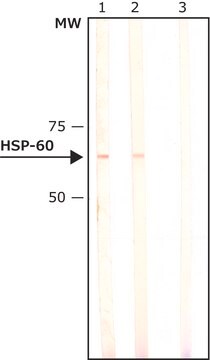
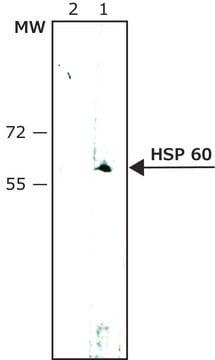
electron microscopy: suitable, immunohistochemistry (formalin-fixed, paraffin-embedded sections): suitable, indirect ELISA: suitable, western blot: 1:100 using cultured human foreskin fibroblast extract

isotype

IgG1

UniProt accession no.

shipped in

dry ice

storage temp.

−20°C

target post-translational modification

unmodified

Gene Information

human ... HSPD1(3329)
rat ... Hspd1(63868)

General description

Monoclonal Anti-Heat Shock Protein 60 (HSP60), clone LK2, recognizes an epitope located between amino acid residues 383-419 of the human (corresponding to a.a. residues 356-393 of the mycobacterial) HSP60. The antibody is reactive against the mammalian (e.g., human, rat), avian (e.g., chicken), bacterial (e.g., E. coli), helminths and spinach HSP60. In immunoblotting, the antibody may label additional bands at approx. 38 and 97 kDa. It is reactive with both the constitutive and the inducible HSP60. It shows a raised level of staining in immunohistochemistry of formalin-fixed, paraffin-embedded synovial membranes taken from patients with juvenile chronic arthritis.
Monoclonal anti-Heat Shock Protein 60 (mouse IgG1 isotype) is derived from the LK2 hybridoma produced by the fusion of mouse myeloma cells and splenocytes from BALB/c mice immunized with recombinant human heat shock protein 60.

Immunogen

recombinant human heat shock protein 60 (HSP60).

Application

Monoclonal Anti-Heat Shock Protein 60 antibody produced in mouse has been used in:western blotting, immunocytochemistry, enzyme linked immuno sorbent assay (ELISA) ,immunoblotting

Biochem/physiol Actions

A wide variety of environmental perturbations, such as a sudden increase in temperature, induce cells to rapidly synthesize a group of polypeptides known as the heat shock (stress) proteins. The 60 kDa HSP family (HSP60) which retained a uniquely high level of sequence conservation during evolution is a focus of interest as a potential antigen in a number of autoimmune diseases. Abnormal immune reactivity involving HSP60 has also been implicated in the pathogenesis of schizophrenia. In human arthritis and experimentally-induced arthritis in animals, disease development was seen to coincide with development of immune reactivity directed against not only bacterial HSP60, but also against its mammalian homologue. A human mitochondrial protein, originally designated P1, has been described as the human homologue of the bacterial HSP60, and >45% of the protein has sequence identity with its bacterial homologue (groEL, HSP65).

Disclaimer

Unless otherwise stated in our catalog or other company documentation accompanying the product(s), our products are intended for research use only and are not to be used for any other purpose, which includes but is not limited to, unauthorized commercial uses, in vitro diagnostic uses, ex vivo or in vivo therapeutic uses or any type of consumption or application to humans or animals.
Ta strona może zawierać tekst przetłumaczony maszynowo.

Porównaj podobne pozycje

Wyświetl pełne porównanie

Pokaż różnice

1 of 1

Ta pozycja
H1775H4149SAB4501464
clone

LK2, monoclonal

clone

AC-16, monoclonal

clone

LK1, monoclonal

clone

polyclonal

species reactivity

spinach, chicken, E. coli, helminth, rat, human

species reactivity

wheat germ, chicken, Sf9 cell line, rabbit, rat, human, mouse, Achlya

species reactivity

rat, human, chicken

species reactivity

human, rat, mouse

Gene Information

human ... HSPD1(3329)
rat ... Hspd1(63868)

Gene Information

human ... HSP90AA1(3320), HSP90AB1(3326)
mouse ... Hsp90aa1(15519), Hsp90ab1(15516)

Gene Information

human ... HSPD1(3329)
rat ... Hspd1(63868)

Gene Information

human ... HSPD1(3329)

biological source

mouse

biological source

mouse

biological source

mouse

biological source

rabbit

conjugate

unconjugated

conjugate

unconjugated

conjugate

unconjugated

conjugate

unconjugated

antibody form

ascites fluid

antibody form

ascites fluid

antibody form

ascites fluid

antibody form

affinity isolated antibody


Still not finding the right product?

lub

Wypróbuj nasze narzędzie Narzędzie selektora produktów, aby zawęzić opcje.


Klasa składowania

10 - Combustible liquids

wgk

nwg

flash_point_f

Not applicable

flash_point_c

Not applicable


Wybierz jedną z najnowszych wersji:

Certyfikaty analizy (CoA)

Lot/Batch Number

It looks like we've run into a problem, but you can still download Certificates of Analysis from our Dokumenty section.

Proszę o kontakt, jeśli potrzebna jest pomoc Obsługa Klienta

Masz już ten produkt?

Dokumenty związane z niedawno zakupionymi produktami zostały zamieszczone w Bibliotece dokumentów.

Odwiedź Bibliotekę dokumentów


Questions

Reviews

No rating value

Active Filters