Przejdź do zawartości
Merck

C4618

Monoclonal Anti-Cathepsin L antibody produced in mouse

clone CPL33/1, purified from hybridoma cell culture

Synonim(y):

Anti-CATL, Anti-CTSL, Anti-MEP

Zaloguj się, aby wyświetlić ceny organizacyjne i kontraktowe.

Wybierz wielkość

200 μL

2750,00 zł

2750,00 zł


Skontaktuj się z Obsługą Klienta, aby uzyskać informacje na temat dostępności
Rekombinowane, niezawierające konserwantów przeciwciało jest dostępne dla Twojego celu. Wypróbuj ZRB1636

Zamów zamówienie zbiorcze

Informacje o tej pozycji

UNSPSC Code:
12352203
NACRES:
NA.41
MDL number:
Conjugate:
unconjugated
Clone:
CPL33/1, monoclonal
Application:
ELISA (i), IHC, WB
Citations:
8

Przejdź do

Pomoc techniczna
Potrzebujesz pomocy? Nasz zespół doświadczonych naukowców chętnie Ci pomoże.
Pozwól nam pomóc

biological source

mouse

Quality Level

conjugate

unconjugated

antibody form

purified immunoglobulin

antibody product type

primary antibodies

clone

CPL33/1, monoclonal

form

buffered aqueous solution

mol wt

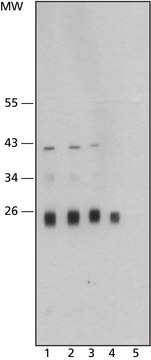
antigen ~25 kDa (human cathepsin L), antigen ~42 kDa (human pro cathepsin L)

species reactivity

human

concentration

~2 mg/mL

technique(s)

indirect ELISA: suitable, immunohistochemistry: suitable, western blot: 0.1-0.2 μg/mL using total cell extracts of A549 cells

isotype

IgG1

shipped in

dry ice

storage temp.

−20°C

target post-translational modification

unmodified

Gene Information

human ... CTSL1(1514)

Szukasz podobnych produktów? Odwiedź Przewodnik dotyczący porównywania produktów

Porównaj podobne pozycje

Wyświetl pełne porównanie

Pokaż różnice

1 of 4

Ta pozycja
C2970T6074R4903
conjugate

unconjugated

conjugate

unconjugated

conjugate

unconjugated

conjugate

unconjugated

clone

CPL33/1, monoclonal

clone

33/2, monoclonal

clone

B-5-1-2, monoclonal

clone

4D11, monoclonal

biological source

mouse

biological source

mouse

biological source

mouse

biological source

mouse

species reactivity

human

species reactivity

mouse, mink, human, rat

species reactivity

mouse, chicken, Chlamydomonas, African green monkey, human, rat, bovine, sea urchin, kangaroo rat

species reactivity

bovine, newt, chicken, human, monkey, mouse

Gene Information

human ... CTSL1(1514)

Gene Information

human ... CTSL1(1514)
mouse ... Ctsl(13039)
rat ... Ctsl1(25697)

Gene Information

human ... TUBA4A(7277)
mouse ... Tuba1a(22142)
rat ... Tuba1a(64158)

Gene Information

human ... HNRNPL(3191)
mouse ... Hnrnpl(15388)

antibody form

purified immunoglobulin

antibody form

ascites fluid

antibody form

purified from hybridoma cell culture

antibody form

purified from hybridoma cell culture

General description

Anti-Cathepsin L antibody, Mouse monoclonal (mouse IgG1 isotype) is derived from the hybridoma CPL33/1 produced by the fusion of mouse myeloma cells and splenocytes from BALB/c mice immunized with human procathepsin L.
Monoclonal Anti-Cathepsin L (mouse IgG1 isotype) is derived from the hybridoma CPL33/1 produced by the fusion of mouse myeloma cells (P3X63Ag8.653) and splenocytes from BALB/c mice immunized with human procathepsin L.

Immunogen

human procathepsin L. The antibody epitope resides within amino acids 258-261 of human cathepsin L (FYKE).

Application

Anti-Cathepsin L antibody has been used for immunoblotting.
Monoclonal Anti-Cathepsin L antibody produced in mouse is suitable for:
  • immunohistochemistry
  • indirect ELISA
  • western blot : 0.1-0.2 μg/mL using total cell extracts of A549 cells

Biochem/physiol Actions

Cathepsins are lysosomal proteases that play an important role in the intracellular degradation of exogenous and endogenous proteins, activation of enzyme precursors, and tumor invasion and metastasis.
Inhibition of the enzyme or the proenzyme by low molecular weight inhibitors or by specific antibodies led to a suppression of the invasive capabilities of malignant cells, or a decline in their ability to form tumors in experimental in vivo and in vitro models.
The antibody recognizes the native and denaturated forms of the protein and does not cross react with human cathepsin V. Monoclonal Anti-Cathepsin L specifically recognizes human cathepsin L (∼ 25 kDa) and procathepsin L (∼ 42 kDa). Anti-Cathepsin L antibody epitope resides within amino acids of human cathepsin L (FYKE).

Physical form

Solution in 0.01 M phosphate buffered saline, pH 7.4, containing 15 mM sodium azide.

Disclaimer

Unless otherwise stated in our catalog or other company documentation accompanying the product(s), our products are intended for research use only and are not to be used for any other purpose, which includes but is not limited to, unauthorized commercial uses, in vitro diagnostic uses, ex vivo or in vivo therapeutic uses or any type of consumption or application to humans or animals.
Ta strona może zawierać tekst przetłumaczony maszynowo.

Nie możesz znaleźć właściwego produktu?  

Wypróbuj nasz Narzędzie selektora produktów.

Klasa składowania

10 - Combustible liquids

wgk

nwg

flash_point_f

Not applicable

flash_point_c

Not applicable

ppe

Eyeshields, Faceshields, Gloves, type ABEK (EN14387) respirator filter


Wybierz jedną z najnowszych wersji:

Certyfikaty analizy (CoA)

Lot/Batch Number

Nie widzisz odpowiedniej wersji?

Jeśli potrzebujesz konkretnej wersji, możesz wyszukać konkretny certyfikat według numeru partii lub serii.

Masz już ten produkt?

Dokumenty związane z niedawno zakupionymi produktami zostały zamieszczone w Bibliotece dokumentów.

Odwiedź Bibliotekę dokumentów

Cheuk-Yiu Law et al.
Biochemistry and biophysics reports, 5, 335-345 (2016-01-14)
Patients with Danon disease may suffer from severe cardiomyopathy, skeletal muscle dysfunction as well as varying degrees of mental retardation, in which the primary deficiency of lysosomal membrane-associated protein-2 (LAMP2) is considerably associated. Owing to the scarcity of human neurons
E Weber et al.
Hybridoma, 16(2), 159-166 (1997-04-01)
Mouse monoclonal antibodies directed against cathepsin L and procathepsin L have been generated. Mice were immunized with human procathepsin L purified from the cell culture medium of human nonsmall cell lung cancer cell line EPLC 32 M1. More than 400
Cysteine cathepsins and the cutting edge of cancer invasion.
Gocheva V and Joyce J A
Cell Cycle, 6(1), 60-64 (2007)
Boris Turk et al.
FEBS letters, 581(15), 2761-2767 (2007-06-05)
Proteases were, for a long time, mainly considered as protein degrading enzymes. However, in the last decade this view has changed dramatically, and the focus is now on proteases as signalling molecules. One of the best examples is apoptosis, the
Myung Jong Kim et al.
JCI insight, 9(3) (2024-02-08)
The glucocerebrosidase (GCase) encoded by the GBA1 gene hydrolyzes glucosylceramide (GluCer) to ceramide and glucose in lysosomes. Homozygous or compound heterozygous GBA1 mutations cause the lysosomal storage disease Gaucher disease (GD) due to severe loss of GCase activity. Loss-of-function variants

Numer pozycji handlu globalnego

SKUNUMER GTIN
C4618-200UL04061838030412

Questions

Reviews

No rating value

Active Filters

Nasz zespół naukowców ma doświadczenie we wszystkich obszarach badań, w tym w naukach przyrodniczych, materiałoznawstwie, syntezie chemicznej, chromatografii, analityce i wielu innych dziedzinach.

Skontaktuj się z zespołem ds. pomocy technicznej