Przejdź do zawartości
Merck

C199

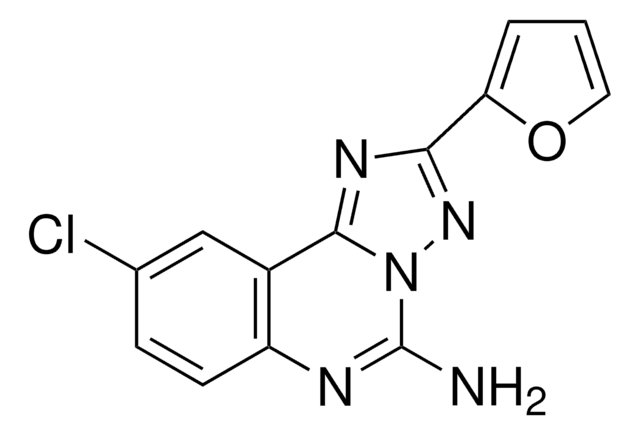
CGS-15943

≥98% (HPLC), Adenosine receptor antagonist, solid

Synonim(y):

9-Chloro-2-(2-furanyl)-[1,2,4]triazolo[1,5-c]quinazolin-5-amine

Zaloguj się, aby wyświetlić ceny organizacyjne i kontraktowe.

Wybierz wielkość

25 MG

701,00 zł

701,00 zł


Skontaktuj się z Obsługą Klienta, aby uzyskać informacje na temat dostępności

Zamów zamówienie zbiorcze

Informacje o tej pozycji

Wzór empiryczny (zapis Hilla):
C13H8ClN5O
Numer CAS:
Masa cząsteczkowa:
285.69
UNSPSC Code:
12352202
PubChem Substance ID:
NACRES:
NA.77
MDL number:
Assay:
≥98% (HPLC)
Form:
solid
Quality level:

Przejdź do

Pomoc techniczna
Potrzebujesz pomocy? Nasz zespół doświadczonych naukowców chętnie Ci pomoże.
Pozwól nam pomóc

Nazwa produktu

CGS-15943, solid

SMILES string

Nc1nc2ccc(Cl)cc2c3nc(nn13)-c4ccco4

InChI key

MSJODEOZODDVGW-UHFFFAOYSA-N

InChI

1S/C13H8ClN5O/c14-7-3-4-9-8(6-7)12-17-11(10-2-1-5-20-10)18-19(12)13(15)16-9/h1-6H,(H2,15,16)

assay

≥98% (HPLC)

form

solid

color

white

solubility

DMSO: >10 mg/mL, H2O: insoluble

storage temp.

room temp

Quality Level

Powiązane kategorie

Porównaj podobne pozycje

Wyświetl pełne porównanie

Pokaż różnice

1 of 4

Ta pozycja
S4568S6451Z0153
assay

≥98% (HPLC)

assay

≥98% (HPLC)

assay

≥98% (HPLC)

assay

≥98% (HPLC)

form

solid

form

solid

form

powder

form

powder

Quality Level

100

Quality Level

100

Quality Level

100

Quality Level

100

storage temp.

room temp

storage temp.

-

storage temp.

2-8°C

storage temp.

room temp

solubility

DMSO: >10 mg/mL, H2O: insoluble

solubility

DMSO: soluble >10 mg/mL, H2O: insoluble

solubility

DMSO: ≥20 mg/mL

solubility

DMSO: >15 mg/mL

color

white

color

off-white

color

light tan to tan

color

white to tan

Application

CGS-15943 has been used as a non-selective adenosine receptor antagonist to study its effects on the proliferation of pancreatic ductal adenocarcinoma (PDAC) cells and hepatocellular carcinoma (HCC)[1]. It has also been used as a non-selective adenosine receptor antagonist to investigate the mechanism underlying adenosine inhibition on cholangiocarcinoma (CCA) cells.[2]

Biochem/physiol Actions

CGS-15943 is a potent and non-selective adenosine receptor antagonist. It exhibits anti-carcinogenic and anti-apoptotic activity.[1]
Ta strona może zawierać tekst przetłumaczony maszynowo.

ppe

Eyeshields, Gloves, type N95 (US)

Klasa składowania

11 - Combustible Solids

wgk

WGK 3

flash_point_f

Not applicable

flash_point_c

Not applicable


Wybierz jedną z najnowszych wersji:

Certyfikaty analizy (CoA)

Lot/Batch Number

Nie widzisz odpowiedniej wersji?

Jeśli potrzebujesz konkretnej wersji, możesz wyszukać konkretny certyfikat według numeru partii lub serii.

Masz już ten produkt?

Dokumenty związane z niedawno zakupionymi produktami zostały zamieszczone w Bibliotece dokumentów.

Odwiedź Bibliotekę dokumentów

J m Li et al.
The Journal of surgical research, 80(2), 357-364 (1999-01-08)
Adenosine is a potent vasodilator of vascular smooth muscle. Endothelium-derived nitric oxide (NO) elicits vasodilation. We have previously reported that adenosine stimulates the production of NO from porcine carotid arterial endothelial cells (PCAEC) via a receptor-mediated mechanism. This study was
Elise M Weerts et al.
Psychopharmacology, 168(1-2), 155-163 (2003-04-02)
Caffeine and the adenosine A(1) and A(2A) receptor antagonist CGS15943 produce many behavioral effects that are similar to those produced by classic stimulant drugs (e.g. cocaine and amphetamines). The current study evaluated whether CGS15943 would maintain self-administration and reinstate extinguished
Soo-Kyung Kim et al.
Journal of medicinal chemistry, 46(23), 4847-4859 (2003-10-31)
A three-dimensional model of the human A(2A) adenosine receptor (AR) and its docked ligands was built by homology to rhodopsin and validated with site-directed mutagenesis and the synthesis of chemically complementary agonists. Different binding modes of A(2A)AR antagonists and agonists
A C Ngai et al.
American journal of physiology. Heart and circulatory physiology, 280(5), H2329-H2335 (2001-04-12)
The purpose of this study was to investigate the receptor subtypes that mediate the dilation of rat intracerebral arterioles elicited by adenosine. Penetrating arterioles were isolated from the rat brain, cannulated with the use of a micropipette system, and luminally
A J Szkotak et al.
American journal of physiology. Cell physiology, 281(6), C1991-C2002 (2001-11-08)
The regulatory actions of adenosine on ion channel function are mediated by four distinct membrane receptors. The concentration of adenosine in the vicinity of these receptors is controlled, in part, by inwardly directed nucleoside transport. The purpose of this study

Questions

Reviews

No rating value

Active Filters

Nasz zespół naukowców ma doświadczenie we wszystkich obszarach badań, w tym w naukach przyrodniczych, materiałoznawstwie, syntezie chemicznej, chromatografii, analityce i wielu innych dziedzinach.

Skontaktuj się z zespołem ds. pomocy technicznej