
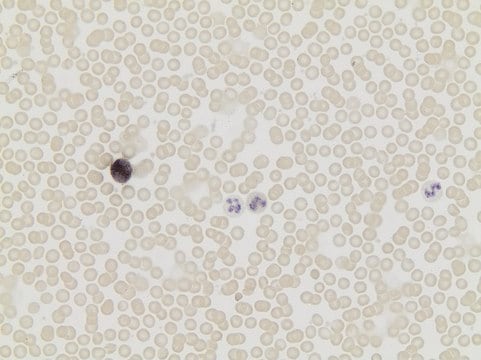


Unfortunately, there is no method to completely prevent this occurrence. Despite using the fluoride inhibition procedure, it is expected that lymphocytes and neutrophils may still exhibit some low levels of staining. Such low levels of staining in these cells are generally considered acceptable and should be disregarded. Hematoxylin staining can aid in distinguishing between the different types of white blood cells, which can be helpful in this context. For laboratories requiring stricter differentiation, it may be advisable to routinely conduct both the non-specific esterase and the non-specific esterase procedure with fluoride inhibition to achieve the desired results.
Przejdź do
90A1

Leukocyte α-Naphthyl Acetate (Non-Specific Esterase) Kit
Select reagents packaged in gelatin capsules.
Zaloguj się, aby wyświetlić ceny organizacyjne i kontraktowe.
Wybierz wielkość
Zmień widok
| Gabaryty przesyłki | SKU | Dostępność | Cena netto |
|---|---|---|---|
| 1 kit | Skontaktuj się z Obsługą Klienta, aby uzyskać informacje na temat dostępności | 2900,00 zł |
Informacje o tej pozycji
2900,00 zł
Skontaktuj się z Obsługą Klienta, aby uzyskać informacje na temat dostępności
Pomoc techniczna
Potrzebujesz pomocy? Nasz zespół doświadczonych naukowców chętnie Ci pomoże.
Pozwól nam pomócQuality Segment
form
liquid
shelf life
Expiry date on the label.
IVD
for in vitro diagnostic use
application(s)
hematology
histology
shipped in
wet ice
storage temp.
2-8°C
Application
Esterases are ubiquitous in nature and encompass a series of different enzymes acting upon select substrates. According to the methodology, α-naphthyl acetate is enzymatically hydrolyzed, liberating a free naphthol compound. This then couples with a diazonium compound, forming black colored deposits at sites of non-specific esterase activity. This enzyme is detected primarily in monocytes, macrophages and histocytes, and is normally absent in granulocytes. Lymphocytes may occasionally exhibit enzyme activity. A sodium fluoride inhibition procedure may be run to demonstrate monocyte inhibition. The procedure is run at 37 °C and may be utilized with blood, bone marrow films, tissue-touch preparations, cytocentrifuge preparations and frozen sections. The enzyme does not survive paraffin processing.
Intended for the cytologic demonstration of a-naphthyl acetate esterase in blood, bone marrow films or tissue touch preparations.
Ta strona może zawierać tekst przetłumaczony maszynowo.
1 of 1
Ta pozycja | |||
|---|---|---|---|
| form liquid | form liquid | form solution | form solution |
| application(s) hematology | application(s) hematology | application(s) hematology | application(s) hematology |
| shipped in wet ice | shipped in wet ice | shipped in wet ice | shipped in wet ice |
| shelf life Expiry date on the label. | shelf life Expiry date on the label. | shelf life Expiry date on the label. | shelf life Expiry date on the label. |
| Quality Level 500 | Quality Level 500 | Quality Level 500 | Quality Level 500 |
| storage temp. 2-8°C | storage temp. 2-8°C | storage temp. 2-8°C | storage temp. 2-8°C |
Still not finding the right product?
Explore all of our products under Leukocyte α-Naphthyl Acetate (Non-Specific Esterase) Kit
Tylko elementy zestawu
Numer produktu
Opis
- α-Naphthyl acetate (90-6) 10 x 20
- Citrate solution (386-1) 20 mL
- Ethylene glycol monomethyl ether 25 mL
- Fast Blue RR Salt (FBS-25) 10 caps
- Mayer's Hematoxylin Solution (MHS-1) 100 mL
- TRIZMAL™ 7.6 Concentrate 50 mL
signalword
Danger
Klasa składowania
3 - Flammable liquids
flash_point_f
104.0 °F - closed cup
flash_point_c
40 °C - closed cup
Hazard Classifications
Acute Tox. 4 Dermal - Acute Tox. 4 Inhalation - Acute Tox. 4 Oral - Aquatic Acute 1 - Aquatic Chronic 1 - Eye Dam. 1 - Flam. Liq. 3 - Met. Corr. 1 - Repr. 1B - Skin Corr. 1B - STOT RE 2 - STOT RE 2 Oral - STOT SE 1
target_organs
Central nervous system, Immune system, thymus
Wybierz jedną z najnowszych wersji:
Masz już ten produkt?
Dokumenty związane z niedawno zakupionymi produktami zostały zamieszczone w Bibliotece dokumentów.
Numer pozycji handlu globalnego
| SKU | NUMER GTIN |
|---|---|
| 90A1-1KT | 04061833253540 |
-
How can the procedure be optimized to prevent any staining of non-specific esterase within lymphocytes or neutrophils
1 answer-
Helpful?
-