
Przejdź do
35373

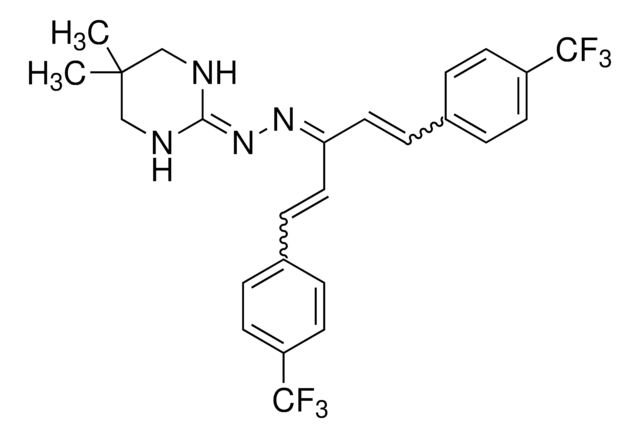
Hydramethylnon
PESTANAL®, analytical standard
Synonim(y):
1,5-Bis[4-(trifluoromethyl)phenyl]-1,4-pentadien-3-one 2-(1,4,5,6-tetrahydro-5,5-dimethyl-2-pyrimidinyl)hydrazone, NSC 379665, Tetrahydro-5,5-dimethyl-2(1H)-pyrimidinone[3-[4-(trifluoromethyl)phenyl]-1-[2-[4-(trifluoromethyl)phenyl]ethenyl]-2-propylidene]hydrazone
Wybierz wielkość
| Gabaryty przesyłki | SKU | Dostępność | Cena netto |
|---|---|---|---|
| 100 mg | Skontaktuj się z Obsługą Klienta, aby uzyskać informacje na temat dostępności | 799,00 zł |
Informacje o tej pozycji
799,00 zł
grade
analytical standard
Quality Segment
product line
PESTANAL®
assay
≥98.0% (HPLC)
shelf life
limited shelf life, expiry date on the label
technique(s)
HPLC: suitable, gas chromatography (GC): suitable
application(s)
agriculture
environmental
format
neat
SMILES string
CC1(C)CN\C(NC1)=N\N=C(\C=C\c2ccc(cc2)C(F)(F)F)/C=C/c3ccc(cc3)C(F)(F)F
InChI
1S/C25H24F6N4/c1-23(2)15-32-22(33-16-23)35-34-21(13-7-17-3-9-19(10-4-17)24(26,27)28)14-8-18-5-11-20(12-6-18)25(29,30)31/h3-14H,15-16H2,1-2H3,(H2,32,33,35)/b13-7+,14-8+
InChI key
IQVNEKKDSLOHHK-FNCQTZNRSA-N
Application
Packaging
Legal Information
1 of 1
Ta pozycja | |||
|---|---|---|---|
| format neat | format neat | format neat | format neat |
| assay ≥98.0% (HPLC) | assay - | assay ≥98.0% (HPLC) | assay - |
| technique(s) HPLC: suitable, gas chromatography (GC): suitable | technique(s) HPLC: suitable, gas chromatography (GC): suitable | technique(s) HPLC: suitable, gas chromatography (GC): suitable | technique(s) HPLC: suitable, gas chromatography (GC): suitable |
| grade analytical standard | grade certified reference material, pharmaceutical secondary standard | grade analytical standard | grade analytical standard |
| product line PESTANAL® | product line - | product line PESTANAL® | product line PESTANAL® |
| Quality Level 100 | Quality Level 300 | Quality Level 100 | Quality Level 100 |



signalword
Danger
hcodes
Hazard Classifications
Acute Tox. 4 Oral - Aquatic Acute 1 - Aquatic Chronic 1 - Eye Irrit. 2 - STOT RE 1 Oral
Klasa składowania
6.1C - Combustible acute toxic Cat.3 / toxic compounds or compounds which causing chronic effects
wgk
WGK 3
flash_point_f
Not applicable
flash_point_c
Not applicable
Wybierz jedną z najnowszych wersji:
Masz już ten produkt?
Dokumenty związane z niedawno zakupionymi produktami zostały zamieszczone w Bibliotece dokumentów.
Numer pozycji handlu globalnego
| SKU | NUMER GTIN |
|---|---|
| 35373-100MG | 04061831676754 |