



Autoclaving affects the pH of the dissolved medium, hence it is preferable to check the pH after autoclaving. pH should be checked at a temperature between 20-25°C. Adjustments can be made with HCl/NaOH if needed, while stirring.
Przejdź do
22091

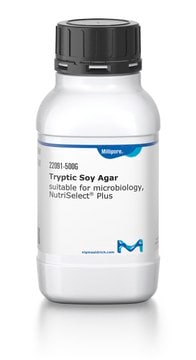
Tryptic Soy Agar - Dehydrated Culture Media
NutriSelect® Plus, powder, suitable for microbiology
Tryptic Soy Agar - Dehydrated Culture Media
Synonim(y):
CASO Agar, Soybean Casein digest Agar, TSA, Tryptone Soy Agar, CASO Agar, Soybean Casein digest Agar, TSA, Tryptone Soya Agar
Zaloguj się, aby wyświetlić ceny organizacyjne i kontraktowe.
Wybierz wielkość
Zmień widok
| Gabaryty przesyłki | SKU | Dostępność | Cena netto |
|---|---|---|---|
| 500 g | Skontaktuj się z Obsługą Klienta, aby uzyskać informacje na temat dostępności | 850,00 zł | |
| 2.5 kg | Skontaktuj się z Obsługą Klienta, aby uzyskać informacje na temat dostępności | 3200,00 zł |
Informacje o tej pozycji
NACRES:
NA.74
UNSPSC Code:
41171605
Manufacturer/tradename:
NutriSelect® Plus
Agency:
according to GB 4789.40-2016, according to ISO 11731:2017, according to ISO 22964:2017
Form:
powder
Suitability:
Enterococcus spp., Haemophilus spp., Pneumococcus spp., nonselective for Bacillus spp., nonselective for Bacteroides spp., nonselective for Campylobacter spp., nonselective for Candida spp., nonselective for Cronobacter spp., nonselective for Escherichia coli, nonselective for Neisseria spp., nonselective for Staphylococcus spp., nonselective for Streptococcus spp., nonselective for bacteria (General Media), nonselective for coliforms
Application(s):
agriculture
bioburden testing
cleaning products
clinical testing
cosmetics
environmental
food and beverages
personal care
surface monitoring
veterinary, microbiology
bioburden testing
cleaning products
clinical testing
cosmetics
environmental
food and beverages
personal care
surface monitoring
veterinary, microbiology
850,00 zł
Skontaktuj się z Obsługą Klienta, aby uzyskać informacje na temat dostępności
Pomoc techniczna
Potrzebujesz pomocy? Nasz zespół doświadczonych naukowców chętnie Ci pomoże.
Pozwól nam pomócQuality Segment
agency
according to GB 4789.40-2016, according to ISO 11731:2017, according to ISO 22964:2017
sterility
non-sterile
product line
BioChemika
form
powder
shelf life
limited shelf life, expiry date on the label
composition
agar, 15 g/L , casein peptone (pancreatic), 15 g/L , sodium chloride, 5 g/L , soya peptone (papainic), 5 g/L
packaging
bottle of 2.5 kg, bottle of 500 g
manufacturer/tradename
NutriSelect® Plus
technique(s)
microbe id | specific enzyme detection: suitable, microbiological culture: suitable
color
light yellow
final pH
7.3±0.2 (25 °C)
application(s)
agriculture
bioburden testing
cleaning products
clinical testing
cosmetics
environmental
food and beverages
personal care
surface monitoring
veterinary, microbiology
suitability
Enterococcus spp., Haemophilus spp., Pneumococcus spp., nonselective for Bacillus spp., nonselective for Bacteroides spp., nonselective for Campylobacter spp., nonselective for Candida spp., nonselective for Cronobacter spp., nonselective for Escherichia coli, nonselective for Neisseria spp., nonselective for Staphylococcus spp., nonselective for Streptococcus spp., nonselective for bacteria (General Media), nonselective for coliforms
General description
Tryptic Soy Agar is a general-purpose culture medium for the isolation and cultivation of fastidious and non-fastidious microorganisms or the maintenance of stock culture. It is a complex medium for the cultivation and isolation of a wide range of bacteria, yeasts, and molds. The formulation of the TSA medium contains a combination of casein and soy peptones supplying organic nitrogen, particularly amino acids, and longer-chained peptides. Sodium chloride maintains the osmotic equilibrium, and the natural sugars from soy peptone are the energy source.
Application
Tryptic Soy Agar is used for the pre-cultivation and enumeration (E. coli) by membrane filtration technique. It is suitable for the cultivation of both aerobic and anaerobic bacteria. Since it does not contain the X and V factors, it is suitable for the identification of Haemophilus sp. by adding X (Hemin) and V (DPN=NAD) factors strips.
Features and Benefits
NutriSelect® Plus are powdered culture media offering
- Quality control with growth promotion test according to industry standards
- Quality assurance acc. to ISO 9001
- Cost-efficient powdered media
Preparation Note
Suspend 40 g of dehydrated media in 1 litre of purified filtered water. Sterilize at 121°C for 15 minutes. Cool to 45-50°C. Mix gently and dispense into sterile Petri dishes or sterile culture tubes.
Legal Information
GRANUCULT is a registered trademark of Merck KGaA, Darmstadt, Germany
NutriSelect is a registered trademark of Merck KGaA, Darmstadt, Germany
Disclaimer
We offer two media types: the superior granulated GranuCult® and the cost-efficient powdered NutriSelect® culture media, depending on your needs. The designations basic, plus, or prime are added to indicate the quality control level, from basic quality control to standard QC plus to prime for full regulatory compliance.
Ta strona może zawierać tekst przetłumaczony maszynowo.
1 of 1
Ta pozycja | |||
|---|---|---|---|
| manufacturer/tradename NutriSelect® Plus | manufacturer/tradename NutriSelect® Plus | manufacturer/tradename NutriSelect® Plus | manufacturer/tradename NutriSelect® Plus |
| suitability Enterococcus spp., Pneumococcus spp., nonselective for Bacteroides spp., nonselective for Candida spp., nonselective for Escherichia coli, nonselective for Staphylococcus spp., nonselective for bacteria (General Media), Haemophilus spp., nonselective for Campylobacter spp., nonselective for Neisseria spp., nonselective for coliforms, nonselective for Bacillus spp., nonselective for Streptococcus spp., nonselective for Cronobacter spp. | suitability Enterococcus spp., Haemophilus spp., Pneumococcus spp., nonselective for Bacillus spp., nonselective for Bacteroides spp., nonselective for Campylobacter spp., nonselective for Candida spp., nonselective for Escherichia coli, nonselective for Neisseria spp., nonselective for Staphylococcus spp., nonselective for Streptococcus spp., nonselective for bacteria (General Media), nonselective for coliforms | suitability Enterococcus spp., Haemophilus spp., Pneumococcus spp., nonselective for Bacillus spp., nonselective for Bacteroides spp., nonselective for Campylobacter spp., nonselective for Candida spp., nonselective for Escherichia coli, nonselective for Neisseria spp., nonselective for Staphylococcus spp., nonselective for Streptococcus spp., nonselective for bacteria (Fastidious organisms), nonselective for coliforms | suitability Micrococcus spp., nonselective for Aspergillus spp., nonselective for Bacillus spp., nonselective for Candida spp., nonselective for Enterococcus spp., nonselective for Escherichia coli, nonselective for Pseudomonas spp., nonselective for Salmonella spp., nonselective for Serratia spp., nonselective for Staphylococcus spp., nonselective for Streptococcus spp., nonselective for bacteria (General Media), nonselective for coliforms |
| agency according to GB 4789.40-2016, according to ISO 22964:2017, according to ISO 11731:2017 | agency - | agency according to GB 4789.40-2016, according to ISO 11731:2017, according to ISO 22964:2017 | agency - |
| form powder | form powder | form powder | form powder |
| application(s) agriculture | application(s) agriculture | application(s) bioburden testing | application(s) cleaning products |
| technique(s) microbe id | specific enzyme detection: suitable, microbiological culture: suitable | technique(s) microbe id | specific enzyme detection: suitable, microbiological culture: suitable | technique(s) microbe id | specific enzyme detection: suitable, microbiological culture: suitable | technique(s) - |
Still not finding the right product?
Explore all of our products under Tryptic Soy Agar - Dehydrated Culture Media
Klasa składowania
11 - Combustible Solids
wgk
WGK 3
flash_point_f
Not applicable
flash_point_c
Not applicable
ppe
Eyeshields, Gloves, type N95 (US)
Wybierz jedną z najnowszych wersji:
Masz już ten produkt?
Dokumenty związane z niedawno zakupionymi produktami zostały zamieszczone w Bibliotece dokumentów.
Produkty
Większość wibrysów wykorzystuje proste źródło C, takie jak glukoza, jako źródło energii i wymaga 2-4% NaCl lub innych soli i pierwiastków śladowych obecnych w wodzie morskiej dla optymalnego wzrostu. Niektóre gatunki mogą wykorzystywać różne źródła energii.
Some Bacillus species are crucial for advancing our understanding of bacteria, while others can be harmful, acting as spoilage organisms or pathogens. Nevertheless, all these species are significant in biotechnological research.
Campylobacter spp. are regarded as the leading cause of bacterial gastroenteritis in humans worldwide.
Powiązane treści
Byron Brook et al.
Science translational medicine, 12(542) (2020-05-08)
Death from sepsis in the neonatal period remains a serious threat for millions. Within 3 days of administration, bacille Calmette-Guérin (BCG) vaccination can reduce mortality from neonatal sepsis in human newborns, but the underlying mechanism for this rapid protection is
Binbin Deng et al.
iScience, 23(2), 100827-100827 (2020-02-15)
Pseudomonas aeruginosa biofilms represent a major threat to health care. Rugose small colony variants (RSCV) of P. aeruginosa, isolated from chronic infections, display hyperbiofilm phenotype. RSCV biofilms are highly resistant to antibiotics and host defenses. This work shows that RSCV
Tara R Catron et al.
Scientific reports, 9(1), 7064-7064 (2019-05-10)
Estrogenic chemicals are widespread environmental contaminants associated with diverse health and ecological effects. During early vertebrate development, estrogen receptor signaling is critical for many different physiologic responses, including nervous system function. Recently, host-associated microbiota have been shown to influence neurodevelopment.
Numer pozycji handlu globalnego
| SKU | NUMER GTIN |
|---|---|
| 22091-500G | 04061838776761 |
| 22091-2.5KG | 04061838776754 |
-
Hi everyone and good afternoon My question is about checking of PH of Media, in which conditions we should check PH of the medium before autoclaving or after autoclaving
1 answer-
Helpful?
-