
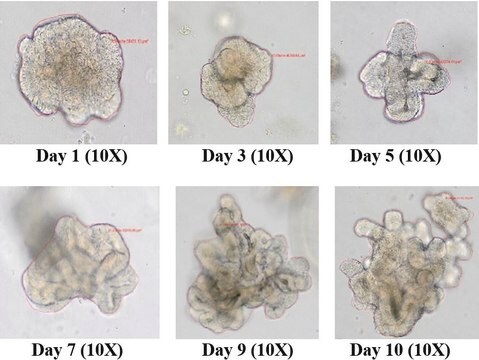


Traditional DNA/RNA isolation kits can be used to prepare genomic material for sequencing (RNA-seq, scRNA-seq, WGS, CHIP-seq etc). For some applications with large organoids, tissue specific DNA/RNA extraction kits are recommended. TRI Reagent (T9424) can be added to the dissociated organoids before RNA extraction and can be stored at -80 °C until future use.
SCM304

3dGRO® Human Colon Organoid Expansion Medium
Complete serum-free organoid media for the expansion and long-term 3D culture of human intestinal colon organoids.
Synonim(y):
Colon Organoid Culture Media, Intestinal Organoid Culture Media
Zaloguj się, aby wyświetlić ceny organizacyjne i kontraktowe.
Wybierz wielkość
Zmień widok
| Gabaryty przesyłki | SKU | Dostępność | Cena netto |
|---|---|---|---|
| 50 mL | Dostępne do wysyłki DZISIAJzKuehne + Nagel Sp. z o.o. | 1450,00 zł |
Informacje o tej pozycji
NACRES:
NA.71
UNSPSC Code:
12352207
1450,00 zł
Dostępne do wysyłki DZISIAJSzczegóły
Pomoc techniczna
Potrzebujesz pomocy? Nasz zespół doświadczonych naukowców chętnie Ci pomoże.
Pozwól nam pomócform
liquid
packaging
pkg of 50 mL
technique(s)
cell culture | stem cell: suitable
osmolality
350-375 mOsm
application(s)
cell analysis
General description
3dGRO® Human Colon Organoid Expansion Medium is a complete ready-to-use serum-free medium for the expansion and long-term culture of human colonic organoids. The medium has been validated for use with 3dGRO® Human iPSC Derived Colon Organoids (Cat. No. SCC300). Colon organoids propagated in the medium express colon-specific markers including the posterior hindgut marker CDX2, a-carbonic anydrase II (CA-II), a-carbonic anhydrase IV (CA-IV), and goblet cell markers Mucin-2 and Mucin-5B.
Application
Complete serum-free organoid media for the expansion and long-term 3D culture of human intestinal colon organoids.
Research Category:
Research Category:
- Cell Culture
- Stem Cell Research
Preparation Note
Upon receipt, store at −20°C. When ready to use, thaw overnight at 2-8°C. Once thawed, mix thoroughly. Use immediately and store at 2-8°C for up to 1 week. Do not re-freeze. Unused aliquots may be stored at −20°C until the expiry date.
Analysis Note
Appearance (Color): Clear/No Particlulates (Red Liquid)
Osmolality: 350-375 mOsm
pH: 7.0 – 7.4
Sterility Tested: No Growth/Pass
Endotoxin: <2 EU/mL
Mycoplasma: Negative
Functional Assay: Thaw and culture of human colon organoids for 2 passages.
Osmolality: 350-375 mOsm
pH: 7.0 – 7.4
Sterility Tested: No Growth/Pass
Endotoxin: <2 EU/mL
Mycoplasma: Negative
Functional Assay: Thaw and culture of human colon organoids for 2 passages.
Legal Information
3dGRO is a registered trademark of Merck KGaA, Darmstadt, Germany
Disclaimer
Unless otherwise stated in our catalog or other company documentation accompanying the product(s), our products are intended for research use only and are not to be used for any other purpose, which includes but is not limited to, unauthorized commercial uses, in vitro diagnostic uses, ex vivo or in vivo therapeutic uses or any type of consumption or application to humans or animals.
Ta strona może zawierać tekst przetłumaczony maszynowo.
1 of 1
Ta pozycja | ||
|---|---|---|
| application(s) cell analysis | application(s) 3D cell culture | application(s) - |
| form liquid | form liquid | form liquid |
| technique(s) cell culture | stem cell: suitable | technique(s) cell culture | stem cell: suitable | technique(s) cell culture | stem cell: suitable |
| packaging pkg of 50 mL | packaging vial of >1500 viable organoids | packaging - |
| osmolality 350-375 mOsm | osmolality - | osmolality - |
Klasa składowania
12 - Non Combustible Liquids
wgk
WGK 1
flash_point_f
Not applicable
flash_point_c
Not applicable
Certyfikaty analizy (CoA)
Poszukaj Certyfikaty analizy (CoA), wpisując numer partii/serii produktów. Numery serii i partii można znaleźć na etykiecie produktu po słowach „seria” lub „partia”.
Masz już ten produkt?
Dokumenty związane z niedawno zakupionymi produktami zostały zamieszczone w Bibliotece dokumentów.
Protokoły
Highly characterized cryopreserved human colonic organoids and a step-by-step organoid culture protocol for epithelial intestinal organoid differentiation from iPS cells.
Learn how to cultivate similar-sized iPSC-derived colon organoids using Millicell® Microwell plates and perform a forskolin-induced swelling assay.
Produkty
Najczęściej zadawane pytania dotyczące hodowli organoidów. Dowiedz się, jak hodować i analizować organoidy zgodnie z ustalonymi protokołami hodowli komórek 3D. Wskazówki i porady.
Produkty do hodowli organoidalnej do generowania trójwymiarowych modeli mózgu, jelit, jelit, płuc i guzów nowotworowych pochodzących z tkanek i komórek macierzystych.
Organoid culture products to generate tissue and stem cell derived 3D brain, intestinal, gut, lung and cancer tumor organoid models.
Powiązane treści
Explore our portfolio of 3D cell culture tools and technologies for any 3D cell line or application and discover organoids, hydrogels, ULA, microwell, or hydrogel plates, and more.
Zapoznaj się z naszą ofertą narzędzi i technologii do hodowli komórek 3D dla dowolnej linii komórek 3D lub zastosowania i odkryj organoidy, hydrożele, ULA, mikrodołki lub płytki hydrożelowe i nie tylko.
Monitor barrier formation using colon PDOs, iPSC-derived colon organoids, Millicell® cell culture inserts, and the Millicell® ERS. 3.0.
Numer pozycji handlu globalnego
| SKU | NUMER GTIN |
|---|---|
| SCM304 | 04054839986451 |
-
How Do you Extract RNA/DNA from Organoids in Cultured in Matrigel?
1 answer-
Helpful?
-
-
How do you stain organoids with antibodies?
1 answer-
Organoids can be stained with antibodies for immunocytochemical (ICC)/Immunohistochemical (IHC) analysis using either whole-mount or paraffin embedding/sectioning techniques. It is critical to use antibodies prequalified for organoid analysis.
Helpful?
-
-
How are organoids cultured?
1 answer-
Once isolated, organoids are cultured in specialized media embedded in a rich extracellular matrix (ECM) basement membrane extract hydrogel such as Growth Factor Reduced Matrigel. Media is replenished every other day and cells are passaged once per week (7-12 days) before cells become too large or necrotic. Cells can be passaged in either small clump fragments or as single cells using mechanical dissociation/enzyme-free passaging reagents. Depending on organoid type and confluency, split ratios of roughly 1:3-1:4 can be used when passaging organoids. For sensitive organoid types, ROCKi (Y27632) (SCM075) can be added during passaging to help in promoting cell viability.
Helpful?
-