
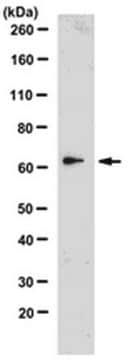


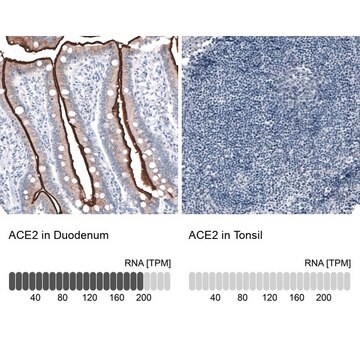
Uniprot indicates the presence of 2 isoforms at approximately 92 kDa (Isoform 1) and approximately 64 kDa (Isoform 2) due to alternative splicing. Isoform 1 is not induced by interferons such as IFNA, IFNB, and IFNG, as supported by 1 publication. On the other hand, the expression of Isoform 2 is induced by interferons such as IFNA, IFNB, and IFNG. It appears that isoform 2 is an interferon-stimulated gene (ISG), but this is not the case for isoform 1.
MABN59

Anti-ACE2 Antibody, clone 4G5.1
clone 4G5.1, from mouse
Synonim(y):
Angiotensin-converting enzyme 2, ACE-related carboxypeptidase, Angiotensin-converting enzyme homolog, ACEH, Metalloprotease MPROT15
Zaloguj się, aby wyświetlić ceny organizacyjne i kontraktowe.
Wybierz wielkość
Zmień widok
| Do Państwa/SKU | Dostępność | Cena netto |
|---|---|---|
100 μL | Dostępne do wysyłki DZISIAJzKuehne + Nagel Sp. z o.o. | 2010,00 zł |
Informacje o tej pozycji
UNSPSC Code:
12352203
NACRES:
NA.41
eCl@ss:
32160702
Clone:
4G5.1, monoclonal
Species reactivity:
human
Application:
WB
Citations:
10
2010,00 zł
Dostępne do wysyłki DZISIAJSzczegóły
Rekombinowane, niezawierające konserwantów przeciwciało jest dostępne dla Twojego celu. Wypróbuj ZRB1631
Pomoc techniczna
Potrzebujesz pomocy? Nasz zespół doświadczonych naukowców chętnie Ci pomoże.
Pozwól nam pomócbiological source
mouse
Quality Segment
tag
GST tagged
antibody form
purified antibody (protein G)
antibody product type
primary antibodies
clone
4G5.1, monoclonal
mol wt
~62 kDa
species reactivity
human
technique(s)
western blot: suitable
isotype
IgG1κ
NCBI accession no.
UniProt accession no.
shipped in
wet ice
storage temp.
2-8°C
target post-translational modification
unmodified
Gene Information
human ... ACE2(59272)
General description
Angiotensin-converting enzyme 2 (ACE2) is a transmembrane protein belonging to the metallopeptidases (M2) family. It is a membrane-associated carboxypeptidase, expressed in the vascular endothelial cells of the heart, kidney, testis, gastrointestinal system and in the epithelial cells of lungs. ACE2 consists of an N-terminal peptidase domain (PD) and a C-terminal collectrin-like domain (CLD). It also comprises a single catalytic domain that is similar to that of ACE. The gene ACE2 is mapped to human chromosome location Xp22.2. ACE2 is a structural homolog ACE.
~62 kDa observed. Uniport describes 2 isoforms at ~92 kDa (Isoform 1) and ~64 kDa (Isoform 2) due to alternative splicing.
Immunogen
GST-tagged recombinant protein corresponding to human ACE2.
Application
Anti-ACE2 Antibody, clone 4G5.1 detects level of ACE2 & has been validated for use in Western Blotting.
ELISA Analysis: A representative lot detected ACE2 in a direct ELISA.
Research Category
Signaling
Signaling
Research Sub Category
Signaling Neuroscience
Signaling Neuroscience
Biochem/physiol Actions
Angiotensin-converting enzyme-2 (ACE2) produces angiotensin (1-9) by hydrolysis of angiotensin 1. Angiotensin (1-9) is a precursor for angiotensin (1-7). ACE2 may also directly produce angiotensin (1-7) by conversion of angiotensin II, which is involved in vasoconstriction.(2) Angiotensin (1-7) plays an important role in the renin-angiotensin system (RAS) signaling pathway and is involved in bradykinin-induced vasodilation. Hence, ACE2 antagonizes the effects of its homolog, ACE. ACE2 is insensitive to commonly used inhibitors such as lisinopril and captopril. This gene is upregulated in heart failure due to the overactivity of angiotensin II. ACE2 is studied for its potential therapeutic value for hypertension and heart failure. It binds to the viral envelope protein spike (S) protein and acts as a major entry receptor for severe acute respiratory syndrome coronavirus (SARS-CoV) and SARS-CoV-2 in human cells. Hence, it is considered as a potential therapeutic target for COVID-19. ACE2 exhibits protection from lung injury.
This antibody recognizes ACE2.
Physical form
Format: Purified
Protein G Purified
Purified mouse monoclonal IgG1κ in buffer containing 0.1 M Tris-Glycine (pH 7.4), 150 mM NaCl with 0.05% sodium azide.
Preparation Note
Stable for 1 year at 2-8°C from date of receipt.
Analysis Note
Control
HEK293 cell lysate
HEK293 cell lysate
Evaluated by Western Blot in HEK293 cell lysate.
Western Blot Analysis: A 1:2,000 dilution of this antibody detected ACE2 in 10 µg of HEK293 cell lysate.
Western Blot Analysis: A 1:2,000 dilution of this antibody detected ACE2 in 10 µg of HEK293 cell lysate.
Other Notes
Replaces: MAB5676
Disclaimer
Unless otherwise stated in our catalog or other company documentation accompanying the product(s), our products are intended for research use only and are not to be used for any other purpose, which includes but is not limited to, unauthorized commercial uses, in vitro diagnostic uses, ex vivo or in vivo therapeutic uses or any type of consumption or application to humans or animals.
Ta strona może zawierać tekst przetłumaczony maszynowo.
1 of 1
Ta pozycja | |||
|---|---|---|---|
| biological source mouse | biological source rabbit | biological source rabbit | biological source mouse |
| antibody form purified antibody (protein G) | antibody form affinity isolated antibody | antibody form affinity isolated antibody | antibody form purified immunoglobulin |
| clone 4G5.1, monoclonal | clone polyclonal | clone polyclonal | clone CL4035, monoclonal |
| species reactivity human | species reactivity human | species reactivity mouse, human | species reactivity human |
| Gene Information human ... ACE2(59272) | Gene Information human ... ACE2(59272) | Gene Information human ... ACE2(59272) | Gene Information human ... ACE2(59272) |
| mol wt ~62 kDa | mol wt 89 kDa | mol wt - | mol wt - |
Still not finding the right product?
Wypróbuj nasze narzędzie Narzędzie selektora produktów, aby zawęzić opcje.
Klasa składowania
12 - Non Combustible Liquids
wgk
WGK 1
flash_point_f
Not applicable
flash_point_c
Not applicable
Certyfikaty analizy (CoA)
Poszukaj Certyfikaty analizy (CoA), wpisując numer partii/serii produktów. Numery serii i partii można znaleźć na etykiecie produktu po słowach „seria” lub „partia”.
Masz już ten produkt?
Dokumenty związane z niedawno zakupionymi produktami zostały zamieszczone w Bibliotece dokumentów.
-
What is the molecular weight of the antigen, and what are the differences between ACE2 isoform 1 and isoform 2?
1 answer-
Helpful?
-