Przejdź do zawartości
Merck

Przejdź do

MABN310

Anti-G-protein coupled receptor 56 (GPR56) Antibody, clone H11

clone H11, from mouse

Synonim(y):

G protein-coupled receptor 56, 7-transmembrane protein with no EGF-like N-terminal domains-1, Protein TM7XN1, G-protein coupled receptor 56

Zaloguj się, aby wyświetlić ceny organizacyjne i kontraktowe.

Wybierz wielkość

Zmień widok
Do Państwa/SKUDostępnośćCena netto
100 μg

Przewidywany termin wysyłki03 czerwca 2026zKuehne + Nagel Sp. z o.o.

2060,00 zł

Informacje o tej pozycji

UNSPSC Code:
12352203
NACRES:
NA.41
eCl@ss:
32160702
Conjugate:
unconjugated
Clone:
H11, monoclonal
Application:
ICC, IHC, WB
Citations:
6

2060,00 zł


Przewidywany termin wysyłki03 czerwca 2026Szczegóły


Zamów zamówienie zbiorcze
Pomoc techniczna
Potrzebujesz pomocy? Nasz zespół doświadczonych naukowców chętnie Ci pomoże.
Pozwól nam pomóc


biological source

mouse

Quality Segment

conjugate

unconjugated

antibody form

purified antibody

antibody product type

primary antibodies

clone

H11, monoclonal

species reactivity

mouse

species reactivity (predicted by homology)

human (based on 100% sequence homology)

technique(s)

immunocytochemistry: suitable, immunohistochemistry: suitable, western blot: suitable

isotype

IgG1κ

NCBI accession no.

UniProt accession no.

shipped in

wet ice

target post-translational modification

unmodified

Gene Information

human ... GPR56(9289)

General description

G-protein coupled receptor 56 (GPR56) is a ubiquitous adhesion receptor, which belongs to the G-protein coupled receptor 2 family and LN-TM7 subfamily. It is abundantly expressed in the in thyroid gland, brain, heart, and various tumor cells. Previous studies have suggested that GPR56 may inhibit the progression and metastasis of melanomas by interaction with extracellular-matrix proteins, such as Tissue Transglutaminase. GPR56 also plays a role in regulating VEGF production and angiogenesis via a PKCα-mediated pathway. GPR56 also plays a critical role in the development of the frontal cortex; previous studies have reported that mutations in GPR56 result in disorganized cortical lamination, which is most pronounced in the frontal cortex. This condition is known as bilateral frontoparietal polymicrogyria or BFPP.
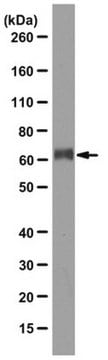
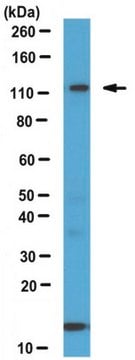
~62 kDa observed. Full-length GPR56 (GPR56FL) migrates at 75 kDa and the cleaved extracellular domain of GPR56 (GPR56ECD) migrates at 62 kDa (J Biol Chem. 2008 May 23;283(21):14469-78).

Immunogen

N-terminal fragment of mouse GPR56

Application

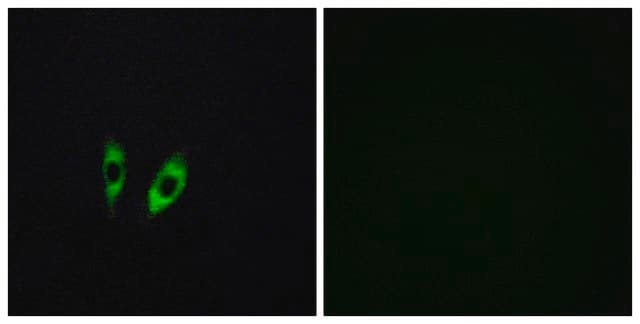
Immunohistochemistry Analysis: A representative lot was used by an independent laboratory in E14.5 mouse brain tissue. (Luo, R., et al. (2011). Proc Natl Acad Sci U S A. 108(31):12925-12930.)

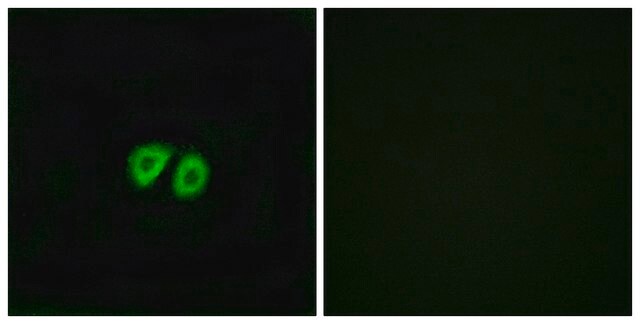
Immunocytochemistry Analysis: A representative lot was used by an independent laboratory in meningeal fibroblasts (MFs). (Luo, R., et al. (2011). Proc Natl Acad Sci U S A. 108(31):12925-12930.)
Research Category
Neuroscience
Research Sub Category
Adhesion (CAMs)
This Anti-G-protein coupled receptor 56 (GPR56) Antibody, clone H11 is validated for use in Western Blotting, ICC, IHC for the detection of G-protein coupled receptor 56 (GPR56).

Physical form

Format: Purified
Protein G Purified
Purified mouse monoclonal IgG1κ in buffer containing 0.1 M Tris-Glycine (pH 7.4), 150 mM NaCl with 0.05% sodium azide.

Preparation Note

Stable for 1 year at 2-8°C from date of receipt.

Analysis Note

Control
Brain tissue lysate from E13-E14 mouse
Evaluated by Western Blot in brain tissue lysate from E13-E14 mouse.

Western Blot Analysis: 0.5 μg/mL of this antibody detected G-protein coupled receptor 56 in 10 µg of brain tissue lysate from E13-E14 mouse.

Other Notes

Concentration: Please refer to the Certificate of Analysis for the lot-specific concentration.

Disclaimer

Unless otherwise stated in our catalog or other company documentation accompanying the product(s), our products are intended for research use only and are not to be used for any other purpose, which includes but is not limited to, unauthorized commercial uses, in vitro diagnostic uses, ex vivo or in vivo therapeutic uses or any type of consumption or application to humans or animals.
Ta strona może zawierać tekst przetłumaczony maszynowo.

Porównaj podobne pozycje

Wyświetl pełne porównanie

Pokaż różnice

1 of 1

Ta pozycja
ABS1028SAB4503610SAB4500640
conjugate

unconjugated

conjugate

unconjugated

conjugate

unconjugated

conjugate

unconjugated

biological source

mouse

biological source

rabbit

biological source

rabbit

biological source

rabbit

Gene Information

human ... GPR56(9289)

Gene Information

human ... GPR56(9289)

Gene Information

human ... GPR56(9289)

Gene Information

human ... GP156(165829)

species reactivity

mouse

species reactivity

rat, human

species reactivity

human

species reactivity

human

clone

H11, monoclonal

clone

polyclonal

clone

polyclonal

clone

polyclonal

antibody form

purified antibody

antibody form

affinity isolated antibody

antibody form

affinity isolated antibody

antibody form

affinity isolated antibody


Still not finding the right product?

Wypróbuj nasze narzędzie Narzędzie selektora produktów, aby zawęzić opcje.


Klasa składowania

12 - Non Combustible Liquids

wgk

WGK 1

flash_point_f

Not applicable

flash_point_c

Not applicable


Certyfikaty analizy (CoA)

Poszukaj Certyfikaty analizy (CoA), wpisując numer partii/serii produktów. Numery serii i partii można znaleźć na etykiecie produktu po słowach „seria” lub „partia”.

Masz już ten produkt?

Dokumenty związane z niedawno zakupionymi produktami zostały zamieszczone w Bibliotece dokumentów.

Odwiedź Bibliotekę dokumentów


Questions

Reviews

No rating value

Active Filters