
MABF954

Anti-LAG3 Antibody, clone 4-10-C9
clone 4-10-C9, from mouse
Synonim(y):
Lymphocyte activation gene 3 protein, CD223, LAG-3
Wybierz wielkość
| Do Państwa/SKU | Dostępność | Cena netto |
|---|---|---|
100 μg | Przewidywany termin wysyłki30 czerwca 2026zKuehne + Nagel Sp. z o.o. | 1860,00 zł |
Informacje o tej pozycji
1860,00 zł
Przewidywany termin wysyłki30 czerwca 2026Szczegóły
biological source
mouse
Quality Segment
conjugate
unconjugated
antibody form
purified immunoglobulin
antibody product type
primary antibodies
clone
4-10-C9, monoclonal
species reactivity
mouse
technique(s)
flow cytometry: suitable, immunocytochemistry: suitable
isotype
IgG2aκ
NCBI accession no.
UniProt accession no.
shipped in
wet ice
target post-translational modification
unmodified
Gene Information
mouse ... Lag3(16768)
General description
Immunogen
Application
Flow Cytometry Analysis: A representative lot was fluorescently conjugated and detected an increased number of LAG-3-positive cells within the CD4+ and CD8+ populations of infiltrating lymphocytes (TILs) in tumors developed in mice exografted with murine B16 melanoma, MC38 colon adenocarcinoma, or Sa1N fibrosarcoma cells (Woo, S.R., et al. (2012). Cancer Res. 72(4): 917–927).
Flow Cytometry Analysis: A representative lot, pre-conjugated with Alexa Fluor™ 647, detected both surface and intracellular LAG-3 by immunofluorescent staining of non-permeabilized and permeabilized primary murine CD4+ T cells activated in vitro via CD3 & CD28 cross-linking by immobilized antibodies. Pronase treatment of cells prior to permeabilization abolished cell surface staining (Woo, S.R., et al. (2010). Eur. J. Immunol. 40(6):1768-1777).
Flow Cytometry Analysis: A representative lot, pre-conjugated with Alexa Fluor 647, detected a time-dependent recovery of cell surface LAG-3 immunoreactivity on activated murine CD4+ T cells after initial surface LAG-3 degradation by pronase treatment. Protein synthesis inhibitor cycloheximide (Cat. No. 239764) or protein transport inhibitor Brefeldin A (Cat. No. 203729) treatment partially blocked the recovery (Woo, S.R., et al. (2010). Eur. J. Immunol. 40(6):1768-1777).
Immunocytochemistry Analysis: A representative lot detected both surface and intracellular LAG-3 by fluorescent immunocytochemistry staining of non-permeabilized and permeabilized primary murine CD4+ T cells activated in vitro via CD3 & CD28 cross-linking by immobilized antibodies. Pronase treatment of cells prior to permeabilization abolished cell surface staining (Woo, S.R., et al. (2010). Eur. J. Immunol. 40(6):1768-1777).
Immunocytochemistry Analysis: A representative lot detected intracellular LAG-3 immunoreactivity co-localized with those of the early and recycling endosome marker EEA1, as well as endosomal markers Rab11b and Rab27a by fluorescent immunocytochemistry staining of activated murine CD4+ T cells following pronase treatment and permeabilization (Woo, S.R., et al. (2010). Eur. J. Immunol. 40(6):1768-1777).
Biochem/physiol Actions
Physical form
Analysis Note
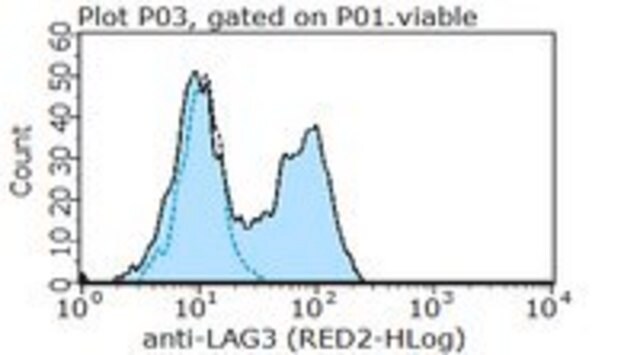
Flow Cytometry Analysis: 1 µg/mL of this antibody detected an induction of LAG-3-positive population in isolated mouse splenocytes following a 3-day 2 µg/mL Concanavalin A (Con A) stimulation.
Legal Information
1 of 1
Ta pozycja | |||
|---|---|---|---|
| Gene Information mouse ... Lag3(16768) | Gene Information - | Gene Information mouse ... Klra1(16627) | Gene Information human ... IL2RA(3559) |
| species reactivity mouse | species reactivity mouse | species reactivity mouse | species reactivity mouse |
| biological source mouse | biological source rat | biological source mouse | biological source rat |
| conjugate unconjugated | conjugate - | conjugate unconjugated | conjugate Allophycocyanin conjugate |
| antibody form purified immunoglobulin | antibody form - | antibody form purified antibody | antibody form purified antibody |
| clone 4-10-C9, monoclonal | clone monoclonal | clone A1, monoclonal | clone PC61.5, monoclonal |


Still not finding the right product?
Wypróbuj nasze narzędzie Narzędzie selektora produktów, aby zawęzić opcje.
Klasa składowania
12 - Non Combustible Liquids
wgk
WGK 1
Certyfikaty analizy (CoA)
Poszukaj Certyfikaty analizy (CoA), wpisując numer partii/serii produktów. Numery serii i partii można znaleźć na etykiecie produktu po słowach „seria” lub „partia”.
Masz już ten produkt?
Dokumenty związane z niedawno zakupionymi produktami zostały zamieszczone w Bibliotece dokumentów.