Przejdź do zawartości
Merck

Przejdź do

MABF3035

Anti-Chikungunya virus E1 Antibody, clone CHK-166

Zaloguj się, aby wyświetlić ceny organizacyjne i kontraktowe.

Wybierz wielkość

Zmień widok
Do Państwa/SKUDostępnośćCena netto
25 μL

Przewidywany termin wysyłki03 czerwca 2026zKuehne + Nagel Sp. z o.o.

717,00 zł
100 μL

Przewidywana wysyłka DZISIAJzKuehne + Nagel Sp. z o.o.

1820,00 zł

Informacje o tej pozycji

NACRES:
NA.41
UNSPSC Code:
12352203
Conjugate:
unconjugated
Clone:
CHK-166, monoclonal
Application:
ELISA, Neutral, inhibition assay
Citations:
-

717,00 zł


Przewidywany termin wysyłki03 czerwca 2026Szczegóły


Zamów zamówienie zbiorcze
Pomoc techniczna
Potrzebujesz pomocy? Nasz zespół doświadczonych naukowców chętnie Ci pomoże.
Pozwól nam pomóc


biological source

mouse

Quality Segment

conjugate

unconjugated

antibody form

purified antibody

antibody product type

primary antibodies

clone

CHK-166, monoclonal

mol wt

calculated mol wt 138.7 kDa

purified by

using protein G

species reactivity

virus

packaging

antibody small pack of 100 μL

technique(s)

ELISA: suitable, inhibition assay: suitable, neutralization: suitable

isotype

IgG2κ

epitope sequence

Unknown

UniProt accession no.

shipped in

dry ice

target post-translational modification

unmodified

General description

Chikungunya virus (CHIKV) that causes distinctive polyarthritis or polyarthralgia with clinical features such as fever, maculopapular rash, and myalgia is transmitted by Aedes spp of mosquitoes. Immune compromised individuals may face serious complications, including encephalitis and mortality. CHIKV genome contains a single-stranded positive-sense RNA that encodes four non-structural proteins known as nsP1, nsP2, nsP3, and nsP4 and also five structural proteins that include a capsid protein, three envelope glycoproteins known as (E1, E2, and E3, and a small molecule known as 6K. The mature alphavirus particles express E1 and E2 heterodimers that form 80 trimeric spikes on the surface of the virion. The mature E2 protein contains three domains with immunoglobulin-like folds: N-terminal domain A, domain B at the tip; and the C-terminal domain C located proximal to the viral membrane. The ectodomain E1 protein consists of three domains known as D1, DII, and DIII. The DIII domain is an immunoglobulin-like domain connected to D1 and DII by a flexible linker. Both E1 and E2 proteins are responsible for virus entry into host cells. The E2 glycoprotein interacts with a cellular receptor, resulting in the virus internalization and the E1 glycoprotein mediates virus fusion to host cell under low pH conditions. Following the fusion of the viral envelope with the endosomal membrane, the viral genomic RNA is released into the cytoplasm and starts replicating. Clone CHK-166 is a moderately inhibitory antibody that protects Ifr -/- mice from lethal infection and when used with clone CHK-152 it provides viral resistance and extends the treatment window by up to 36 hours post infection. (Ref.: Zhang, R., et al. (2019). Cell Reports 28(10); 2647-2658; Pal, P., et al. (2013). PLoS Pathog. 9(4); e1003312).

Immunogen

Irf-7 deficient mice injected with La Reunion 2006 OPY-1 strain of Chikungunya virus (CHIKV-LR) and boosted with CHIKV virus-like particles.

Application

Quality Control Testing

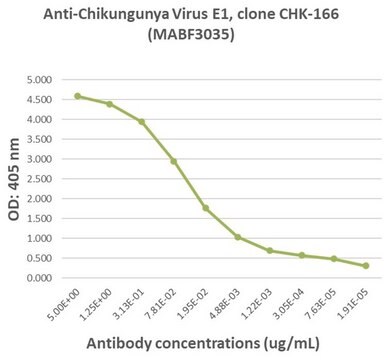
Evaluated by ELISA with recombinant Chikungunya Virus E1 protein.

ELISA Analysis: Various dilutions of this antibody detected recombinant Chikungunya virus E1 protein.

Tested Applications

Inhibition Analysis: A representative lot inhibited CHIKV infection when added after virus adsorption to the cell surface. (Pal, P., et al. (2013). PLoS Pathog. 9(4):e1003312).

ELISA Analysis: A representative lot detected Chikungunya virus E1 in ELISA applications (Zhang, R., et al. (2019). Cell Rep. 28(10): 2647-2658.e5).

Neutralizing Analysis: A representative lot neutralized CHIKV and protected immunocompromised mice against disease. (Pal, P., et al. (2013). PLoS Pathog. 9(4):e1003312).

Note: Actual optimal working dilutions must be determined by end user as specimens, and experimental conditions may vary with the end user
Anti-Chikungunya virus E1, clone CHK-166, Cat. No. MABF3035, is a mouse monoclonal antibody that detects Chikungunya virus (CHIKV) E1 protein and is tested for use in ELISA, Inhibition, and Neutralizing assay.

Biochem/physiol Actions

Clone CHK-166 is a mouse monoclonal antibody that detects E1 protein of Chikungunya virus. It targets an epitope within the DII region of E1 protein, adjacent to the fusion loop.

Physical form

Purified mouse monoclonal antibody IgG2a in PBS without azide.

Preparation Note

Store at -10°C to -25°C. Handling Recommendations: Upon receipt and prior to removing the cap, centrifuge the vial and gently mix the solution. Aliquot into microcentrifuge tubes and store at -20°C. Avoid repeated freeze/thaw cycles, which may damage IgG and affect product performance.

Other Notes

Concentration: Please refer to the Certificate of Analysis for the lot-specific concentration.

Disclaimer

Unless otherwise stated in our catalog or other company documentation accompanying the product(s), our products are intended for research use only and are not to be used for any other purpose, which includes but is not limited to, unauthorized commercial uses, in vitro diagnostic uses, ex vivo or in vivo therapeutic uses or any type of consumption or application to humans or animals.
Ta strona może zawierać tekst przetłumaczony maszynowo.

Porównaj podobne pozycje

Wyświetl pełne porównanie

Pokaż różnice

1 of 1

Ta pozycja
MABF2218MABF3073MABF2048M
species reactivity

virus

species reactivity

influenza A virus

species reactivity

SARS coronavirus

species reactivity

virus

antibody form

purified antibody

antibody form

purified antibody

antibody form

purified antibody

antibody form

purified antibody

clone

CHK-166, monoclonal

clone

2H6, monoclonal

clone

S3D8, monoclonal

clone

ZV-2, monoclonal

biological source

mouse

biological source

mouse

biological source

mouse

biological source

mouse

conjugate

unconjugated

conjugate

unconjugated

conjugate

unconjugated

conjugate

unconjugated

UniProt accession no.

Q5XXP3

UniProt accession no.

Q4QZ06

UniProt accession no.

P0DTC2

UniProt accession no.

Q32ZE1 (strain Mr 766)


Still not finding the right product?

Wypróbuj nasze narzędzie Narzędzie selektora produktów, aby zawęzić opcje.


Klasa składowania

12 - Non Combustible Liquids

wgk

WGK 2

flash_point_f

Not applicable

flash_point_c

Not applicable


Certyfikaty analizy (CoA)

Poszukaj Certyfikaty analizy (CoA), wpisując numer partii/serii produktów. Numery serii i partii można znaleźć na etykiecie produktu po słowach „seria” lub „partia”.

Masz już ten produkt?

Dokumenty związane z niedawno zakupionymi produktami zostały zamieszczone w Bibliotece dokumentów.

Odwiedź Bibliotekę dokumentów


Questions

Reviews

No rating value

Active Filters