Przejdź do zawartości
Merck

Przejdź do

MABF1975

Anti-Herpes Simplex Virus Glycoprotein D Antibody, clone LP14

clone LP14, from mouse

Synonim(y):

HSV glycoprotein D

Zaloguj się, aby wyświetlić ceny organizacyjne i kontraktowe.

Wybierz wielkość

Zmień widok
Do Państwa/SKUDostępnośćCena netto
25 μL

Przewidywany termin wysyłki03 sierpnia 2026zKuehne + Nagel Sp. z o.o.

773,00 zł
100 μL

Przewidywany termin wysyłki03 czerwca 2026zKuehne + Nagel Sp. z o.o.

1740,00 zł

Informacje o tej pozycji

UNSPSC Code:
12352203
NACRES:
NA.41
eCl@ss:
32160702
Conjugate:
unconjugated
Clone:
LP14, monoclonal
Application:
ICC, WB, inhibition assay
Citations:
1

773,00 zł


Przewidywany termin wysyłki03 sierpnia 2026Szczegóły


Zamów zamówienie zbiorcze
Pomoc techniczna
Potrzebujesz pomocy? Nasz zespół doświadczonych naukowców chętnie Ci pomoże.
Pozwól nam pomóc


biological source

mouse

Quality Segment

conjugate

unconjugated

antibody form

purified immunoglobulin

antibody product type

primary antibodies

clone

LP14, monoclonal

species reactivity

virus

species reactivity (predicted by homology)

all

packaging

antibody small pack of 25 μL

technique(s)

immunocytochemistry: suitable, inhibition assay: suitable, western blot: suitable

isotype

IgG2aκ

NCBI accession no.

UniProt accession no.

shipped in

ambient

target post-translational modification

unmodified

General description

Herpes Simplex Virus envelope Glycoprotein D (UniProt: Q69091) is also known as gD. The envelope of herpes simplex virus (HSV) is complex and contains at least 10 virus-encoded glycoproteins, some of which mediate virus entry into the host cell. HSV virus enters the cell by first fusing its envelope with a membrane of the host cell. Five viral envelope glycoproteins are reported to be involved in this entry process. Binding of glycoprotein D of HSV to a cell surface receptor is required to trigger membrane fusion during entry into host cells. Glycoproteins C and B promote attachment by interacting with cell surface proteoglycans and then glycoprotein D binds to the herpes virus entry mediator (HVEM) receptor that initiates a process that ultimately leads to glycoprotein B-mediated membrane fusion. Glycoprotein D is synthesized with a signal peptide (aa 1-25) that is subsequently cleaved off. It is a homodimeric protein that contains two zinc-binding sites (aa 64 and 264). The ectodomain region of glycoprotein D contains three sites for the addition of N-linked oligosaccharides (N-CHO) and six cysteine residues arranged into three disulfide bonds. During virion morphogenesis, glycoprotein D probably accumulates in the endosomes and trans-Golgi where secondary envelopment occurs. (Ref.: Whitbeck JC et al. (1997). J. Virol. 71(8); p. 6083 6093; Nicola, AV et al. (1998). J Virol. 72(5): 3595-3601; Giovine, PD et al. (2011). PLos Pathog. 7(9); e1002277).
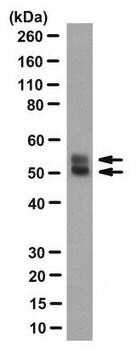
~50 and 55 kDa observed; 43.35 kDa calculated. Uncharacterized bands may be observed in some lysate(s).

Immunogen

Whole Herpex Simplex Virus 2 (HSV-2).

Application

Anti-Herpes Simplex Virus Glycoprotein D, clone LP14, Cat. No. MABF1975, is a mouse monoclonal antibody that detects Glycoprotein D of Herpes Simplex Virus and has been tested for use in Inhibition, Immunocytochemistry, and Western Blotting.
Research Category
Inflammation & Immunology
Western Blotting Analysis: A 1:2,000 dilution from a representative lot detected Herpes Simplex Virus Glycoprotein D in lysates from VERO cells transfected with HSV-1.

Western Blotting Analysis: A representative lot detected Herpes Simplex Virus Glycoprotein D in Western Blotting applications (Lau, S.Y., et. al. (2015). Viruses. 7(3):915-38; Zenner, H.L., et. al. (2011). J Virol. 85(16):8012-21; Pawliczek, T., et. al. (2009). J Virol. 83(21):11254-64).

Western Blotting Analysis: A representative lot detected Herpes Simplex Virus Glycoprotein D in Western Blotting applications (Ren, Y., et. al. (2012). J Gen Virol. 93(Pt 2):319-29).

Immunocytochemistry Analysis: A representative lot detected Herpes Simplex Virus Glycoprotein D in Immunocytochemistry applications (Lau, S.Y., et. al. (2015). Viruses. 7(3):915-38).

Inhibition Analysis: A representative lot inhibited the fusion of cells infected with HSV-1. (Minson, A.C., et. al. (1986). J Gen Virol. 67(6); 1001-1013.

Biochem/physiol Actions

Clone LP14 detects glycoprotein D of Herpes Simplex virus.

Physical form

Format: Purified
Protein G purified
Purified mouse monoclonal antibody IgG2a in PBS without azide.

Preparation Note

Stable for 1 year at -20°C from date of receipt. Handling Recommendations: Upon receipt and prior to removing the cap, centrifuge the vial and gently mix the solution. Aliquot into microcentrifuge tubes and store at -20°C. Avoid repeated freeze/thaw cycles, which may damage IgG and affect product performance.

Analysis Note

Evaluated by Western Blotting in HEK293T cell lysate transfected with HSV gD.

Western Blotting Analysis: A 1:2,000 dilution of this antibody detected Herpes Simplex Virus Glycoprotein D in HEK293T cell lysate transfected with HSV gD.

Other Notes

Concentration: Please refer to lot specific datasheet.

Disclaimer

Unless otherwise stated in our catalog or other company documentation accompanying the product(s), our products are intended for research use only and are not to be used for any other purpose, which includes but is not limited to, unauthorized commercial uses, in vitro diagnostic uses, ex vivo or in vivo therapeutic uses or any type of consumption or application to humans or animals.
Ta strona może zawierać tekst przetłumaczony maszynowo.

Porównaj podobne pozycje

Wyświetl pełne porównanie

Pokaż różnice

1 of 1

Ta pozycja
MAB8672MABF2820MABF2113
species reactivity

virus

species reactivity

human

species reactivity

virus

species reactivity

virus, Ebola virus

conjugate

unconjugated

conjugate

-

conjugate

unconjugated

conjugate

unconjugated

biological source

mouse

biological source

mouse

biological source

mouse

biological source

mouse

antibody form

purified immunoglobulin

antibody form

purified immunoglobulin

antibody form

purified antibody

antibody form

purified immunoglobulin

clone

LP14, monoclonal

clone

10A3, monoclonal

clone

AP33, monoclonal

clone

1H3, monoclonal

Quality Level

100

Quality Level

300

Quality Level

200

Quality Level

-


Still not finding the right product?

Wypróbuj nasze narzędzie Narzędzie selektora produktów, aby zawęzić opcje.


Klasa składowania

12 - Non Combustible Liquids

wgk

WGK 2

flash_point_f

does not flash

flash_point_c

does not flash


Certyfikaty analizy (CoA)

Poszukaj Certyfikaty analizy (CoA), wpisując numer partii/serii produktów. Numery serii i partii można znaleźć na etykiecie produktu po słowach „seria” lub „partia”.

Masz już ten produkt?

Dokumenty związane z niedawno zakupionymi produktami zostały zamieszczone w Bibliotece dokumentów.

Odwiedź Bibliotekę dokumentów


Questions

Reviews

No rating value

Active Filters