Przejdź do zawartości
Merck

Przejdź do

MABE285

Anti-Replication Protein A Antibody, clone RPA34-20

clone RPA34-20, from mouse

Synonim(y):

Replication protein A 32 kDa subunit, RP-A p32, Replication factor A protein 2, RF-A protein 2, Replication protein A 34 kDa subunit, RP-A p34

Zaloguj się, aby wyświetlić ceny organizacyjne i kontraktowe.

Wybierz wielkość

Zmień widok
Gabaryty przesyłkiSKUDostępnośćCena netto
100 μg

Dostępne do wysyłki DZISIAJzKuehne + Nagel Sp. z o.o.

1800,00 zł

Informacje o tej pozycji

UNSPSC Code:
12352203
NACRES:
NA.41
eCl@ss:
32160702
Conjugate:
unconjugated
Clone:
RPA34-20, monoclonal
Application:
ICC, IHC, WB
Citations:
24

1800,00 zł


Dostępne do wysyłki DZISIAJSzczegóły


Zamów zamówienie zbiorcze
Pomoc techniczna
Potrzebujesz pomocy? Nasz zespół doświadczonych naukowców chętnie Ci pomoże.
Pozwól nam pomóc


biological source

mouse

Quality Level

conjugate

unconjugated

antibody form

purified immunoglobulin

antibody product type

primary antibodies

clone

RPA34-20, monoclonal

species reactivity

human

technique(s)

immunocytochemistry: suitable, immunohistochemistry: suitable, western blot: suitable

isotype

IgG1κ

NCBI accession no.

UniProt accession no.

shipped in

wet ice

target post-translational modification

unmodified

Gene Information

human ... RPA2(6118)

General description

RPA (RP-A p32) is a heterotrimeric protein complex that binds specifically to single-stranded DNA (ssDNA). It is composed of three subunits: RPA1 (70 kDa), RPA2 (32 kDa), and RPA3 (14 kDa). RPA plays multiple roles in DNA replication. At the onset of DNA replication, RPA is loaded onto chromatin, and is needed for subsequent loading of DNA polymerase and other replication proteins to initiate DNA replication. After replication begins, RPA moves with replication forks, stabilizing ssDNA and assisting in DNA synthesis. In addition to its replication function, RPA is also known to play essential roles in damage repair and recombination. The 32 kDa subunit is phosphorylated by the cdc2 family of kinases when cells enter S-phase; and by ATM, ATR, and DNA-PK proteins in response to DNA damage.
~30 kDa observed. Uniprot describes three isoforms at ~29 kDa, ~30 kDa, and ~39 kDa

Immunogen

Replication Protein A purified from U293 cells

Application

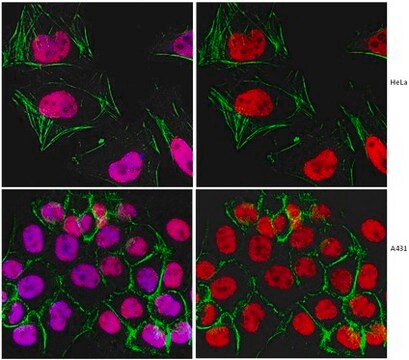
Immunocytochemistry Analysis: A 1:500 dilution from a representative lot detected Replication Protein A in HeLa and A431 cells.

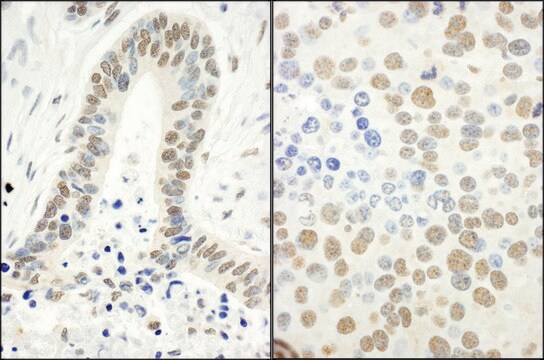
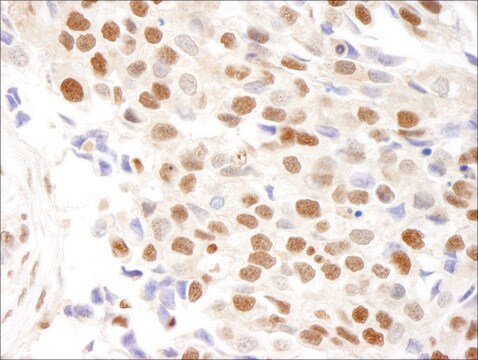
Immunohistochemistry Analysis: A 1:5 dilution from a representative lot detected Replication Protein A in human colorectal adenocarcinoma tissues.
Research Category
Epigenetics & Nuclear Function
Research Sub Category
Cell Cycle, DNA Replication & Repair
Use Anti-Replication Protein A Antibody, clone RPA34-20 (mouse monoclonal antibody) validated in WB, ICC, IHC to detect Replication Protein A also known as Replication protein A 32 kDa subunit, RP-A p32.

Physical form

Format: Purified
Protein G Purified
Purified mouse monoclonal IgG1κ in buffer containing 0.1 M Tris-Glycine (pH 7.4), 150 mM NaCl with 0.05% sodium azide.

Preparation Note

Stable for 1 year at 2-8°C from date of receipt.

Analysis Note

Control
HeLa cell lysate.B10
Evaluated by Western Blot in HeLa cell lysate.

Western Blot Analysis: 1 µg/mL of this antibody detected Replication Protein A in 10 µg of HeLa cell lysate.

Other Notes

Concentration: Please refer to the Certificate of Analysis for the lot-specific concentration.
Replaces: NA19L

Disclaimer

Unless otherwise stated in our catalog or other company documentation accompanying the product(s), our products are intended for research use only and are not to be used for any other purpose, which includes but is not limited to, unauthorized commercial uses, in vitro diagnostic uses, ex vivo or in vivo therapeutic uses or any type of consumption or application to humans or animals.
Ta strona może zawierać tekst przetłumaczony maszynowo.

Porównaj podobne pozycje

Wyświetl pełne porównanie

Pokaż różnice

1 of 1

Ta pozycja
MABE286PLA0310SAB1406399
conjugate

unconjugated

conjugate

unconjugated

conjugate

-

conjugate

unconjugated

biological source

mouse

biological source

mouse

biological source

rabbit

biological source

mouse

antibody form

purified immunoglobulin

antibody form

purified antibody

antibody form

affinity purified immunoglobulin

antibody form

purified immunoglobulin

Gene Information

human ... RPA2(6118)

Gene Information

human ... RPA2(6118)

Gene Information

human ... RPA2(6118)

Gene Information

human ... RPA1(6117)

species reactivity

human

species reactivity

human

species reactivity

human

species reactivity

human

clone

RPA34-20, monoclonal

clone

RPA34-19, monoclonal

clone

-

clone

polyclonal


Still not finding the right product?

Wypróbuj nasze narzędzie Narzędzie selektora produktów, aby zawęzić opcje.


Klasa składowania

12 - Non Combustible Liquids

wgk

WGK 1

flash_point_f

Not applicable

flash_point_c

Not applicable


Certyfikaty analizy (CoA)

Poszukaj Certyfikaty analizy (CoA), wpisując numer partii/serii produktów. Numery serii i partii można znaleźć na etykiecie produktu po słowach „seria” lub „partia”.

Masz już ten produkt?

Dokumenty związane z niedawno zakupionymi produktami zostały zamieszczone w Bibliotece dokumentów.

Odwiedź Bibliotekę dokumentów


Powiązane treści

New Products: Antibodies, Assays, Small Molecules, Inhibitors, and Proteins


Victor Chun-Lam Wong et al.
Cell cycle (Georgetown, Tex.), 11(13), 2526-2537 (2012-06-23)
We examined genotoxic signaling and cell fate decisions in response to a potent DNA-protein crosslinker formaldehyde (FA). DNA-protein crosslinks (DPC) are poorly understood lesions produced by bifunctional carcinogens and several cancer drugs. FA-treated human cells showed a rapid activation of
Yana P Blokhina et al.
Journal of visualized experiments : JoVE, (157) (2020-03-24)
Meiosis is the key cellular process required to create haploid gametes for sexual reproduction. Model organisms have been instrumental in understanding the chromosome events that take place during meiotic prophase, including the pairing, synapsis, and recombination events that ensure proper
Joëlle A Desmarais et al.
Stem cells (Dayton, Ohio), 30(7), 1385-1393 (2012-05-04)
Pluripotent cells of the early embryo, to which embryonic stem cells (ESCs) correspond, give rise to all the somatic cells of the developing fetus. Any defects that occur in their genome or epigenome would have devastating consequences. Genetic and epigenetic


Numer pozycji handlu globalnego

SKUNUMER GTIN
MABE28504053252549304

Questions

Reviews

No rating value

Active Filters