Przejdź do zawartości
Merck

Przejdź do

MABC40

Anti-LAMP-2 Antibody, clone ABL-93

clone ABL-93, from rat

Synonim(y):

lysosomal-associated membrane protein 2, CD107 antigen-like family member B, CD107b antigen

Zaloguj się, aby wyświetlić ceny organizacyjne i kontraktowe.

Wybierz wielkość

Zmień widok
Gabaryty przesyłkiSKUDostępnośćCena netto
100 μg

Przewidywany termin wysyłki21 maja 2026zKuehne + Nagel Sp. z o.o.

1820,00 zł

Informacje o tej pozycji

UNSPSC Code:
12352203
NACRES:
NA.41
eCl@ss:
32160702
Conjugate:
unconjugated
Clone:
ABL-93, monoclonal
Application:
IF, IP, WB
Citations:
7

1820,00 zł


Przewidywany termin wysyłki21 maja 2026Szczegóły


Zamów zamówienie zbiorcze
Pomoc techniczna
Potrzebujesz pomocy? Nasz zespół doświadczonych naukowców chętnie Ci pomoże.
Pozwól nam pomóc


biological source

rat

Quality Level

conjugate

unconjugated

antibody form

purified immunoglobulin

antibody product type

primary antibodies

clone

ABL-93, monoclonal

species reactivity

mouse

technique(s)

immunofluorescence: suitable, immunoprecipitation (IP): suitable, western blot: suitable

isotype

IgG2aκ

NCBI accession no.

UniProt accession no.

shipped in

wet ice

target post-translational modification

unmodified

Gene Information

mouse ... Lamp2(16784)

General description

Lysosome-associated membrane protein 2 (LAMP-2) is a highly glycosolated protein belonging to the lysosome-associated membrane protein family. This group pf proteins composes a significant portion of the lysosomal membrane and are considered crucial mediators for cellular adhesion by interacting with carbohydrate receptors. LAMP-2 is a profuse and critical component of the lysosomal membrane as it has been implicated in playing a role in lysosomal biogenesis. It also appears to be involved in later stages of phagocytosis and autophagy, where it may act to protect the lysosomal membrane from being digested, assist in signal transduction, moderate levels of acidity within the lysosomal environment, and participate in adhesion. Mutations in LAMP-2 expression have been associated with lysosomal storage diseases or LSDs, along with Danon disease, an X-linked disorder characterized by skeletal myopathy, mental retardation, and hypertrophic cardiomyopathy.
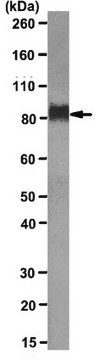
~ 80 kDa observed MW. The calculated MW is 45 kDa LAMP-2 is heavily glycosoated and has been routinely observed at MW′s of 80-120 kDa based on publication data, (Chen, 1985; Ferguson, 2009).

Immunogen

Purified glycoproteins from NIH/3T3 cells, corresponding to mouse LAMP-2.

Application

Anti-LAMP-2 Antibody, clone ABL-93 is an antibody against LAMP-2 for use in WB, IP & IF.
Immunoprecipitation Analysis: This antibody has been shown to immunoprecipitate LAMP-2 in HaNIH cells, (Chen, 1985).

Immunofluorescence Analysis: This antibody has been shown to detect LAMP-2 in mouse brain, (Ferguson, 2009).
Research Category
Apoptosis & Cancer
Research Sub Category
Apoptosis - Additional

Biochem/physiol Actions

This antibody recognizes LAMP-2.

Physical form

Format: Purified
Protein G
Purified rat monoclonal IgG2aκ in buffer containing 0.1 M Tris-Glycine (pH 7.4), 150 mM NaCl with 0.05% sodium azide.

Preparation Note

Stable for 1 year at 2-8°C from date of receipt.

Analysis Note

Control
NIH/3T3 cell lysate
Evaluated by Western Blot in NIH/3T3 cell lysate.

Western Blot Analysis: 1 µg/mL of this antibody detected LAMP-2 in 10 µg of NIH/3T3 cell lysate.

Other Notes

Concentration: Please refer to the Certificate of Analysis for the lot-specific concentration.

Disclaimer

Unless otherwise stated in our catalog or other company documentation accompanying the product(s), our products are intended for research use only and are not to be used for any other purpose, which includes but is not limited to, unauthorized commercial uses, in vitro diagnostic uses, ex vivo or in vivo therapeutic uses or any type of consumption or application to humans or animals.
Ta strona może zawierać tekst przetłumaczony maszynowo.

Porównaj podobne pozycje

Wyświetl pełne porównanie

Pokaż różnice

1 of 1

Ta pozycja
PRS3627MABC39MABC1108
antibody form

purified immunoglobulin

antibody form

affinity isolated antibody

antibody form

purified immunoglobulin

antibody form

purified immunoglobulin

clone

ABL-93, monoclonal

clone

polyclonal

clone

1D4B, monoclonal

clone

H4A3, monoclonal

biological source

rat

biological source

rabbit

biological source

rat

biological source

mouse

species reactivity

mouse

species reactivity

mouse, human

species reactivity

mouse

species reactivity

human

conjugate

unconjugated

conjugate

unconjugated

conjugate

unconjugated

conjugate

unconjugated

Gene Information

mouse ... Lamp2(16784)

Gene Information

mouse ... Lamp2(16784)

Gene Information

mouse ... Lamp1(16783)

Gene Information

human ... LAMP1(3916)


Still not finding the right product?

Wypróbuj nasze narzędzie Narzędzie selektora produktów, aby zawęzić opcje.


Klasa składowania

12 - Non Combustible Liquids

wgk

WGK 1

flash_point_f

Not applicable

flash_point_c

Not applicable


Certyfikaty analizy (CoA)

Poszukaj Certyfikaty analizy (CoA), wpisując numer partii/serii produktów. Numery serii i partii można znaleźć na etykiecie produktu po słowach „seria” lub „partia”.

Masz już ten produkt?

Dokumenty związane z niedawno zakupionymi produktami zostały zamieszczone w Bibliotece dokumentów.

Odwiedź Bibliotekę dokumentów


Celia A McKee et al.
Scientific reports, 12(1), 1796-1796 (2022-02-04)
An emerging link between circadian clock function and neurodegeneration has indicated a critical role for the molecular clock in brain health. We previously reported that deletion of the core circadian clock gene Bmal1 abrogates clock function and induces cell-autonomous astrocyte activation. Regulation of
Hui Shen et al.
Neural regeneration research, 18(8), 1770-1776 (2023-02-09)
Recent studies have shown that microglia/macrophages and astrocytes can mediate synaptic phagocytosis through the MER proto-oncokinase in developmental or stroke models, but it is unclear whether the same mechanism is also active in traumatic brain injury. In this study, we
Abhilash P Appu et al.
Journal of inherited metabolic disease, 42(5), 944-954 (2019-04-27)
Mutations in at least 13 different genes (called CLNs) underlie various forms of neuronal ceroid lipofuscinoses (NCLs), a group of the most common neurodegenerative lysosomal storage diseases. While inactivating mutations in the CLN1 gene, encoding palmitoyl-protein thioesterases-1 (PPT1), cause infantile


Numer pozycji handlu globalnego

SKUNUMER GTIN
MABC4004053252523854

Questions

Reviews

No rating value

Active Filters