Przejdź do zawartości
Merck

Przejdź do

MAB4310

Anti-CD133 Antibody, clone 13A4

clone 13A4, Chemicon®, from rat

Synonim(y):

Prominin-1, AC133 (human)

Zaloguj się, aby wyświetlić ceny organizacyjne i kontraktowe.

Wybierz wielkość

Zmień widok
Gabaryty przesyłkiSKUDostępnośćCena netto
100 μg

Dostępne do wysyłki DZISIAJzKuehne + Nagel Sp. z o.o.

2180,00 zł

Informacje o tej pozycji

UNSPSC Code:
12352203
NACRES:
NA.41
eCl@ss:
32160702
Conjugate:
unconjugated
Clone:
13A4, monoclonal
Application:
FACS, IHC, IP, WB
Citations:
28

2180,00 zł


Dostępne do wysyłki DZISIAJSzczegóły


Zamów zamówienie zbiorcze
Pomoc techniczna
Potrzebujesz pomocy? Nasz zespół doświadczonych naukowców chętnie Ci pomoże.
Pozwól nam pomóc


biological source

rat

Quality Level

conjugate

unconjugated

antibody form

purified immunoglobulin

antibody product type

primary antibodies

clone

13A4, monoclonal

species reactivity

mouse

should not react with

chicken, Drosophila, rat

manufacturer/tradename

Chemicon®

technique(s)

flow cytometry: suitable, immunohistochemistry: suitable, immunoprecipitation (IP): suitable, western blot: suitable

input

sample type hematopoietic stem cell(s)
sample type neural stem cell(s)
sample type epithelial cells
sample type: mouse embryonic stem cell(s)
sample type mesenchymal stem cell(s)

isotype

IgG1κ

suitability

not suitable for immunohistochemistry (Paraffin)

NCBI accession no.

UniProt accession no.

shipped in

wet ice

target post-translational modification

unmodified

Gene Information

dog ... Prom1(488816)
human ... PROM1(8842)
mouse ... Prom1(19126)
rat ... Prom1(60357)

General description

115 kDa
Prominin is a novel plasma membrane protein with an N-terminal extracellular domain, five transmembrane segments flanking two short cytoplasmic loops and two large glycosylated extracellular domains, and a cytoplasmic C-terminal domain. DNA sequences from Caenorhabditis elegans predict the existence of a protein with the same features, suggesting that prominin is conserved between vertebrates and invertebrates. Prominin is found not only in the neuroepithelium but also in various other epithelia of the mouse embryo. In the adult mouse, prominin has been detected in the brain ependymal layer, and in kidney tubules. In these epithelia, prominin is specific to the apical surface, where it is selectively associated with microvilli and microvilli-related structures. Remarkably, upon expression in CHO cells, prominin is preferentially localized to plasma membrane protrusions such as filopodia, lamellipodia, and microspikes. These observations imply that prominin contains information to be targeted to, and/or retained in, plasma membrane protrusions rather than the planar cell surface. Moreover, results show that the mechanisms underlying targeting of membrane proteins to microvilli of epithelial cells and to plasma membrane protrusions of non-epithelial cells are highly related. {Weigmann, A et al.1997}. Also see {http://www.ncbi.nlm.nih.gov/prow/guide/438375806_g.htm} for more information on CD133 and prominin expression.

Immunogen

Telencephali of ten 12-day-old NMRI mouse embryos (E12, ~1 mg protein), which consist mostly of neuroepithelium, were homogenized in 1 ml PBS, mixed with crushed nitrocellulose filter (1 cm2 in 0.5 ml PBS) as adjuvant, and injected i.p. into a LouXSD rat. {Weigmann et al, PNAS 1997}

Application

Anti-CD133 Antibody, clone 13A4 detects level of CD133 & has been published & validated for use in FC, IH, IP & WB.

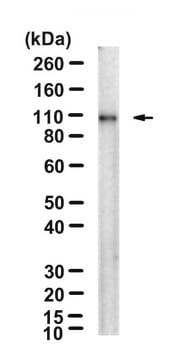
Western Blot Analysis: A 1:1000 dilution from a representative lot detected CD133 in monkey kidney lysate.
Research Category
Stem Cell Research
Research Sub Category
Neural Stem Cells

Hematopoietic Stem Cells

Biochem/physiol Actions

Recognizes mouse Prominin-1 (sometimes also referred to as CD133 and, in the case of the human orthologue, as AC133), a 115-120 kDa pentaspan transmembrane (5-TM) domain glycoprotein. Prominin-1 is expressed on primitive cells such as hematopoietic stem and progenitor cells, neural & endothelial stem cells, retina and retinoblastoma, as well as developing epithelium. To date, the function and ligand of Prominin-1 are unknown.

This antibody can be used to isolate murine stem cells from brain and bone marrow.

The 13A4 antibody does not cross react with rat, human, chicken, or Drosophila antigen. The original paper is located at: http://www.pnas.org/cgi/reprint/94/23/12425.pdf

Physical form

Format: Purified
Protein A Purified mouse immunoglobulin in 20 mM sodium phosphate, 250 mM NaCl, pH. 7.6, with 0.1% sodium azide as a preservative.
Protein A purified

Preparation Note

Maintain for 1 year at 2–8°C from date of shipment. For maximum recovery of product, centrifuge the original vial after thawing and prior to removing the cap.

Analysis Note

Control
Positive Control: Kidney tissue or membranes
Negative Control: Liver tissue or membranes

Other Notes

Concentration: Please refer to the Certificate of Analysis for the lot-specific concentration.

Legal Information

CHEMICON is a registered trademark of Merck KGaA, Darmstadt, Germany

Disclaimer

Unless otherwise stated in our catalog or other company documentation accompanying the product(s), our products are intended for research use only and are not to be used for any other purpose, which includes but is not limited to, unauthorized commercial uses, in vitro diagnostic uses, ex vivo or in vivo therapeutic uses or any type of consumption or application to humans or animals.
Ta strona może zawierać tekst przetłumaczony maszynowo.

Porównaj podobne pozycje

Wyświetl pełne porównanie

Pokaż różnice

1 of 1

Ta pozycja
SAB4701143FCMAB216APSAB5700600
biological source

rat

biological source

mouse

biological source

mouse

biological source

rabbit

conjugate

unconjugated

conjugate

Allophycocyanin conjugate

conjugate

Allophycocyanin conjugate

conjugate

unconjugated

clone

13A4, monoclonal

clone

293C3, monoclonal

clone

MI15, monoclonal

clone

polyclonal

species reactivity

mouse

species reactivity

-

species reactivity

human

species reactivity

mouse, human, rat

antibody form

purified immunoglobulin

antibody form

purified immunoglobulin

antibody form

purified immunoglobulin

antibody form

affinity isolated antibody

Gene Information

dog ... Prom1(488816)
human ... PROM1(8842)
mouse ... Prom1(19126)
rat ... Prom1(60357)

Gene Information

human ... PROM1(8842)

Gene Information

human ... SDC1(6382)

Gene Information

human ... PROM1(8842)


Still not finding the right product?

Wypróbuj nasze narzędzie Narzędzie selektora produktów, aby zawęzić opcje.


Klasa składowania

12 - Non Combustible Liquids

wgk

WGK 2

flash_point_f

Not applicable

flash_point_c

Not applicable


Certyfikaty analizy (CoA)

Poszukaj Certyfikaty analizy (CoA), wpisując numer partii/serii produktów. Numery serii i partii można znaleźć na etykiecie produktu po słowach „seria” lub „partia”.

Masz już ten produkt?

Dokumenty związane z niedawno zakupionymi produktami zostały zamieszczone w Bibliotece dokumentów.

Odwiedź Bibliotekę dokumentów


Powiązane treści

As the focus of stem cell research undergoes a transition from animal to human models, researchers are in critical need of validated products to support the isolation, maintenance, differentiation, and characterization of human stem cells. While many reagents designed for rodent systems can be applied to human stem cell studies, they are not truly optimized for robust human stem cell culture or analysis. This is why human stem cell researchers have always trusted EMD Millipore, the first provider of commercially available human embryonic stem cells and human neural stem cell lines, to accelerate their research. All of our human stem cell systems are extensively tested in defined media culture, and differentiated progeny are comprehensively characterized with highly validated antibodies and detection reagents.


Regional differences in stem cell/progenitor cell populations from the mouse achilles tendon.
Mienaltowski, MJ; Adams, SM; Birk, DE
Tissue Engineering: Part A null
Taofeek K Owonikoko et al.
Journal of translational medicine, 14(1), 111-111 (2016-05-05)
SCLC has limited treatment options and inadequate preclinical models. Promising activity of arsenic trioxide (ASO) recorded in conventional preclinical models of SCLC supported the clinical evaluation of ASO in patients. We assessed the efficacy of ASO in relapsed SCLC patients
Ectopic expression of the WWOX gene suppresses stemness of human ovarian cancer stem cells.
Yan, HC; Xu, J; Fang, LS; Qiu, YY; Lin, XM; Huang, HX; Han, QY
Oncology Letters null


Numer pozycji handlu globalnego

SKUNUMER GTIN
MAB431004053252662362

Questions

Reviews

No rating value

Active Filters