


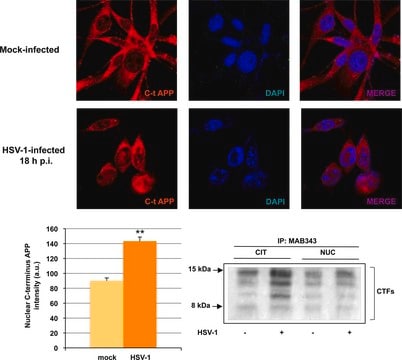
We've struggled to find an APP antibody that consistently worked for our WB and IF experiments. This antibody has worked excellently.
MAB348

Anti-Beta (β)-Amyloid antibody
CHEMICON®, mouse monoclonal, 22C11
Anti-APP A4 Antibody, a.a. 66-81 of APP {NT}, clone 22C11
Synonim(y):
APP, Anti - APP A4, Anti-amyloid precursor protein A4
Zaloguj się, aby wyświetlić ceny organizacyjne i kontraktowe.
Wybierz wielkość
Zmień widok
| Gabaryty przesyłki | SKU | Dostępność | Cena netto |
|---|---|---|---|
| 50 μg | Sprawdź dostępność w koszyku | 2660,00 zł |
Informacje o tej pozycji
UNSPSC Code:
12352203
eCl@ss:
32160702
NACRES:
NA.41
Clone:
22C11, monoclonal
Species reactivity:
rat, fish, human, mouse, canine, pig, monkey
Application:
IF, IHC (p), WB
Citations:
610
2660,00 zł
Sprawdź dostępność w koszyku
Rekombinowane, niezawierające konserwantów przeciwciało jest dostępne dla Twojego celu. Wypróbuj ZRB1151
Pomoc techniczna
Potrzebujesz pomocy? Nasz zespół doświadczonych naukowców chętnie Ci pomoże.
Pozwól nam pomócNazwa produktu
Anti-APP A4 Antibody, a.a. 66-81 of APP {NT}, clone 22C11, clone 22C11, Chemicon®, from mouse
biological source
mouse
Quality Level
antibody form
purified immunoglobulin
antibody product type
primary antibodies
clone
22C11, monoclonal
species reactivity
rat, fish, human, mouse, canine, pig, monkey
manufacturer/tradename
Chemicon®
technique(s)
immunofluorescence: suitable, immunohistochemistry (formalin-fixed, paraffin-embedded sections): suitable, western blot: suitable
isotype
IgG1
NCBI accession no.
UniProt accession no.
shipped in
dry ice
target post-translational modification
unmodified
Gene Information
human ... APP(351)
General description
The β/A4 amyloid precursor protein (APP) is a transmembrane glycoprotein[1] and exists in three isoforms. This protein is composed of a single-pass transmembrane domain, a large extracellular N-terminal domain, and a short cytoplasmic C-terminal tail. The APP gene is located on the human chromosome at 21q21.3-q22.[2]
110/120/130 kDa
Immunogen
Epitope: a.a. 66-81 of APP {N-terminus}
Purified recombinant Alzheimer precursor A4 (pre A4695) fusion protein.
Application
Biochem/physiol Actions
Anti-APP A4 Antibody reacts with pre-A4 and recognizes amino acids 66-81 of the N-terminus on the pre-A4 molecule (Hilbich et al., 1993). 22C11 recognizes all three isoforms of APP, immature ~110kDa, sAPP ~120kDa, and mature ~130kDa (Hoffmann et al., 2000). The Anti-APP A4 antibody is known to cross-react with APLP2 (Slunt, 1994).
The β/A4 amyloid precursor protein (APP) undergoes proteolytic cleavage and produces β/A4 peptide. The extracellular deposition of this peptide is observed in brain cortical parenchyma and cerebro-meningeal blood vessels which marks the pathological condition of Alzheimer′s disease. Mutations of the APP gene lead to the early onset of Alzheimer′s disease and hereditary cerebral hemorrhage with amyloidosis.[1]
Physical form
Format: Purified
Protein A Purified mouse immunoglobulin in 20 mM sodium phosphate, 250 mM NaCl, pH. 7.6, with 0.1% sodium azide as a preservative.
Protein A purified
Preparation Note
Maintain for 1 year at 2–8°C from date of shipment. Aliquot to avoid repeated freezing and thawing. For maximum recovery of product, centrifuge the original vial after thawing and prior to removing the cap.
Analysis Note
Control
Brain tissue, brain cell lysates
Brain tissue, brain cell lysates
Other Notes
Concentration: Please refer to the Certificate of Analysis for the lot-specific concentration.
Legal Information
CHEMICON is a registered trademark of Merck KGaA, Darmstadt, Germany
Disclaimer
Unless otherwise stated in our catalog or other company documentation accompanying the product(s), our products are intended for research use only and are not to be used for any other purpose, which includes but is not limited to, unauthorized commercial uses, in vitro diagnostic uses, ex vivo or in vivo therapeutic uses or any type of consumption or application to humans or animals.
Ta strona może zawierać tekst przetłumaczony maszynowo.
1 of 1
Ta pozycja | |||
|---|---|---|---|
| antibody form purified immunoglobulin | antibody form affinity isolated antibody | antibody form ascites fluid | antibody form serum |
| Gene Information human ... APP(351) | Gene Information human ... APP(351) | Gene Information human ... APP(351) | Gene Information human ... APP(351) |
| clone 22C11, monoclonal | clone polyclonal | clone 2.F2.19B4, monoclonal | clone polyclonal |
| biological source mouse | biological source rabbit | biological source mouse | biological source goat |
| species reactivity rat, fish, human, mouse, canine, pig, monkey | species reactivity mouse, eukaryotes, rat, human | species reactivity rat, human | species reactivity human |
| UniProt accession no. | UniProt accession no. | UniProt accession no. | UniProt accession no. |
Still not finding the right product?
Klasa składowania
12 - Non Combustible Liquids
wgk
WGK 2
flash_point_c
Not applicable
Certyfikaty analizy (CoA)
Poszukaj Certyfikaty analizy (CoA), wpisując numer partii/serii produktów. Numery serii i partii można znaleźć na etykiecie produktu po słowach „seria” lub „partia”.
Masz już ten produkt?
Dokumenty związane z niedawno zakupionymi produktami zostały zamieszczone w Bibliotece dokumentów.
Protokoły
Protokół hodowli komórek macierzystych do generowania modeli 3D NSC choroby Alzheimera z wykorzystaniem linii ludzkich neuronalnych komórek macierzystych ReNcell.
A stem cell culture protocol to generate 3D NSC models of Alzheimer’s disease using ReNcell human neural stem cell lines.
Powiązane treści
There’s so much room for experimental variability in traditional immunodetection workflows. For your peace of mind – and ours – we designed the SNAP i.d.® 2.0 system to streamline your Western blot and immunohistochemistry experiments. The concept is simple: a vacuum-driven flow of blocking, antibody, and washing solutions reduces slide and membrane handling. That means a lot less shaking, dipping, pouring and waiting. And now you can process multiple blots and slides in parallel, so it’s easy to apply consistent conditions across experiments.
Alzheimer’s Disease: Amyloid Cascade and Beyond Product Focus
G L Caporaso et al.
The Journal of neuroscience : the official journal of the Society for Neuroscience, 14(5 Pt 2), 3122-3138 (1994-05-01)
Abnormal metabolic processing of the beta/A4 amyloid precursor protein (APP) has been implicated in the pathogenesis of Alzheimer disease. Several aspects of normal APP processing have been elucidated, but the precise cellular trafficking of APP remains unclear. To investigate APP
Protein phosphorylation regulates secretion of Alzheimer beta/A4 amyloid precursor protein
Caporaso G L, et al.
Proceedings of the National Academy of Sciences of the USA, 89(7), 3055-3059 (1992)
Response of Circulating Inflammatory Markers to Intermittent Hypoxia-Hyperoxia Training in Healthy Elderly People and Patients with Mild Cognitive Impairment
Serebrovska Z O, et al.
All Life, 12(3), 432-432 (2022)
Numer pozycji handlu globalnego
| SKU | NUMER GTIN |
|---|---|
| MAB348 | 08436037126390 |