

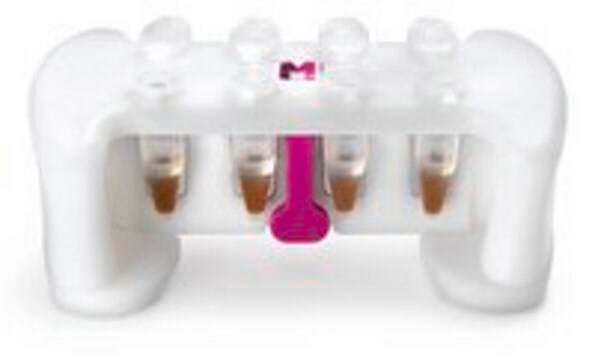


The beads are not characterized in terms of beads/ml but only in terms of a percentage slurry (10%, weight [g] by volume [mL]).
LSKMAGA

PureProteome Protein A Magnetic Bead System
The PureProteome Protein A Magnetic Bead System is a powerful system that helps researchers purify proteins by maximizing recovery and eliminating variability
Synonim(y):
Protein A Magnetic Beads
Zaloguj się, aby wyświetlić ceny organizacyjne i kontraktowe.
Wybierz wielkość
Zmień widok
| Gabaryty przesyłki | SKU | Dostępność | Cena netto |
|---|---|---|---|
| 2 x 1 mL | Dostępne do wysyłki DZISIAJzKuehne + Nagel Sp. z o.o. | 1420,00 zł | |
| 10 mL | Dostępne do wysyłki DZISIAJzKuehne + Nagel Sp. z o.o. | 4350,00 zł |
Informacje o tej pozycji
UNSPSC Code:
41105507
NACRES:
NA.56
eCl@ss:
32160405
1420,00 zł
Dostępne do wysyłki DZISIAJSzczegóły
Pomoc techniczna
Potrzebujesz pomocy? Nasz zespół doświadczonych naukowców chętnie Ci pomoże.
Pozwól nam pomócQuality Level
packaging
pkg of 2 × 1 mL
manufacturer/tradename
PureProteome
technique(s)
depletion: suitable (serum), immunoprecipitation (IP): suitable, protein purification: suitable
particle size
10 μm
capacity
1.5-2.5 μg/μL, suspension binding capacity (rabbit IgG)
shipped in
wet ice
General description
The PureProteome™ Protein A Magnetic Bead System is a powerful system that helps researchers in protein purification by maximizing recovery and reducing variability.
Application
PureProteome™ Protein A Magnetic Bead System may be used:
- in serum depletion, in immunoprecipitation, for protein purification, and in cell lysates to analyze the bound proteins by western blot[1]
- in magnetic bead-binding assays[1]
- for immunoprecipitating cell lysate and antibodies for ATPase activity[1]
Legal Information
PureProteome is a trademark of Merck KGaA, Darmstadt, Germany
Disclaimer
Unless otherwise stated in our catalog or other company documentation accompanying the product(s), our products are intended for research use only and are not to be used for any other purpose, which includes but is not limited to, unauthorized commercial uses, in vitro diagnostic uses, ex vivo or in vivo therapeutic uses or any type of consumption or application to humans or animals.
Ta strona może zawierać tekst przetłumaczony maszynowo.
1 of 1
Ta pozycja | |||
|---|---|---|---|
| particle size 10 μm | particle size 10 μm | particle size 10 μm | particle size 10 μm |
| manufacturer/tradename PureProteome | manufacturer/tradename PureProteome | manufacturer/tradename PureProteome | manufacturer/tradename PureProteome |
| packaging pkg of 2 × 1 mL | packaging pkg of 2 × 1 mL | packaging pkg of 10 mL | packaging pkg of 2 × 1 mL |
| capacity 1.5-2.5 μg/μL, suspension binding capacity (rabbit IgG) | capacity 2.5-3.5 μg/μL, suspension binding capacity (rabbit IgG) | capacity 1-5.5 mg/mL, bead suspension binding capacity (protein) | capacity 2-3 mg/mL, suspension binding capacity (rabbit IgG) |
| shipped in wet ice | shipped in wet ice | shipped in ambient | shipped in wet ice |
| technique(s) depletion: suitable (serum), protein purification: suitable, immunoprecipitation (IP): suitable | technique(s) depletion: suitable (serum), immunoprecipitation (IP): suitable, protein purification: suitable | technique(s) protein purification: suitable (histidine tagged recombinant protein) | technique(s) immunoprecipitation (IP): suitable (crosslinking), protein purification: suitable (antibody) |
Klasa składowania
12 - Non Combustible Liquids
flash_point_f
Not applicable
flash_point_c
Not applicable
signalword
Warning
hcodes
Hazard Classifications
Skin Sens. 1
Certyfikaty analizy (CoA)
Poszukaj Certyfikaty analizy (CoA), wpisując numer partii/serii produktów. Numery serii i partii można znaleźć na etykiecie produktu po słowach „seria” lub „partia”.
Masz już ten produkt?
Dokumenty związane z niedawno zakupionymi produktami zostały zamieszczone w Bibliotece dokumentów.
Produkty
Możliwe przyczyny i potencjalne środki zaradcze dla wyzwań napotykanych w technice immunoprecypitacji-Western blot, która składa się z lizy komórek, tworzenia kompleksu przeciwciało-antygen (immunologicznego), wytrącania kompleksów immunologicznych i analizy metodą Western blot.
PureProteome™ Protein A and G Magnetic beads provide a rapid and reproducible means to purify immunoglobulins (IgG) using the KingFisher Duo particle processor.
The possible causes and potential remedies for challenges encountered in the immunoprecipitation-Western blot technique, which consists of cell lysis, formation of the antibody-antigen (immune) complex, precipitation of the immune complexes, and analysis by Western blotting.
Powiązane treści
Find protein research tools to prepare, isolate, and analyze proteins. Organized by how to extract, protect, purify, enrich, modify, and quantify proteins.
Immunoprecipitation (IP) is a powerful technique for proteomic screening, biomarker discovery, and signaling network elucidation. It is frequently used to enrich target proteins from complex samples such as cell lysates or extracts. Traditional IP protocols use Protein A, Protein G or a mixture of Protein A and G coupled to a solid support resin, such as agarose beads, to capture an antigen/antibody complex in solution. As the number of samples increase, the traditional, manual IP method can be time-consuming. Processing of multiple IP reactions in parallel can introduce complexity, variability and pipetting errors, which may affect reproducibility.
Konstantin Chegaev et al.
ACS medicinal chemistry letters, 8(3), 361-365 (2017-03-25)
Nitric oxide (NO) release from a suitable NO photodonor (NOP) can be fine-tuned by visible light stimuli at doses that are not toxic to cells but that inhibit several efflux pumps; these are mainly responsible for the multidrug resistance of
Kris Wilson et al.
Journal of biomolecular screening, 20(2), 292-298 (2014-10-10)
Human kynurenine 3-monooxygenase (KMO) is emerging as an important drug target enzyme in a number of inflammatory and neurodegenerative disease states. Recombinant protein production of KMO, and therefore discovery of KMO ligands, is challenging due to a large membrane targeting
Holger Laux et al.
Biotechnology and bioengineering, 115(10), 2530-2540 (2018-05-20)
An increasing number of nonantibody format proteins are entering clinical development. However, one of the major hurdles for the production of nonantibody glycoproteins is host cell-related proteolytic degradation, which can drastically impact developability and timelines of pipeline projects. Chinese hamster
Numer pozycji handlu globalnego
| SKU | NUMER GTIN |
|---|---|
| LSKMAGA10 | 04053252408557 |
| LSKMAGA02 | 04053252674846 |
-
What is the concentration of the beads?
1 answer-
Helpful?
-