Przejdź do zawartości
Merck

Przejdź do

CBL407

Anti-PCNA Antibody, clone PC10

clone PC10, Chemicon®, from mouse

Synonim(y):

Proliferating Cell Nuclear Antigen, DNA Polymerase delta Processivity Factor

Zaloguj się, aby wyświetlić ceny organizacyjne i kontraktowe.

Wybierz wielkość

Zmień widok
Gabaryty przesyłkiSKUDostępnośćCena netto
100 μg

Przewidywany termin wysyłki20 kwietnia 2026zKuehne + Nagel Sp. z o.o.

1350,00 zł

Informacje o tej pozycji

UNSPSC Code:
12352203
NACRES:
NA.41
eCl@ss:
32160702
Conjugate:
unconjugated
Clone:
PC10, monoclonal
Application:
ELISA, FACS, IHC, IP, WB
Citations:
24

1350,00 zł


Przewidywany termin wysyłki20 kwietnia 2026Szczegóły


Zamów zamówienie zbiorcze
Pomoc techniczna
Potrzebujesz pomocy? Nasz zespół doświadczonych naukowców chętnie Ci pomoże.
Pozwól nam pomóc


biological source

mouse

Quality Level

conjugate

unconjugated

antibody form

purified antibody

antibody product type

primary antibodies

clone

PC10, monoclonal

species reactivity

vertebrates, invertebrates

manufacturer/tradename

Chemicon®

technique(s)

ELISA: suitable, flow cytometry: suitable, immunohistochemistry: suitable (paraffin), immunoprecipitation (IP): suitable, western blot: suitable

isotype

IgG2a

NCBI accession no.

UniProt accession no.

shipped in

wet ice

target post-translational modification

unmodified

Gene Information

human ... PCNA(5111)

General description

Proliferating cell nuclear antigen (UniProt: P04961; also known as PCNA) is encoded by the Pcna gene (Gene ID: 25737) in rat. PCNA is a homotrimeric nuclear protein that serves as an auxiliary protein of DNA polymerase delta and is involved in the control of eukaryotic DNA replication by increasing the polymerase′s processability during elongation of the leading strand. It Induces a robust stimulatory effect on the 3′-5′ exonuclease and 3′-phosphodiesterase, but not apurinic-apyrimidinic (AP) endonuclease, APEX2 activities. It is reported to colocalize with CREBBP, EP300 and POLD1 to sites of DNA damage. It acts as a loading platform to recruit DDR proteins that allow completion of DNA replication after DNA damage and promote post-replication repair. PCNA can undergo phosphorylation on tyrosine 211 by EGFR that stabilizes chromatin-associated PCNA. Following DNA damage, it can undergo monoubiquitination to stimulate direct bypass of DNA lesions by specialized DNA polymerases or polyubiquitination to promote recombination-dependent DNA synthesis across DNA lesions by template switching mechanisms. Mutations in PCN gene are known to cause Ataxia-telangiectasia-like disorder 2 (ATLD2) that is characterized by developmental delay, ataxia, hearing loss, and short stature.

Immunogen

Rat PCNA induced in the Protein A expression vector pR1T2T.

Application

Anti-PCNA Antibody, clone PC10 is a mouse monoclonal antibody for detection of PCNA also known as Proliferating Cell Nuclear Antigen, DNA Polymerase delta Processivity Factor & has been validated in ELISA, FC, IP, WB,IHC(P).
Research Category
Epigenetics & Nuclear Function
Research Sub Category
Cell Cycle, DNA Replication & Repair

Biochem/physiol Actions

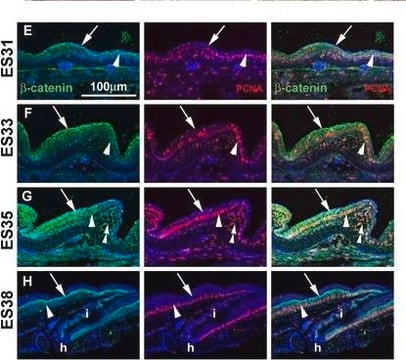
Clone PC10 recognizes PCNA from all vertebrate and insect species tested and has been used to identify transformed cells (Kurki, 1988), proliferating cells in solid tumors (Smetana, 1983), and blast cells in leukemia patients (Takasaki, 1984). Immunohistochemistry with clone PC10 has been used to study the expression of PCNA in paraffin sections of normal tissues and lymphoid neoplasms (Hall, 1990). In proliferating cells, PCNA staining pattern is predominantly nuclear. By western blot, the antibody detects a polypeptide migrating at 36 kDa with an isoelectric point of 4.8.

Physical form

Format: Purified
The monoclonal is presented at a concentration of 100μg/1mL in phosphate buffered saline containing 10mM sodium azide and 1mg/ml bovine serum albumin. We recommend that each laboratory determine an optimum working titre for use in its particular application.

Preparation Note

For use within 1 month of purchase store at +4°C, for long term storage aliquot antibody into small volumes and store at -20°C. Avoid repeated freeze/ thawing.

Analysis Note

Control
POSITIVE CONTROL: Tonsil or reactive lymph node.

Other Notes

Concentration: Please refer to the Certificate of Analysis for the lot-specific concentration.

Legal Information

CHEMICON is a registered trademark of Merck KGaA, Darmstadt, Germany

Disclaimer

Unless otherwise stated in our catalog or other company documentation accompanying the product(s), our products are intended for research use only and are not to be used for any other purpose, which includes but is not limited to, unauthorized commercial uses, in vitro diagnostic uses, ex vivo or in vivo therapeutic uses or any type of consumption or application to humans or animals.
Ta strona może zawierać tekst przetłumaczony maszynowo.

Porównaj podobne pozycje

Wyświetl pełne porównanie

Pokaż różnice

1 of 1

Ta pozycja
WH0005111M2P8825SAB2108448
Gene Information

human ... PCNA(5111)

Gene Information

human ... PCNA(5111)

Gene Information

human ... PCNA(5111)

Gene Information

human ... PCNA(5111)

clone

PC10, monoclonal

clone

1G7, monoclonal

clone

PC 10, monoclonal

clone

polyclonal

species reactivity

vertebrates, invertebrates

species reactivity

human

species reactivity

human, monkey, insect, yeast, rat, mouse

species reactivity

bovine, rat, dog, mouse, human

biological source

mouse

biological source

mouse

biological source

mouse

biological source

rabbit

conjugate

unconjugated

conjugate

unconjugated

conjugate

unconjugated

conjugate

unconjugated

antibody form

purified antibody

antibody form

purified immunoglobulin

antibody form

ascites fluid

antibody form

IgG fraction of antiserum


Still not finding the right product?

Explore all of our products under

lub

Wypróbuj nasze narzędzie Narzędzie selektora produktów, aby zawęzić opcje.


Klasa składowania

12 - Non Combustible Liquids

wgk

WGK 2

flash_point_f

Not applicable

flash_point_c

Not applicable


Certyfikaty analizy (CoA)

Poszukaj Certyfikaty analizy (CoA), wpisując numer partii/serii produktów. Numery serii i partii można znaleźć na etykiecie produktu po słowach „seria” lub „partia”.

Masz już ten produkt?

Dokumenty związane z niedawno zakupionymi produktami zostały zamieszczone w Bibliotece dokumentów.

Odwiedź Bibliotekę dokumentów


Ting-Xin Jiang et al.
Experimental dermatology, 28(4), 442-449 (2019-02-09)
Wound-induced hair follicle neogenesis (WIHN) has been demonstrated in laboratory mice (Mus musculus) after large (>1.5 × 1.5 cm2 ) full-thickness wounds. WIHN occurs more robustly in African spiny mice (Acomys cahirinus), which undergo autotomy to escape predation. Yet, the non-WIHN regenerative ability
BLIMP1 is required for postnatal epidermal homeostasis but does not define a sebaceous gland progenitor under steady-state conditions.
Kretzschmar, K; Cottle, DL; Donati, G; Chiang, MF; Quist, SR; Gollnick, HP; Natsuga et al.
Stem Cell Reports null
Xiaoxia Jia et al.
Frontiers in oncology, 10, 586752-586752 (2021-01-26)
Epstein-Barr virus-associated gastric cancer(EBVaGC)has a unique tumor immune microenvironment. We performed a comprehensive analysis of the tumor-infiltrating immune cells in a cohort of EBVaGC in a Chinese population. Epstein-Barr encoding region (EBER) in situ hybridization was performed in 1,328 consecutive


Numer pozycji handlu globalnego

SKUNUMER GTIN
CBL40704053252409806

Questions

Reviews

No rating value

Active Filters