Przejdź do zawartości
Merck

Przejdź do

ABS574

Anti-Surfactant Protein D

from rabbit, purified by affinity chromatography

Synonim(y):

Pulmonary surfactant-associated protein D, Collectin-7, Lung surfactant protein D, PSP-D, SP-D

Zaloguj się, aby wyświetlić ceny organizacyjne i kontraktowe.

Wybierz wielkość

Zmień widok
Gabaryty przesyłkiSKUDostępnośćCena netto

Informacje o tej pozycji

UNSPSC Code:
12352203
NACRES:
NA.41
eCl@ss:
32160702
Conjugate:
unconjugated
Clone:
polyclonal
Application:
IHC, WB
Citations:
-
Informacje o cenach i dostępności nie są obecnie dostępne.
Pomoc techniczna
Potrzebujesz pomocy? Nasz zespół doświadczonych naukowców chętnie Ci pomoże.
Pozwól nam pomóc


biological source

rabbit

Quality Level

conjugate

unconjugated

antibody form

affinity isolated antibody

antibody product type

primary antibodies

clone

polyclonal

purified by

affinity chromatography

species reactivity

human

technique(s)

immunohistochemistry: suitable, western blot: suitable

NCBI accession no.

UniProt accession no.

shipped in

ambient

target post-translational modification

unmodified

General description

Pulmonary surfactant-associated protein D (UniProt P35247; also known as Collectin-7, Lung surfactant protein D, PSP-D, SP-D) is encoded by the SFTPD (also known as COLEC7, PSPD, SFTP4) gene (Gene ID 6441) in human. Surfactant, produced by alveolar type II cells and airway Clara cells, resides at the air-liquid interface of the lungs and is most commonly known for its role in reducing surface tension. Surfactant is a lipoprotein complex composed of approximately 10% proteins, including surfactant protein A (SP-A), SP-B, SP-C, and SP-D. SP-A and SP-D belong to the collectin family of proteins and can modulate innate immunity. SP-D is known to enhance pulmonary clearance of pathogens, such as Pseudomonous aerginosa, Klebsiella pneumonia, respiratory syncytial virus (RSV) and Influenza virus. SP-D is also shown to modify allergic responsee in the lungs by binding common allergens, including house dust mite and pollen particles. SP-A-deficient and SP-D-deficient mice are susceptible to bleomycin-induced lung injury and display increased cellular inflammation, more severe lung fibrosis, and reduced survival. In addition to lung, SP-D is also reported to be detected in extrapulmonary tissues, such as kidney and pancreas. Serum levels of either SP-A or SP-D in human are correlated with mortality in patients with pulmonary fibrosis. Human SP-D is produced with a signal peptide sequence (a.a. 1-20), which is removed posttranslationally to yield the mature protein (a.a. 21-375) that contains a collagen-like domain (a.a. 46-222), a coiled coil region (a.a. 223-252), and a C-type lectin domain (a.a. 260-375).
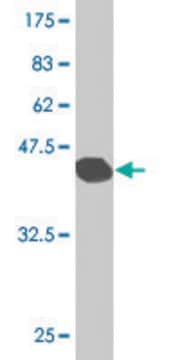
~48 kDa observed. Target band size appears larger than the calculated molecular weights of 35.50/37.73 kDa (mature/pro-form) due to posttranslational modifications. Uncharacterized bands may be observed in some lysate(s).

Immunogen

Epitope: domain of:
KLH-conjugated linear peptide corresponding to a sequence within the C-type lectin domain of human surfactant protein D.

Application

Detect Surfactant Protein D using this rabbit polyclonal Anti-Surfactant Protein D Antibody, Cat. No. ABS574, validated for use in Immunohistochemistry and Western Blotting.
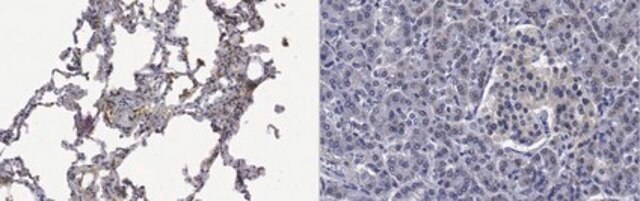
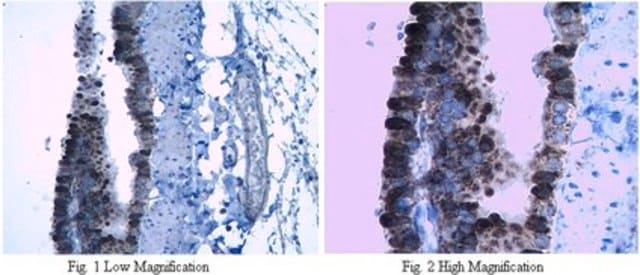
Immunohistochemistry Analysis: A 1:1,000 dilution from a representative lot detected surfactant protein D in human lung and pancreas tissue sections.
Research Category
Signaling

Biochem/physiol Actions

This rabbit polyclonal antibody targets a sequence within the C-type lectin domain of human surfactant protein D.

Physical form

Affinity purified.
Purified rabbit polyclonal antibody in buffer containing 0.1 M Tris-Glycine (pH 7.4), 150 mM NaCl with 0.05% sodium azide

Preparation Note

Stable for 1 year at 2-8°C from date of receipt.

Analysis Note

Evaluated by Western Blotting in A549 cell lysate.

Western Blotting Analysis: 0.2 µg/mL of this antibody detected surfactant protein D in 10 µg of A549 cell lysate.

Other Notes

Concentration: Please refer to lot specific datasheet.
Replaces: AB3434

Disclaimer

Unless otherwise stated in our catalog or other company documentation accompanying the product(s), our products are intended for research use only and are not to be used for any other purpose, which includes but is not limited to, unauthorized commercial uses, in vitro diagnostic uses, ex vivo or in vivo therapeutic uses or any type of consumption or application to humans or animals.
Ta strona może zawierać tekst przetłumaczony maszynowo.

Porównaj podobne pozycje

Wyświetl pełne porównanie

Pokaż różnice

1 of 1

Ta pozycja
ABS21ABS1030SAB1402914
antibody form

affinity isolated antibody

antibody form

affinity isolated antibody

antibody form

serum

antibody form

purified immunoglobulin

conjugate

unconjugated

conjugate

unconjugated

conjugate

unconjugated

conjugate

unconjugated

biological source

rabbit

biological source

rabbit

biological source

rabbit

biological source

mouse

Quality Level

100

Quality Level

100

Quality Level

100

Quality Level

100

shipped in

ambient

shipped in

wet ice

shipped in

dry ice

shipped in

dry ice

species reactivity

human

species reactivity

rat, mouse, human

species reactivity

human

species reactivity

human


Still not finding the right product?

Wypróbuj nasze narzędzie Narzędzie selektora produktów, aby zawęzić opcje.


Klasa składowania

12 - Non Combustible Liquids

wgk

WGK 1

flash_point_f

Not applicable

flash_point_c

Not applicable


Certyfikaty analizy (CoA)

Poszukaj Certyfikaty analizy (CoA), wpisując numer partii/serii produktów. Numery serii i partii można znaleźć na etykiecie produktu po słowach „seria” lub „partia”.

Masz już ten produkt?

Dokumenty związane z niedawno zakupionymi produktami zostały zamieszczone w Bibliotece dokumentów.

Odwiedź Bibliotekę dokumentów


Numer pozycji handlu globalnego

SKUNUMER GTIN
ABS57404054839056352

Questions

Reviews

No rating value

Active Filters