Przejdź do zawartości
Merck

Przejdź do

ABS1652

Anti-GSTA4 Antibody

serum, from rabbit

Synonim(y):

Glutathione S-transferase alpha-4, Glutathione S-transferase A4, Glutathione S-transferase Yk, GSTA4, GST 8-8, GST A4-4, GST K, GST Yk

Zaloguj się, aby wyświetlić ceny organizacyjne i kontraktowe.

Informacje o tej pozycji

UNSPSC Code:
12352203
NACRES:
NA.41
eCl@ss:
32160702
Conjugate:
unconjugated
Clone:
polyclonal
Application:
IHC, WB
Citations:
1


biological source

rabbit

Quality Level

conjugate

unconjugated

antibody form

serum

antibody product type

primary antibodies

clone

polyclonal

species reactivity

mouse, rat

technique(s)

immunohistochemistry: suitable (paraffin), western blot: suitable

NCBI accession no.

UniProt accession no.

shipped in

dry ice

target post-translational modification

unmodified

General description

Glutathione S-transferase alpha-4 (EC:2.5.1.18; UniProt P14942; also known as Glutathione S-transferase A4, Glutathione S-transferase Yk, GST 8-8, GST A4-4, GST K, GST Yk) is encoded by the Gsta4 gene (Gene ID 300850) in rat. Glutathione S-transferases constitute a family of isozymes that are involved in detoxification by catalyzing the conjugation of the reduced form of glutathione (GSH) to xenobiotic substrates. The GST family can be subdivided into the cytosolic, mitochondrial, and microsomal (a.k.a. MAPEG) proteins. Mammalian GSTs exist either as homodimers or heterodimers. The individual monomers were historically characterized by their quaternary structure and size, Yf (24.5 kDa), Yk (25 kDa), Ya1 (25.5 kDa), Ya2 (25.5 kDa), Yn (26.5 kDa), Yb1 (27 kDa), Yb2 (27 kDa) and Yc (28.5 kDa). The Y designation refers to the Y fraction (as opposed to the X and Z fractions) that were found during purification by Sephadex G75 chromatography. Two GST superfamilies exist that comprise either cytosolic or membrane-bound proteins. Evidence suggests that cytosolic GST increases bodily resistance to carcinogens, products of oxidative stress, environmental pollutants and certain anti-cancer drugs. The cytosolic GSTs are further subdivided into eight classes, namely alpha (GSTA), mu (GSTM), pi (GSTP), sigma (GSTS), theta (GSTT), kappa (GSTK), zeta (GSTZ), and omega (GSTO). GSTA4 exists as a homodimer composed of two Yk subunits.
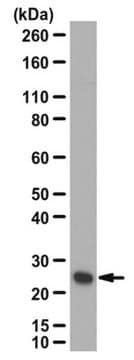
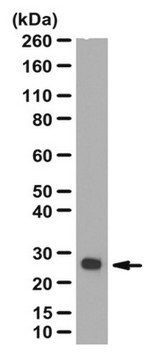
~25 kDa observed.

Immunogen

Purified rat liver GST K (YkYk).

Application

Anti-GSTA4 Antibody is an antibody against GSTA4 for use in Western Blotting, Immunohistochemistry (Paraffin).
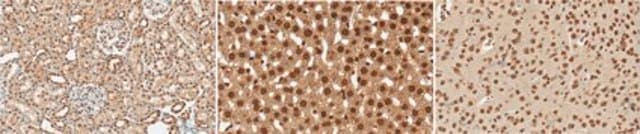
Immunohistochemistry Analysis: A 1:250 dilution from a representative lot detected GSTA4 in rat kidney, rat liver, and mouse cerebral cortex tissue.
Western Blotting Analysis: A representative lot detected upregulated Glutathione S-transferase alpha-4 in liver cytosolic preparations from mice on high-fat diet (F) when compared with liver samples from mice on regular diet (Meakin, P.J., et al. (2014). Mol. Cell. Biol. 34(17):3305-3320).
Western Blotting Analysis: A representative lot detected upregulated Glutathione S-transferase alpha-4 levels in liver homogenates from mice fed on diets supplemented with the antioxidant butylated hydroxyanisol (BHA) (Chanas, S.A., et al. (2002). Biochem. J. 365:405-416).
Western Blotting Analysis: A representative lot detected purified rat liver GST K (YkYk) and kidney GST J (YkYk), but not Ya, Yc, Yb1, Yb2, Yb3, Yf, or Yn subunits from other forms of purified rat GSTs (Hayes, J.D,, and Mantle, T.J. (1986). Biochem. J. 233(3):779-788).
Research Category
Signaling
Research Sub Category
Oxidative Stress

Biochem/physiol Actions

This antiserum selectively reacts with Yk from purified rat liver GST K and rat kidney GST J. No reactivity toward Ya, Yc, Yb1, Yb2, Yb3, Yf, or Yn subunits from other forms of purified rat GSTs (Hayes, J.D,, and Mantle, T.J. (1986). Biochem. J. 233(3):779-788).

Physical form

Rabbit polyclonal antibody in serum with 0.05% sodium azide.
Unpurified

Preparation Note

Stable for 1 year at -20°C from date of receipt.
Handling Recommendations: Upon receipt and prior to removing the cap, centrifuge the vial and gently mix the solution. Aliquot into microcentrifuge tubes and store at -20°C. Avoid repeated freeze/thaw cycles, which may damage IgG and affect product performance.

Analysis Note

Evaluated by Western Blotting in rat kidney tissue lysate.

Western Blotting Analysis: A 1:5,000 dilution of this antibody detected GSTA4 in 10 µg of rat kidney tissue lysate.

Other Notes

Concentration: Please refer to lot specific datasheet.

Disclaimer

Unless otherwise stated in our catalog or other company documentation accompanying the product(s), our products are intended for research use only and are not to be used for any other purpose, which includes but is not limited to, unauthorized commercial uses, in vitro diagnostic uses, ex vivo or in vivo therapeutic uses or any type of consumption or application to humans or animals.
Ta strona może zawierać tekst przetłumaczony maszynowo.

Porównaj podobne pozycje

Wyświetl pełne porównanie

Pokaż różnice

1 of 1

Ta pozycja
A7340ABS1650ABS1651
conjugate

unconjugated

conjugate

peroxidase conjugate

conjugate

unconjugated

conjugate

unconjugated

biological source

rabbit

biological source

rabbit

biological source

rabbit

biological source

rabbit

Quality Level

100

Quality Level

200

Quality Level

100

Quality Level

100

antibody form

serum

antibody form

IgG fraction of antiserum

antibody form

serum

antibody form

serum

clone

polyclonal

clone

polyclonal

clone

polyclonal

clone

polyclonal

technique(s)

immunohistochemistry: suitable (paraffin), western blot: suitable

technique(s)

direct ELISA: 1:10,000, western blot: 1:10,000 using lysates of Escherichia coli induced to express recombinant GST

technique(s)

immunohistochemistry: suitable, western blot: suitable

technique(s)

western blot: suitable


Still not finding the right product?

Wypróbuj nasze narzędzie Narzędzie selektora produktów, aby zawęzić opcje.


Klasa składowania

12 - Non Combustible Liquids

wgk

WGK 1

flash_point_f

Not applicable

flash_point_c

Not applicable


Certyfikaty analizy (CoA)

Poszukaj Certyfikaty analizy (CoA), wpisując numer partii/serii produktów. Numery serii i partii można znaleźć na etykiecie produktu po słowach „seria” lub „partia”.

Masz już ten produkt?

Dokumenty związane z niedawno zakupionymi produktami zostały zamieszczone w Bibliotece dokumentów.

Odwiedź Bibliotekę dokumentów


Elizabeth G Kleinschmidt et al.
Oncogene, 38(36), 6323-6337 (2019-07-17)
Ovarian cancer is the fifth-leading cause of cancer death among women. The dissemination of ovarian tumors and growth as spheroids accompanies late-stage disease. In cell culture, ovarian tumor cell spheroids can exhibit elevated resistance to environmental stressors, such as reactive


Numer pozycji handlu globalnego

SKUNUMER GTIN
ABS165204055977312508

Questions

Reviews

No rating value

Active Filters