Przejdź do zawartości
Merck

Przejdź do

ABE2622

Anti-SYCP2

serum, from rabbit

Synonim(y):

Synaptonemal complex protein 2, SCP-2, Synaptonemal complex lateral element protein

Zaloguj się, aby wyświetlić ceny organizacyjne i kontraktowe.

Wybierz wielkość

Zmień widok
Gabaryty przesyłkiSKUDostępnośćCena netto
100 μL

Dostępne do wysyłki DZISIAJzKuehne + Nagel Sp. z o.o.

1510,00 zł

Informacje o tej pozycji

UNSPSC Code:
12352203
NACRES:
NA.41
eCl@ss:
32160702
Conjugate:
unconjugated
Clone:
polyclonal
Application:
IF, WB
Citations:
1

1510,00 zł


Dostępne do wysyłki DZISIAJSzczegóły


Zamów zamówienie zbiorcze
Pomoc techniczna
Potrzebujesz pomocy? Nasz zespół doświadczonych naukowców chętnie Ci pomoże.
Pozwól nam pomóc


biological source

rabbit

Quality Level

conjugate

unconjugated

antibody form

serum

antibody product type

primary antibodies

clone

polyclonal

species reactivity

mouse, human

technique(s)

immunofluorescence: suitable, western blot: suitable

NCBI accession no.

UniProt accession no.

shipped in

ambient

target post-translational modification

unmodified

Gene Information

human ... SYCP2(10388)
mouse ... Sycp2(320558)

General description

Synaptonemal complex protein 2 (UniProt: Q9CUU3; also known as SCP-2, SYCP2, Synaptonemal complex lateral element protein) is encoded by the Sycp2 (also known as Scp2) gene (Gene ID: 320558) in murine species.SYCP2 is present in testis and spermatocyte and is a major component of the axial/lateral elements of synaptonemal complexes (SCS) during meiotic prophase and plays a role in the assembly of synaptonemal complexes. It is required for normal meiotic chromosome synapsis during oocyte and spermatocyte development and for normal male and female fertility. SYCP2 is considered to be a primary determinant of axial/lateral elements and can heterodimerize with SYCP3 and it is is required for the incorporation of SYCP3 into the synaptonemal complex. An evolutionarily conserved coiled coil domain in SYCP2 is required for binding to SYCP3. Defects in SYCP2 leads to sterility in male mice due to defective meiotic chromosome synapsis during spermatocyte development. Also, SYCP2 deficient mice show much reduced testes weight.
~200 kDa observed; 172.12 kDa calculated. Uncharacterized bands may be observed in some lysate(s).

Immunogen

Epitope: C-terminus
His-tagged recombinant fragment corresponding to 246 amino acids from the C-terminal region of murine Synaptonemal complex protein 2.

Application

Anti-SYCP2 , Cat. No. ABE2622, is a highly specific rabbit polyclonal antibody that targets Synaptonemal complex protein 2 and has been tested in Immunofluorescence and Western Blotting.
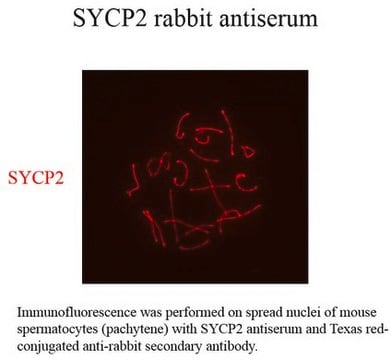
Immunofluorescence Analysis: A representative lot detected SYCP2 in spread nuclei of mouse spermatocytes. (Courtesy of Dr. P. Jeremy Wang at University of Pennsylvania).

Immunofluorescence Analysis: A representative lot detected SYCP2 in spread nuclei of oocytes and spermocytes (Yang, F., et. al. (2015). EMBO Mol Med. 7(9):1198-210).

Western Blotting Analysis: A representative lot detected SYCP2 in adult mouse testis tissue lysate (Yang, F., et. al. (2006). J Cell Biol. 173(4):497-507).
Research Category
Epigenetics & Nuclear Function

Biochem/physiol Actions

This polyclonal antibody detects Synaptonemal complex protein 2 in mouse testis and recognizes an epitope within amino acids 1255-1500 in the C-terminal region.

Physical form

Rabbit polyclonal anti-serum with 0.05% sodium azide.
Unpurified

Preparation Note

Stable for 1 year at -20°C from date of receipt.

Handling Recommendations: Upon receipt and prior to removing the cap, centrifuge the vial and gently mix the solution. Aliquot into microcentrifuge tubes and store at -20°C. Avoid repeated freeze/thaw cycles, which may damage IgG and affect product performance.

Analysis Note

Evaluated by Western Blotting in mouse testis tissue lysate.

Western Blotting Analysis: A 1:1,000 dilution of this antibody detected SYCP2 in 50 µg of mouse testis tissue lysate.

Other Notes

Concentration: Please refer to lot specific datasheet.

Disclaimer

Unless otherwise stated in our catalog or other company documentation accompanying the product(s), our products are intended for research use only and are not to be used for any other purpose, which includes but is not limited to, unauthorized commercial uses, in vitro diagnostic uses, ex vivo or in vivo therapeutic uses or any type of consumption or application to humans or animals.
Ta strona może zawierać tekst przetłumaczony maszynowo.

Porównaj podobne pozycje

Wyświetl pełne porównanie

Pokaż różnice

1 of 1

Ta pozycja
SAB4301824WH0010106M1WH0006342M1
conjugate

unconjugated

conjugate

unconjugated

conjugate

unconjugated

conjugate

unconjugated

biological source

rabbit

biological source

rabbit

biological source

mouse

biological source

mouse

antibody form

serum

antibody form

affinity isolated antibody

antibody form

purified immunoglobulin

antibody form

purified immunoglobulin

Quality Level

100

Quality Level

-

Quality Level

-

Quality Level

-

clone

polyclonal

clone

polyclonal

clone

4F4, monoclonal

clone

2E9-1B3, monoclonal

UniProt accession no.

Q9CUU3

UniProt accession no.

Q9BX26

UniProt accession no.

O14595

UniProt accession no.

P22307


Still not finding the right product?

Explore all of our products under

lub

Wypróbuj nasze narzędzie Narzędzie selektora produktów, aby zawęzić opcje.


Klasa składowania

12 - Non Combustible Liquids

wgk

WGK 1

flash_point_f

Not applicable

flash_point_c

Not applicable


Certyfikaty analizy (CoA)

Poszukaj Certyfikaty analizy (CoA), wpisując numer partii/serii produktów. Numery serii i partii można znaleźć na etykiecie produktu po słowach „seria” lub „partia”.

Masz już ten produkt?

Dokumenty związane z niedawno zakupionymi produktami zostały zamieszczone w Bibliotece dokumentów.

Odwiedź Bibliotekę dokumentów


Samantha L P Schilit et al.
American journal of human genetics, 106(1), 41-57 (2019-12-24)
Unexplained infertility affects 2%-3% of reproductive-aged couples. One approach to identifying genes involved in infertility is to study subjects with this clinical phenotype and a de novo balanced chromosomal aberration (BCA). While BCAs may reduce fertility by production of unbalanced


Numer pozycji handlu globalnego

SKUNUMER GTIN
ABE262204054839169618

Questions

Reviews

No rating value

Active Filters