Przejdź do zawartości
Merck

Przejdź do

ABE1453

Anti-phospho Brd4 (Ser492/Ser494)

from rabbit, purified by affinity chromatography

Synonim(y):

Bromodomain-containing protein 4, Protein HUNK1

Zaloguj się, aby wyświetlić ceny organizacyjne i kontraktowe.

Wybierz wielkość

Zmień widok
Gabaryty przesyłkiSKUDostępnośćCena netto
100 μL

Przewidywany termin wysyłki22 kwietnia 2026zKuehne + Nagel Sp. z o.o.

1810,00 zł

Informacje o tej pozycji

UNSPSC Code:
12352203
NACRES:
NA.41
eCl@ss:
32160702
Clone:
polyclonal
Species reactivity:
human
Application:
DB, ICC, IHC, WB
Citations:
3

1810,00 zł


Przewidywany termin wysyłki22 kwietnia 2026Szczegóły


Zamów zamówienie zbiorcze
Pomoc techniczna
Potrzebujesz pomocy? Nasz zespół doświadczonych naukowców chętnie Ci pomoże.
Pozwól nam pomóc


biological source

rabbit

Quality Level

antibody form

affinity isolated antibody

antibody product type

primary antibodies

clone

polyclonal

purified by

affinity chromatography

species reactivity

human

species reactivity (predicted by homology)

porcine (based on 100% sequence homology), mouse (based on 100% sequence homology), rat (based on 100% sequence homology)

packaging

antibody small pack of 25 μL

technique(s)

dot blot: suitable, immunocytochemistry: suitable, immunohistochemistry: suitable, western blot: suitable

NCBI accession no.

UniProt accession no.

shipped in

ambient

target post-translational modification

phosphorylation (pSer492)

Gene Information

human ... BRD4(23476)

General description

200 kDa observed, 152.22 kDa calculated. Uncharacterized bands may be observed in some lysate(s).
Bromodomain-containing protein 4 (UniProt O60885; also known as MCAP, Mitotic chromosome-associated protein, Protein HUNK1) is encoded by the BRD4 (also known as HUNK1, MCAP) gene (Gene ID 23476) in human. Bromodomain-containing protein 4 is a BET (bromodomain and extra-terminal) protein family member that functions as a chromatin reader by binding acetylated lysines in histones. It plays a key role in transmission of epigenetic memory across cell divisions and transcription regulation. It remains associated with acetylated chromatin throughout the entire cell cycle and provides epigenetic memory for post-mitotic G1 gene transcription by preserving acetylated chromatin status and maintaining high-order chromatin structure. During interphase, it plays a key role in regulating the transcription of signal-inducible genes by associating with the P-TEFb complex and recruiting it to promoters. Bromodomain-containing protein 4 is required to form the transcriptionally active P-TEFb complex where it displaces negative regulators such as HEXIM1 and 7SKsnRNA complex from P-TEFb and transforms it into an active form that can then phosphorylate the C-terminal domain of RNA polymerase II. It promotes the phosphorylation of Ser2 of the C-terminal domain of RNA polymerase II. In addition to acetylated histones, Bromodomain-containing protein 4 also recognizes and binds acetylated RELA, leading to further recruitment of the P-TEFb complex and subsequent activation of NF-kappa-B. It is also reported to act as a regulator of p53/TP53-mediated transcription and following phosphorylation by casein kinase 2K2, it is recruited to p53/TP53 specific target promoters. BRD4 knockout in mice is shown to be lethal, while BRD4 function blockage by inhibitor JQ1 (Cat. No. 500586) treatment is reported to affect the transcription of critical synaptic proteins, resulting in memory deficits and decreased seizure susceptibility in mice.

Immunogen

KLH-conjugated linear peptide corresponding to 14 amino acids surrounding Ser492/Ser494 from the internal N-terminal half of human phospho Brd4 protein.

Application

Anti-phospho Brd4 (Ser492/Ser494), Cat. No. ABE1453, is a highly specific rabbit polyclonal antibody that targets Bromodomain-containing protein 4 and has been tested in Dot Blot, Immunocytochemistry, Immunohistochemistry, and Western Blotting.
Research Category
Epigenetics & Nuclear Function
Western Blotting Analysis: A 1:500 dilution from a representative lot detected phospho Brd4 (Ser492/Ser494) in whole cell neuronal lysate (Courtesy of Erica Korb, Ph.D., Rockefeller University).

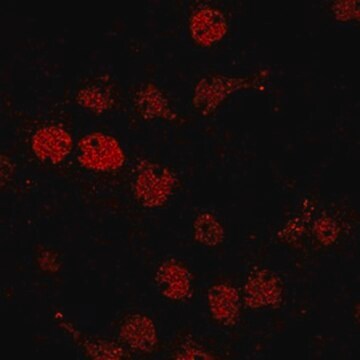
Immunocytochemistry Analysis: A 1:500 dilution from a representative lot detected phospho Brd4 (Ser492/Ser494) in cultured cortical cells from mouse (C47blac6). (Courtesy of Erica Korb, Ph.D., Rockefeller University).

Dot Blot Analysis: A representative lot detected phospho Brd4 (Ser492/Ser494) in phospho Brd4 peptides (Courtesy of Erica Korb, Ph.D., Rockefeller University).


Biochem/physiol Actions

This rabbit polyclonal antibody detects Bromodomain-conntaining protein 4 phosphorylated at Ser492/Ser494. It targets an epitope of 14 amino acids in the N-terminal half.

Physical form

Affinity Purified
Purified rabbit polyclonal antibody in buffer containing 0.1 M Tris-Glycine (pH 7.4), 150 mM NaCl with 0.05% sodium azide.

Preparation Note

Stable for 1 year at 2-8°C from date of receipt.

Analysis Note

Evaluated by Western Blotting in humans IPS cell lysate.

Western Blotting Analysis: A 1:2,000 dilution of this antibody detected phospho Brd44 (Ser492/Ser494) in 10 µg of human IPS cell lysate.

Other Notes

Concentration: Please refer to lot specific datasheet.

Disclaimer

Unless otherwise stated in our catalog or other company documentation accompanying the product(s), our products are intended for research use only and are not to be used for any other purpose, which includes but is not limited to, unauthorized commercial uses, in vitro diagnostic uses, ex vivo or in vivo therapeutic uses or any type of consumption or application to humans or animals.
Ta strona może zawierać tekst przetłumaczony maszynowo.

Porównaj podobne pozycje

Wyświetl pełne porównanie

Pokaż różnice

1 of 1

Ta pozycja
ABE1451MABE918HPA015055
antibody form

affinity isolated antibody

antibody form

affinity isolated antibody

antibody form

purified immunoglobulin

antibody form

affinity isolated antibody

Quality Level

100

Quality Level

100

Quality Level

100

Quality Level

100

biological source

rabbit

biological source

rabbit

biological source

mouse

biological source

rabbit

UniProt accession no.

O60885

UniProt accession no.

O60885

UniProt accession no.

O60885

UniProt accession no.

O60885

clone

polyclonal

clone

polyclonal

clone

1F11, monoclonal

clone

polyclonal

shipped in

ambient

shipped in

wet ice

shipped in

wet ice

shipped in

wet ice


Still not finding the right product?

Wypróbuj nasze narzędzie Narzędzie selektora produktów, aby zawęzić opcje.


Klasa składowania

12 - Non Combustible Liquids

wgk

WGK 1

flash_point_f

Not applicable

flash_point_c

Not applicable


Certyfikaty analizy (CoA)

Poszukaj Certyfikaty analizy (CoA), wpisując numer partii/serii produktów. Numery serii i partii można znaleźć na etykiecie produktu po słowach „seria” lub „partia”.

Masz już ten produkt?

Dokumenty związane z niedawno zakupionymi produktami zostały zamieszczone w Bibliotece dokumentów.

Odwiedź Bibliotekę dokumentów


Xuemei Li et al.
Neurochemical research, 49(5), 1254-1267 (2024-02-21)
Fibrotic scars play important roles in tissue reconstruction and functional recovery in the late stage of nervous system injury. However, the mechanisms underlying fibrotic scar formation and regulation remain unclear. Casein kinase II (CK2) is a protein kinase that regulates
Abhiraami Kannan-Sundhari et al.
Frontiers in cell and developmental biology, 8, 576654-576654 (2020-10-06)
Hair cells (HCs) play crucial roles in perceiving sound, acceleration, and fluid motion. The tonotopic architecture of the sensory epithelium recognizes mechanical stimuli and convert them into electrical signals. The expression and regulation of the genes in the inner ear
Clara Penas et al.
Nature communications, 10(1), 3028-3028 (2019-07-12)
Cerebellar neuronal progenitors undergo a series of divisions before irreversibly exiting the cell cycle and differentiating into neurons. Dysfunction of this process underlies many neurological diseases including ataxia and the most common pediatric brain tumor, medulloblastoma. To better define the


Numer pozycji handlu globalnego

SKUNUMER GTIN
ABE145304054839224249
ABE1453-25UL04054839437991

Questions

Reviews

No rating value

Active Filters