Przejdź do zawartości
Merck

Przejdź do

AB5423

Anti-Tyrosine Hydroxylase Antibody, phosphoSer31

Chemicon®, from rabbit

Zaloguj się, aby wyświetlić ceny organizacyjne i kontraktowe.

Informacje o tej pozycji

UNSPSC Code:
12352203
NACRES:
NA.41
eCl@ss:
32160702
Clone:
polyclonal
Species reactivity:
rat
Application:
ICC, IHC, WB
Citations:
18


biological source

rabbit

Quality Level

antibody form

affinity purified immunoglobulin

antibody product type

primary antibodies

clone

polyclonal

purified by

affinity chromatography

species reactivity

rat

manufacturer/tradename

Chemicon®

technique(s)

immunocytochemistry: suitable, immunohistochemistry: suitable, western blot: suitable

NCBI accession no.

UniProt accession no.

shipped in

dry ice

target post-translational modification

phosphorylation (pSer31)

Gene Information

rat ... Th(25085)

Immunogen

Epitope: phosphoSer31
Synthetic peptide from the phosphoSer31 of rat Tyrosine Hydroxylase. Available as catalog number AG398

Application

Research Category
Neuroscience
Research Sub Category
Neurotransmitters & Receptors
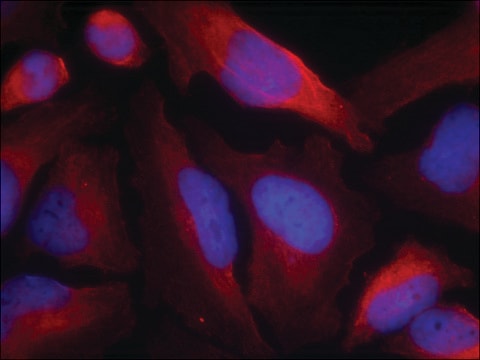
This Anti-Tyrosine Hydroxylase Antibody, phosphoSer31 is validated for use in IC, IH, WB for the detection of Tyrosine Hydroxylase.
Western blot: 1:1,000

Immunocytochemistry: 1:1,000

Immunohistochemistry: 1:1,000

Optimal working dilutions must be determined by the end user.

Biochem/physiol Actions

Tyrosine Hydroxylase, phosphoSer31. The antibody recognizes a protein of 60 kDa corresponding to TH phosphorylated at Ser31 in lysates of PC-12 cells stimulated by okadaic acid.

Physical form

Affinity purified immunoglobulin. Liquid in 10 mM HEPES (pH 7.5), 150 mM NaCl, 100 μg/mL BSA and 50% glycerol.

Preparation Note

Maintain at -20°C in undiluted for up to 6 months after date of receipt. Avoid repeated freeze/thaw cycles. Do not store in a self defrosting freezer.

Legal Information

CHEMICON is a registered trademark of Merck KGaA, Darmstadt, Germany

Disclaimer

Unless otherwise stated in our catalog or other company documentation accompanying the product(s), our products are intended for research use only and are not to be used for any other purpose, which includes but is not limited to, unauthorized commercial uses, in vitro diagnostic uses, ex vivo or in vivo therapeutic uses or any type of consumption or application to humans or animals.
Ta strona może zawierać tekst przetłumaczony maszynowo.

Porównaj podobne pozycje

Wyświetl pełne porównanie

Pokaż różnice

1 of 1

Ta pozycja
AB5986SAB4300257T9573
Quality Level

100

Quality Level

100

Quality Level

-

Quality Level

200

biological source

rabbit

biological source

rabbit

biological source

rabbit

biological source

rabbit

antibody form

affinity purified immunoglobulin

antibody form

serum

antibody form

affinity isolated antibody

antibody form

affinity isolated antibody

technique(s)

immunocytochemistry: suitable, western blot: suitable, immunohistochemistry: suitable

technique(s)

immunohistochemistry: suitable

technique(s)

indirect immunofluorescence: 1:100-1:200

technique(s)

immunohistochemistry: 1:1000, western blot: 1:1000 using lysates of PC-12 Cells stimulated by Okadaic Acid (1 μM for 60 minutes)

clone

polyclonal

clone

polyclonal

clone

polyclonal

clone

polyclonal

shipped in

dry ice

shipped in

dry ice

shipped in

wet ice

shipped in

dry ice


Still not finding the right product?

Wypróbuj nasze narzędzie Narzędzie selektora produktów, aby zawęzić opcje.


Klasa składowania

10 - Combustible liquids

wgk

WGK 2


Certyfikaty analizy (CoA)

Poszukaj Certyfikaty analizy (CoA), wpisując numer partii/serii produktów. Numery serii i partii można znaleźć na etykiecie produktu po słowach „seria” lub „partia”.

Masz już ten produkt?

Dokumenty związane z niedawno zakupionymi produktami zostały zamieszczone w Bibliotece dokumentów.

Odwiedź Bibliotekę dokumentów


Cristina Núñez et al.
Endocrinology, 148(12), 5780-5793 (2007-09-08)
Our previous studies have shown that naloxone-induced morphine withdrawal increases the hypothalamic-pituitary-adrenocortical (HPA) axis activity, which is dependent on a hyperactivity of noradrenergic pathways [nucleus tractus solitarius (NTS) A(2)] innervating the hypothalamic paraventricular nucleus (PVN). Short-term regulation of catecholamine biosynthesis
Claire B de La Serre et al.
American journal of physiology. Regulatory, integrative and comparative physiology, 311(5), R930-R939 (2016-11-03)
Increased neuropeptide Y (NPY) gene expression in the dorsomedial hypothalamus (DMH) has been shown to cause hyperphagia, but the pathway underlying this effect remains less clear. Hypothalamic neural systems play a key role in the control of food intake, in
Rubén García-Cabrerizo et al.
Addiction biology, 24(2), 239-250 (2017-12-29)
While prior studies have established various interacting mechanisms and neural consequences (i.e. monoaminergic nerve terminal damage) that might contribute to the adverse effects caused by methamphetamine administration, the precise mechanisms that mediate relapse during withdrawal remain unknown. This study evaluated


Numer pozycji handlu globalnego

SKUNUMER GTIN
AB542304053252287923

Questions

Reviews

No rating value

Active Filters