Przejdź do zawartości
Merck

Przejdź do

AB2302

Anti-GAPDH Antibody

chicken polyclonal

Synonim(y):

glyceraldehyde 3-phosphate dehydrogenase, aging-associated gene 9 protein, glyceraldehyde-3-phosphate dehydrogenase

Zaloguj się, aby wyświetlić ceny organizacyjne i kontraktowe.

Wybierz wielkość

Zmień widok
Gabaryty przesyłkiSKUDostępnośćCena netto
25 μg

Przewidywany termin wysyłki12 maja 2026zKuehne + Nagel Sp. z o.o.

750,00 zł
100 μg

Przewidywany termin wysyłki12 maja 2026zKuehne + Nagel Sp. z o.o.

1960,00 zł

Informacje o tej pozycji

UNSPSC Code:
12352203
eCl@ss:
32160702
NACRES:
NA.41
Clone:
polyclonal
Species reactivity:
human, mouse, horse, rat
Application:
WB
Citations:
251

750,00 zł


Przewidywany termin wysyłki12 maja 2026Szczegóły

Rekombinowane, niezawierające konserwantów przeciwciało jest dostępne dla Twojego celu. Wypróbuj ZRB374

Zamów zamówienie zbiorcze
Pomoc techniczna
Potrzebujesz pomocy? Nasz zespół doświadczonych naukowców chętnie Ci pomoże.
Pozwól nam pomóc


Nazwa produktu

Anti-GAPDH Antibody, from chicken, purified by affinity chromatography

biological source

chicken

Quality Level

antibody form

affinity isolated antibody

antibody product type

primary antibodies

clone

polyclonal

purified by

affinity chromatography

species reactivity

human, mouse, horse, rat

species reactivity (predicted by homology)

canine (based on 100% sequence homology), equine (based on 100% sequence homology)

packaging

antibody small pack of 25 μg

technique(s)

western blot: suitable

NCBI accession no.

UniProt accession no.

shipped in

ambient, wet ice

storage temp.

2-8°C

target post-translational modification

unmodified

Gene Information

human ... GAPDH(2597)
mouse ... Gapdh(14433)

General description

Glyceraldehyde 3-phosphate dehydrogenase (GAPDH) is an ubiquitous glycolytic enzyme present in reasonably high levels in almost all tissues. As a ′house-keeping′ enzyme, it catalyzes the synthesis of 1,3-biphosphoglycerate, a "high energy" intermediate used for the synthesis of ATP. Besides its cytoplasmic action in metabolism it is also involved in the initial stages of apoptosis or oxidative stress response where GAPDH is translocated to the nucleus. Such actions may reflect the role of GAPDH in DNA repair or as one nuclear carrier for apoptotic molecules. GAPDH has also been found to bind specifically to proteins implicated in the pathogenesis of a variety of neurodegenerative disorders including the beta-amyloid precursor protein and the huntingtin protein where decreased function of GAPDH is associated with Alzheimer′s and Huntington′s disease fibroblasts. GAPDH has also been identified as a potential target for nitric oxide (NO)-mediated cellular toxicity. The complete and functional enzyme is a tetramer with each of four identical subunits occupying the vertex of a tetrahedron. Binding domains also include one principally interacting with NAD+ and another interacting with glyceraldehyde 3-phosphate (GAP).
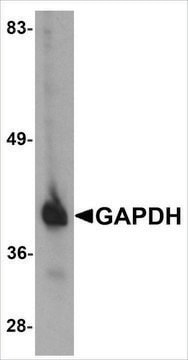
~ 38 kDa

Immunogen

Epitope: WARS interacting region
KLH-conjugated linear peptide corresponding to the WARS interacting region of human GAPDH.

Application

Anti-GAPDH Antibody detects level of GAPDH & has been published & validated for use in WB.
Research Category
Metabolism
Western Blot (SNAP ID) Analysis: 0.125 µg/ml from a previous lot detected GAPDH on 10 µg of NIH/3T3 and PC12 cell lysates.

Biochem/physiol Actions

This antibody recognizes GAPDH.

Physical form

Affinity purified
Purified chicken polyclonal antibody in buffer containing 0.1 M Tris-Glycine (pH 7.4, 150 mM NaCl) with 0.05% sodium azide.

Preparation Note

Stable for 1 year at 2-8°C from date of receipt.

Analysis Note

Control
HEK293 cell lysate
Evaluated by Western Blot in HEK293 and PC12 cell lysate.

Western Blot Analysis: 0.0625 µg/ml of this antibody detected GAPDH on 10 µg of HEK293 and PC12 cell lysate.

Other Notes

Concentration: Please refer to lot specific datasheet.
Concentration: Please refer to the Certificate of Analysis for the lot-specific concentration.

Disclaimer

Unless otherwise stated in our catalog or other company documentation accompanying the product(s), our products are intended for research use only and are not to be used for any other purpose, which includes but is not limited to, unauthorized commercial uses, in vitro diagnostic uses, ex vivo or in vivo therapeutic uses or any type of consumption or application to humans or animals.
Ta strona może zawierać tekst przetłumaczony maszynowo.

Porównaj podobne pozycje

Wyświetl pełne porównanie

Pokaż różnice

1 of 1

Ta pozycja
G8795SAB2500450SAB3500247
antibody form

affinity isolated antibody

antibody form

purified from hybridoma cell culture, purified immunoglobulin

antibody form

affinity isolated antibody

antibody form

affinity isolated antibody

Quality Level

100

Quality Level

200

Quality Level

100

Quality Level

100

biological source

chicken

biological source

mouse

biological source

goat

biological source

chicken

shipped in

ambient, wet ice

shipped in

dry ice

shipped in

dry ice

shipped in

dry ice

UniProt accession no.

P04406

UniProt accession no.

P04406

UniProt accession no.

P04406

UniProt accession no.

P04406

Gene Information

human ... GAPDH(2597)
mouse ... Gapdh(14433)

Gene Information

human ... GAPDH(2597)
mouse ... Gapdh(14433)
rat ... Gapdh(24383)

Gene Information

human ... GAPDH(2597)

Gene Information

human ... GAPDH(2597)


Still not finding the right product?

Explore all of our products under

lub

Wypróbuj nasze narzędzie Narzędzie selektora produktów, aby zawęzić opcje.


Klasa składowania

12 - Non Combustible Liquids

wgk

WGK 1

flash_point_f

Not applicable

flash_point_c

Not applicable


Certyfikaty analizy (CoA)

Poszukaj Certyfikaty analizy (CoA), wpisując numer partii/serii produktów. Numery serii i partii można znaleźć na etykiecie produktu po słowach „seria” lub „partia”.

Masz już ten produkt?

Dokumenty związane z niedawno zakupionymi produktami zostały zamieszczone w Bibliotece dokumentów.

Odwiedź Bibliotekę dokumentów


Transgenic APP expression during postnatal development causes persistent locomotor hyperactivity in the adult.
Rodgers, SP; Born, HA; Das, P; Jankowsky, JL
Mol. Neurodegener. null
Acid-sensing ion channels contribute to synaptic transmission and inhibit cocaine-evoked plasticity.
Kreple, CJ; Lu, Y; Taugher, RJ; Schwager-Gutman, AL; Du, J; Stump, M; Wang, Y; Ghobbeh et al.
Nature Neuroscience null
Brian S Muntean et al.
The Journal of biological chemistry, 291(13), 7195-7204 (2016-01-27)
Regulators of G protein Signaling (RGS) promote deactivation of heterotrimeric G proteins thus controlling the magnitude and kinetics of responses mediated by G protein-coupled receptors (GPCR). In the nervous system, RGS7 and RGS9-2 play essential role in vision, reward processing


Numer pozycji handlu globalnego

SKUNUMER GTIN
AB2302-25UG04054839342622

Questions

Reviews

No rating value

Active Filters