Przejdź do zawartości
Merck

Przejdź do

AB2267

Anti-LCN2 Antibody

from rabbit, purified by affinity chromatography

Synonim(y):

lipocalin 2, migration-stimulating factor inhibitor, siderocalin, Oncogene 24p3, 25 kDa alpha-2-microglobulin-related subunit of MMP-9, lipocalin 2 (oncogene 24p3), neutrophil gelatinase-associated lipocalin, Lipocalin-2

Zaloguj się, aby wyświetlić ceny organizacyjne i kontraktowe.

Wybierz wielkość

Zmień widok
Gabaryty przesyłkiSKUDostępnośćCena netto
100 μg

Dostępne do wysyłki DZISIAJzKuehne + Nagel Sp. z o.o.

1960,00 zł

Informacje o tej pozycji

UNSPSC Code:
12352203
NACRES:
NA.41
eCl@ss:
32160702
Conjugate:
unconjugated
Clone:
polyclonal
Application:
IHC, WB
Citations:
7

1960,00 zł


Dostępne do wysyłki DZISIAJSzczegóły

Rekombinowane, niezawierające konserwantów przeciwciało jest dostępne dla Twojego celu. Wypróbuj ZRB2293

Zamów zamówienie zbiorcze
Pomoc techniczna
Potrzebujesz pomocy? Nasz zespół doświadczonych naukowców chętnie Ci pomoże.
Pozwól nam pomóc


biological source

rabbit

Quality Level

conjugate

unconjugated

antibody form

affinity isolated antibody

antibody product type

primary antibodies

clone

polyclonal

purified by

affinity chromatography

species reactivity

human

species reactivity (predicted by homology)

rat (based on 100% sequence homology), bovine (based on 100% sequence homology), mouse (based on 100% sequence homology)

technique(s)

immunohistochemistry: suitable, western blot: suitable

NCBI accession no.

UniProt accession no.

shipped in

wet ice

target post-translational modification

unmodified

Gene Information

human ... LCN2(3934)

General description

LCN2 (also known as Neurophil Gelatinase-Associated Lipocalin or NGAL) belongs to a superfamily of lipocalins, a collection of small, diversely functional, extracellular proteins. NGAL is secreted from neutrophil granules in three different forms; a monomer of 25 kDa, a disulfide-linked homodimer at 46 kDa, and a disulfide-linked heterodimer with MMP-9 at 135-kDa. It is widely known to induce development of kidney epithelia, to bind and traffic iron, and to act as a molecular signal under inflammatory conditions, such as Crohn’s Disease. Multiple carcinoma studies have also shown elevated expression levels of LCN2 in several different human tumors affecting such organs as: colon, lung, breast, ovaries and pancreas. Additionally, there has been great interest in this protein as a possible marker for: onset of Acute Kidney Injury following cardiac surgery, the progression of Chronic Kidney Disease (CKD), and the survival chances of patients with Chronic Heart Failure (CHF).
LCN2 band observed at 25 kDa Heavy concentration of tissue lysate and a 5 minute exposure time were used to generate the band of interest.

Immunogen

Epitope: Mature chain
KLH-conjugated linear peptide corresponding to the mature chain of human LCN2.

Application

Anti-LCN2 Antibody detects level of LCN2 & has been published & validated for use in WB, IH.
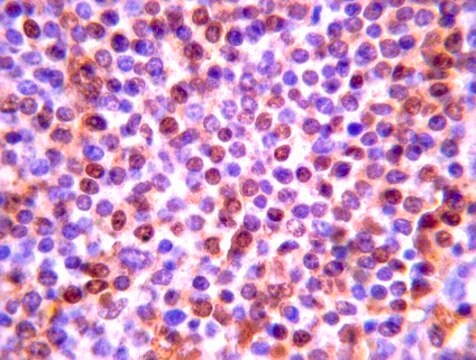
Immunohistochemistry Analysis: A 1:200 dilution of Anti-LCN2 antibody from a previous lot detected LCN2 in human spleen tissue.
Research Category
Neuroscience
Research Sub Category
Neurodegenerative Diseases

Biochem/physiol Actions

This antibody recognizes LCN2.

Physical form

Affinity purified
Purified rabbit polyclonal in buffer containing 0.1 M Tris-Glycine (pH 7.4, 150 mM NaCl) with 0.05% sodium azide.

Preparation Note

Stable for 1 year at 2-8°C from date of receipt.

Analysis Note

Control
Human kidney tissue lysate
Evaluated by Western Blot in human kidney tissue lysate.

Western Blot Analysis: 5 µg/mL of this antibody detected LCN2 in 10 µg of human kidney tissue lysate.

Other Notes

Concentration: Please refer to the Certificate of Analysis for the lot-specific concentration.

Disclaimer

Unless otherwise stated in our catalog or other company documentation accompanying the product(s), our products are intended for research use only and are not to be used for any other purpose, which includes but is not limited to, unauthorized commercial uses, in vitro diagnostic uses, ex vivo or in vivo therapeutic uses or any type of consumption or application to humans or animals.
Ta strona może zawierać tekst przetłumaczony maszynowo.

Porównaj podobne pozycje

Wyświetl pełne porównanie

Pokaż różnice

1 of 1

Ta pozycja
MABN481HPA002695SAB2500595
conjugate

unconjugated

conjugate

unconjugated

conjugate

unconjugated

conjugate

unconjugated

biological source

rabbit

biological source

mouse

biological source

rabbit

biological source

goat

antibody form

affinity isolated antibody

antibody form

purified antibody

antibody form

affinity isolated antibody

antibody form

affinity isolated antibody

Quality Level

100

Quality Level

100

Quality Level

100

Quality Level

100

clone

polyclonal

clone

PA348-26.3.5, monoclonal

clone

polyclonal

clone

polyclonal

UniProt accession no.

P80188

UniProt accession no.

P80188

UniProt accession no.

P80188

UniProt accession no.

P80188


Still not finding the right product?

Wypróbuj nasze narzędzie Narzędzie selektora produktów, aby zawęzić opcje.


Klasa składowania

12 - Non Combustible Liquids

wgk

WGK 1

flash_point_f

Not applicable

flash_point_c

Not applicable


Certyfikaty analizy (CoA)

Poszukaj Certyfikaty analizy (CoA), wpisując numer partii/serii produktów. Numery serii i partii można znaleźć na etykiecie produktu po słowach „seria” lub „partia”.

Masz już ten produkt?

Dokumenty związane z niedawno zakupionymi produktami zostały zamieszczone w Bibliotece dokumentów.

Odwiedź Bibliotekę dokumentów


Reactive astrocytes secrete lcn2 to promote neuron death.
Bi, F; Huang, C; Tong, J; Qiu, G; Huang, B; Wu, Q; Li, F; Xu, Z; Bowser, R; Xia, XG; Zhou, H
Proceedings of the National Academy of Sciences of the USA null
Emanuele Schiavon et al.
PloS one, 13(8), e0201022-e0201022 (2018-08-15)
Hyperbilirubinemia (jaundice) is caused by raised levels of unconjugated bilirubin in the blood. When severe, susceptible brain regions including the cerebellum and auditory brainstem are damaged causing neurological sequelae such as ataxia, hearing loss and kernicterus. The mechanism(s) by which
Mohammad A Alzubi et al.
Breast cancer research : BCR, 21(1), 36-36 (2019-03-08)
The seed and soil hypothesis was proposed over a century ago to describe why cancer cells (seeds) grow in certain organs (soil). Since then, the genetic properties that define the cancer cells have been heavily investigated; however, genomic mediators within


Numer pozycji handlu globalnego

SKUNUMER GTIN
AB226704053252679100

Questions

Reviews

No rating value

Active Filters