Przejdź do zawartości
Merck

Przejdź do

AB16501

Anti-AIF Antibody, internal domain

Chemicon®, from rabbit

Synonim(y):

Apoptosis Inducing Factor

Zaloguj się, aby wyświetlić ceny organizacyjne i kontraktowe.

Wybierz wielkość

Zmień widok
Gabaryty przesyłkiSKUDostępnośćCena netto
100 μg

Przewidywana wysyłka DZISIAJzKuehne + Nagel Sp. z o.o.

2010,00 zł

Informacje o tej pozycji

UNSPSC Code:
12352203
NACRES:
NA.41
eCl@ss:
32160702
Conjugate:
unconjugated
Clone:
polyclonal
Application:
IHC, WB
Citations:
32

2010,00 zł


Przewidywana wysyłka DZISIAJSzczegóły

Rekombinowane, niezawierające konserwantów przeciwciało jest dostępne dla Twojego celu. Wypróbuj ZRB1849

Pomoc techniczna
Potrzebujesz pomocy? Nasz zespół doświadczonych naukowców chętnie Ci pomoże.
Pozwól nam pomóc


biological source

rabbit

Quality Level

conjugate

unconjugated

antibody form

purified immunoglobulin

antibody product type

primary antibodies

clone

polyclonal

species reactivity

human, mouse, rat

manufacturer/tradename

Chemicon®

technique(s)

immunohistochemistry: suitable (paraffin), western blot: suitable

NCBI accession no.

UniProt accession no.

shipped in

wet ice

target post-translational modification

unmodified

Gene Information

human ... AIFM1(9131)

General description

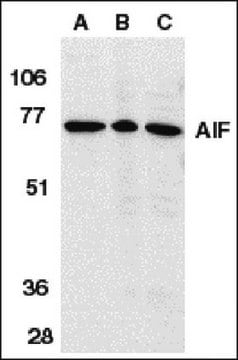
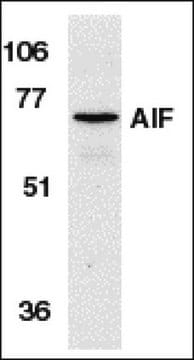
67 kDa
Apoptosis is characterized by several morphological nuclear changes including chromatin condensation and nuclear fragmentation. These changes are triggered by the activation of members of the caspase family, caspase activated DNase, and several novel proteins (Zamzami et al., 1999). A novel gene, the product of which causes chromatin condensation and DNA fragmentation, was recently identified, cloned, and designated apoptosis inducing factor (AIF) (Susin et al., 1999). Like the critical molecules, cytochrome c and caspase 9, in apoptosis, AIF localizes in mitochondria. AIF translocates to the nucleus when apoptosis is induced and induces mitochondria to release the apoptogenic proteins, cytochrome c and caspase-9. AIF induces chromatin condensation and DNA fragmentation, which are the hallmarks of apoptosis, of the isolated nucleus and the nucleus in live cells by microinjection. AIF is highly conserved between human and mouse and widely expressed (Susin et al., 1999).

Immunogen

Epitope: internal domain
Rabbit anti-AIF (Internal region) polyclonal antibody was raised against a peptide corresponding to amino acids 517 to 531 of human AIF (Susin et al. 1999). This sequence is identical to those of mouse and rat AIF (Susin et al. 1999).

Application

Anti-AIF Antibody, internal domain is an antibody against AIF for use in IH(P) & WB.
Research Category
Apoptosis & Cancer
Research Sub Category
Apoptosis - Additional
Western blot: 0.25 to 1 μg/mL.

K562 cell lysate can be used as a positive control and a 67 kDa band should be detected.

Immunohistochemistry on formalin fixed, paraffin sections: 5-20 μg/ml, with antigen retrieval; see website protocol for details and photographs.

Optimal working dilutions must be determined by end user.

Biochem/physiol Actions

Apoptosis is characterized by several morphological nuclear changes including chromatin condensation and nuclear fragmentation. These changes are triggered by the activation of members of the caspase family, caspase activated DNase, and several novel proteins (Zamzami & Kroemer 1999). A novel gene, the product of which causes chromatin condensation and DNA fragmentation, was recently identified, cloned, and designated apoptosis inducing factor (AIF) (Susin et al. 1999). Like the critical molecules, cytochrome c and caspase 9, in apoptosis, AIF localizes in mitochondria. AIF translocates to the nucleus when apoptosis is induced and induces mitochondria to release the apoptogenic proteins, cytochrome c and caspase-9. AIF induces chromatin condensation and DNA fragmentation, which are the hallmarks of apoptosis, of the isolated nucleus and the nucleus in live cells by microinjection. AIF is highly conserved between human and mouse and widely expressed (Susin et al. 1999).

Physical form

Ammonium sulfate precipitation and DEAE-cellulose chromatography
Format: Purified
Purified IgG in PBS containing 0.02% sodium azide.

Preparation Note

Maintain for 1 year at 2–8°C from date of shipment. For maximum recovery of product, centrifuge the original vial after thawing and prior to removing the cap.

Analysis Note

Control
Widely expressed

Other Notes

Concentration: Please refer to the Certificate of Analysis for the lot-specific concentration.
Replaces: 04-430

Legal Information

CHEMICON is a registered trademark of Merck KGaA, Darmstadt, Germany

Disclaimer

Unless otherwise stated in our catalog or other company documentation accompanying the product(s), our products are intended for research use only and are not to be used for any other purpose, which includes but is not limited to, unauthorized commercial uses, in vitro diagnostic uses, ex vivo or in vivo therapeutic uses or any type of consumption or application to humans or animals.
Ta strona może zawierać tekst przetłumaczony maszynowo.

Porównaj podobne pozycje

Wyświetl pełne porównanie

Pokaż różnice

1 of 1

Ta pozycja
AB16502MABC1609MA7549
antibody form

purified immunoglobulin

antibody form

purified antibody

antibody form

purified immunoglobulin

antibody form

IgG fraction of antiserum

conjugate

unconjugated

conjugate

unconjugated

conjugate

unconjugated

conjugate

unconjugated

Quality Level

100

Quality Level

100

Quality Level

100

Quality Level

200

biological source

rabbit

biological source

rabbit

biological source

mouse

biological source

rabbit

clone

polyclonal

clone

polyclonal

clone

3C11, monoclonal

clone

polyclonal

Gene Information

human ... AIFM1(9131)

Gene Information

human ... AIFM1(9131)

Gene Information

human ... AIFM1(9131)

Gene Information

human ... AIFM1(9131)
mouse ... Aifm1(26926)


Still not finding the right product?

Wypróbuj nasze narzędzie Narzędzie selektora produktów, aby zawęzić opcje.


Klasa składowania

12 - Non Combustible Liquids

wgk

WGK 2

flash_point_f

Not applicable

flash_point_c

Not applicable


Certyfikaty analizy (CoA)

Poszukaj Certyfikaty analizy (CoA), wpisując numer partii/serii produktów. Numery serii i partii można znaleźć na etykiecie produktu po słowach „seria” lub „partia”.

Masz już ten produkt?

Dokumenty związane z niedawno zakupionymi produktami zostały zamieszczone w Bibliotece dokumentów.

Odwiedź Bibliotekę dokumentów


Francisco J Martínez-Morcillo et al.
PLoS biology, 19(11), e3001455-e3001455 (2021-11-09)
Several studies have revealed a correlation between chronic inflammation and nicotinamide adenine dinucleotide (NAD+) metabolism, but the precise mechanism involved is unknown. Here, we report that the genetic and pharmacological inhibition of nicotinamide phosphoribosyltransferase (Nampt), the rate-limiting enzyme in the
Carlo Rinaldi et al.
American journal of human genetics, 91(6), 1095-1102 (2012-12-12)
Cowchock syndrome (CMTX4) is a slowly progressive X-linked recessive disorder with axonal neuropathy, deafness, and cognitive impairment. The disease locus was previously mapped to an 11 cM region at chromosome X: q24-q26. Exome sequencing of an affected individual from the
Tamara M Peneder et al.
Movement disorders : official journal of the Movement Disorder Society, 31(11), 1729-1733 (2016-06-15)
The nigrostriatal dopaminergic pathway is more susceptible to neurodegeneration in primates than in mice, including the neurotoxic effect of MPTP. Apoptosis-inducing-factor was shown to be involved in the pathogenesis of dopaminergic degeneration. We therefore compared its occurrence in nigral dopamine


Numer pozycji handlu globalnego

SKUNUMER GTIN
AB1650104053252673887

Questions

Reviews

No rating value

Active Filters